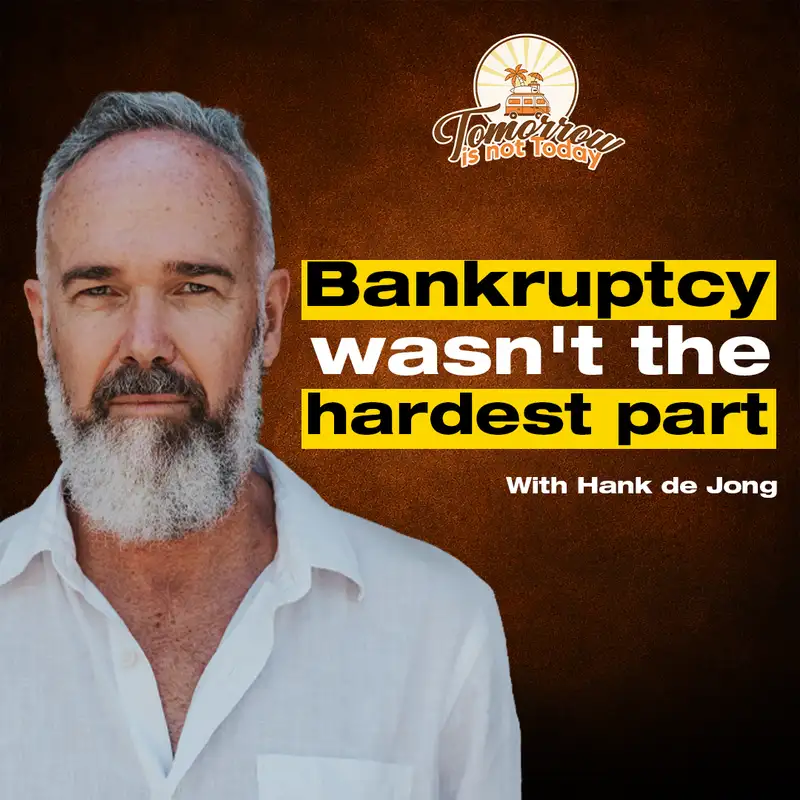
Bankruptcy wasn't the hardest part - I failed my family
Download MP3[00:00:00] I did the wrong thing, and I really kept my wife in the dark a lot. I was then made personally bankrupt, felt like a failure at home. Yeah. I really felt like I let my family down. I was embarrassed, didn't wanna talk to anyone. My son was about 14 at the time. Um, had a, a trail bike. Trail bike needed repairs, and I just didn't have the coin to be able to do it.
You could start seeing everything crowding in. What were you thinking? How did it affect your mind and your judgment and decisions and things? The same as when I went... was going through it. Um, you can't think clearly. You're not making good decisions. We lost our cars, and we lost all of that, and I remember going and buying a, an old Magna wagon, which was particularly tidy, and- Anyone who's listening or watching, it's not the end of the world
and feeding the birds. Like, I've never, ever, I was 35 at the time, never ever had any interest [00:01:00] in, um, in feeding birds. Even sometimes people try to say things that are helpful but actually do a lot of harm. They start going, "Well, why did you do that? Why did you make that decision? Why didn't you just do this?"
The emotional side was massive
We're seeing the highest number of insolvencies now that this country's ever seen. Australians, um, we're proud people. We wanna pay our bills. So often we see business owners lending money to their company and not taking security, but they're actually acting as a bank. Yeah. I wanted to offer a service offering that did a couple of different things.
Number one, gave really, really good advice. That was really paramount. Uh, number two, if I can give any advice to, to, to business owners, it's having the correct structure. 'Cause that's what really makes these numbers work [00:02:00] or not work to a large degree. Yes. Because that will save you a, could save you hundreds and hundreds and hundreds of thousands of dollars when something goes wrong, if it does.
I'm the director of our companies. My wife owns all the assets. I own nothing. How can you create the life you want and leave a legacy you're proud of?
Well, welcome to the Tomorrow's Not Today podcast. I'm really excited today because I've got a gentleman in here who's lived an experience different to what we usually do, but it's a really, really critically important experience that so many people deal with. Hank, welcome to the Tomorrow's Not Today podcast.
Thank you very much for having me. Uh, I really, uh, appreciate the opportunity to, um, to come along and, uh, and, uh, share some of, uh, some of my experiences. Yes, which, uh, some of our experiences we don't like at the time. True. That's true, too. But you have made a phenomenal job now of helping [00:03:00] so many other people that, uh, have gone through, and hopefully you can prevent other people going through similar things as well.
So tell us a little bit about how are you making a difference in the world. Sure. No, uh, thanks, uh, for that. Uh, I head up a firm called De Jong Reid, and we specialize in doing nothing but helping company directors and individuals who are in challenging situations, uh, predominantly financially, uh, get out of that the best way possible, you know, and how they can, uh, navigate that, um, moving forward.
I guess, uh, generally our clients have got, uh, financial issues, and they're looking at the best way out of, um, out of dodge. And that's what our firm does, is it takes the time to, to sit down with each client, understand where they're at, understand, uh, the different options that are available, and then give our recommendations on how that, um, on how they can, uh, move forward and what, uh, what to [00:04:00] expect on that, uh, on that journey.
I was just thinking, Hank, timing could not be better right now with everything that's going on. Sure. Uh, not just, not just around the world, but in Australia in particular right now. How... Have you seen a difference in people in the last, say, 6 to 12 months as far as people needing services like yours? Oh, that would be the understatement.
Mm. We're seeing the highest number of insolvencies now that this country's ever seen, and I don't think it's something that's going to ease off. Um, I think there's lots and lots of different reasons for that. Uh, one of the reasons is during COVID, um, someone upstairs, uh, said to the ATO, "Leave people alone," and they did.
They left people alone for two to three years, and without a doubt that caused a, um, the debt to, um, to the ATO to grow substantially. And, uh, and now as what needs to happen, the ATO [00:05:00] are collecting those funds, as they should. Um, and I think that's making a big difference, but there's also a number of other underlying issues, um, that are, um, are causing, um, problems, and that's, uh, uh, rising interest rates and so on, which is means less disposable income.
And we're s- definitely seeing an increase in clients, um, that run businesses that rely on disposable income. And I'm picking businesses such as restaurants and, um, and those type of, um, uh, businesses are really, really feeling the pinch. Um, and we're also seeing, you know, like, uh, restaurants are a good one to, to sort of pick on for a moment because with the increase in the cost of employment, uh, that's putting further, uh, impact.
Mm. Uh, so not only do they have a drop in sales, but they've also got a, an issue where they've got, um, further [00:06:00] costs in running their business. So, um, so to answer your question, absolutely, we're, we're seeing, uh, a number of, uh, distressed businesses, um, more than we, than we have done. It's interesting 'cause, uh, restaurants is probably, like you said, a good example because we're seeing people, they're getting hit on both ends.
They are. Uh, their costs are going up, but their number of people- Mm ... coming through quite regularly would be down a little bit. Um, now I wanna go back into your story a little bit. And because I think this is where people are going to understand that there's a bunch of people do what you do. Yes, that's correct.
Um, a lot of them. Very savvy finance people like yourself. Mm-hmm. However, and, and, and I, I love your story because I hate it. Which is what I find with most people that sit in that chair there- Yes ... is they've got the most unbelievable story. Uh, but yet there's so many people in similar situations, when they see it, they [00:07:00] know, "I...
There is hope for me." And I know that's gonna be the case today. That's correct, yeah. Tell me a little bit about... 'Cause you- You're not just successful now, you've been successful before, but you've also been at the other end of life financially as well. Mm. So tell us a little bit about where you were and how it all happened.
Sure, sure. No, I, look, I'm, um, I really appreciate the opportunity to do that because it's, it's something that's, um, uh, uh, that, um, is, uh, is, is, it's, it's a bit of sweet- Yeah. ... I, I would say. Um, but, um, yeah, I, I was, um, I, I left school at, at fourth form, couldn't wait to get out, and I bought my first business at, at 21, 22, and- Grade 10 for anyone under about 40.
There you go. There you go. Um, and bought and sold businesses. Um, and, but, and I had a, a business that was, uh, quite successful in the end. Uh, we turned over six or seven million a year. I had the- Mm ... the Porsche, had the nice home, had all of the stuff. I was about 35 at the time. Nice. Um, and we were [00:08:00] in a pretty comfortable position.
Um, I bought out a competitor a couple of years beforehand, and I went to the bank, and I needed to borrow a couple of million dollars to do that, and the bank gave me the money. Five years P&I, principal and interest, so it was, uh, high repayments, but we were- Mm ... making good money. Was- I wasn't scared at all.
You know? Like, uh, we're in a, in a, in a good position. Anyway, um, I, uh, I bought that, uh, bought that business. We were, we were traveling along quite nicely. Um, September 11 happened. Now, my market was international tourism. So what happened is pretty much overnight, and by overnight I mean, uh, two months, um, international tour- tourism just stopped, not just in Australia, but throughout the world.
People just were scared to fly, and they weren't, and that went on for, for quite some time. Um, our business went from a six or seven mil turnover down to about [00:09:00] three, um, or probably less. Can't even remember exactly anymore, but- Mm ... substantially down, and we were suddenly in a position where we couldn't afford the overheads.
Okay? We still had that massive P&I loan. Um, and all of a sudden we're in a situation where we just couldn't, um, uh, couldn't move forward. I had a really good accountant and really good lawyer, and both of them were, uh, were based here on the Gold Coast, where we are today. Um, and I went and saw these guys, and I said, "Listen, how do I save the house?
How do I save the business? How do I look after my staff?" Pretty much they were the- Mm-hmm ... pretty much the three questions. And the house was at the top because the family. That was- Mm ... that was really what was important. And then, and, um- The accountant and lawyer, uh, both said, "You know what? We're great accountants and we're great lawyers.
We're not insolvency experts. Go and see an insolvency practitioner." And I drove into [00:10:00] Brisbane, and I sat down with one of these guys and, um, um, and I asked him the same questions. House, business, staff. How do, how do I, how do I navigate these? How do I look after these? And what the insolvency practitioner said to me is he's saying, "Listen, I can tell you how to move stuff around legally.
Um, but if I do, I conflict myself out of a job The re- reason being an insolvency practitioner has got a fiduciary duty if he takes on the appointment as liquidator of my company to get the best result for creditors. Mm. Not the director- Right ... not my family, not my staff, not my business for that matter, purely creditors.
So it was a bit of a light bulb moment, not initially, probably a little bit later, but I left that meeting really, really scared, really upset- Mm ... because I wanted to [00:11:00] know what to do, and this guy couldn't tell me that or, or, um, uh, so on. Um, and, uh, and I, like I said, I was really, really scared. Uh, so I left that meeting and, um, and I appointed the guy 'cause I didn't have a choice.
People were ringing. I didn't know what to do. Um, I went through a liquidation and then, uh, problem was, uh, about three or four months later, due to some personal guarantees that I guess as business owners we always sign- Mm ... um, uh, most, a lot of creditors these days require it, uh, I was then made personally bankrupt under, um, under a personal guarantee.
And like I said, uh, 35 I was at the time. I lost the house. Um, I lost the business, lost everything. Very, very, very uncomfortable position to say the least. And, um, I think it brings up, um, a, a lot of [00:12:00] emotional, um, issues. I felt like a failure at home. Mm. I really felt like I let my family down. Um, I was embarrassed, you know?
Um, you don't talk to your mates about it. Um- No ... you tend to, to go off into a shell. Um, so I became pretty recluse, I suppose, for, uh, for a number of months because I just, I just wanted to... didn't wanna talk to anyone. I just wanted to, to shrivel away. Um, so, um, and I remember we'd, um, just built, um, a home on 10 acres.
It was my dream home. It was beautiful. Um, and of course I remember the last night in that house, um, uh, having to, uh, to leave the next day, and we went and had dinner, um, with the neighbors and I... It was really, it was sad. Mm. And like I said, I, I just felt, I felt embarrassed. You know? I felt embarrassed with my wife and, uh, and my kids.
And I think, um, I said to my [00:13:00] wife, I said, um- So we had to get a, a rental home, and I said, "I don't, don't care. I just want something on acreage. I want somewhere where it's quiet, where I can just sit down by myself and not have to, um, to deal with anything." And, and that's, and that's what happened. And, uh, and we did, and, um, the phone stopped ringing.
And I guess- Yeah ... um, a few, you know, again, emotional stuff there, and I remember my son was about 14 at the time, um, had a, a trail bike and, um, uh, and the trail bike needed repairs, and I just didn't have the coin to be able to do it. And stuff like that- Mm ... I found really hurt. Mm. Really hurt a lot more than, than other stuff because, um, whilst, um, you know, we all tend to spoil our kids, I suppose, in different ways, but I, I never had thought I'd have to say to this boy, "Look, I just can't afford [00:14:00] to- Yeah
fix your bike at the moment." And- Yeah, that's, that's, that's a horrible scenario to be in. 100, 100%, you know? There's so much in there I wanna unpack. Yeah, great. Uh, so much to unpack. Because I know there's people listening or watching right now- Yeah ... who are like, "I don't wanna get to that place, but I feel like I'm going there."
Mm-hmm. The ATO's coming around. I, all my expenses are going up, but I'm not bringing in as much money here, or all sorts of different reasons. People may, might have made decisions or mistakes that looked great at the time, and then they feel guilty. Mm-hmm. Um, we've all done that in life, I don't know how many times.
Mm-hmm. But I want you to help people get a bit of, um- sense of there's hope, and give yourself a bit of grace through this because I know that's what it takes. Yes. Um, take me back, though, where ... Because you went from the top of the world to probably you couldn't feel much worse, I would imagine- 100% ... pretty much over a very short period of time.
Yeah. So what [00:15:00] was going on in your mind as, as that was starting to see, and you could start seeing everything crowding in, what were you thinking? How did it affect your mind and your judgment and decisions and things? Oh, that's such a good question because, um, you ... When people are going through that type of situation, the same as when I went, was going through it, um, you can't think clearly.
You're not making good decisions. And, and I think that's, um, um, that's one of the reasons why I do what I do today is giving people the opportunity to, to bounce, to bounce off. Um, because ... And, and again, a lot of professionals, um, um, they, they'll give you different options. They'll go, "Well, you can do this or you can do that."
Well, I, I don't wanna know that. What's the- Yeah ... what's the best thing- Yeah ... that I can do in my situation? That's what I want to know, and that's one of the [00:16:00] things that I make sure that my team do now because like I ... And, and like I said, give specific advice on what ... We'll lay out different options but we'll go, "Listen, if I was in your shoes, this is what I would be doing."
Um, and I think that's so important 'cause you're right, you can't make clear decisions, and I wasn't at the time. And I think the other thing is Australians, um, we're proud people. We wanna pay our bills. Um, we, we don't want to, um, give up, and I see that every day with clients that come in to see us. They should have really come to see us six months or 12 months beforehand because the earlier you talk to a professional, um, um, uh, the more options that are available.
Uh, but we as a, a, as Australians are proud people. We wanna pay our debts, [00:17:00] and we wanna keep fighting. So I think, um, I was in that mindset without a doubt. And one thing I did, um, which I really regret now, that house that we had- Um, there was some extra equity in that home, and probably about six months, uh, well, probably three months before the, the whole business imploded, uh, I talked my wife into borrowing, uh, some additional funds from the home to put into that business, and we did.
We borrowed another 100K or whatever it was. But whilst it wasn't a massive amount of money, it was pretty much the only equity that we had left. Um, and I guess, um, um, again, I was f- fighting. I was, I was being Australian. Yeah. I was being, "I'm not gonna give up." Yeah. "I'm gonna [00:18:00] keep going here." When, if I would've got good advice at that time, the good advice probably would've been, "Look, you probably gotta go into liquidation, without a doubt.
Um, maybe bankruptcy, but maybe we can save some of the equity that's left in the house or- Mm ... or what else have you, and, um, and at least establish moving forward and come out of it stronger." And I think, um, yeah, so I think in, in summary, all of that gabble, um, but in summary, I, I would say you're not thinking clearly We often see people fighting too long before they stop and get advice, and sometimes it's good to, to stop and get advice, and then even if you wanna keep going, at least you've got a plan B.
Yeah. At least you go, "Well, hang on. Um, okay, I'm gonna keep going, but I know that, that there are options available." Um, yeah. Yeah. Which I, I think it's [00:19:00] important, 'cause you're right, we do leave it too long. "I've got this, I'm okay. Don't worry about me. I'm, I'm fine. I'm sweet, thanks. I'm gonna make this work."
Yeah. And we are, as, as, uh, particularly males- Yes ... in Australia. Very much that way. So let, let's say, um, going back from your experience, personally, uh, which I think is probably the best judgment you're ever gonna get, plus also the professional things, you working with so many other people with. If, if s- someone can see maybe a little bit of hiccup coming now, um, it's okay, 'cause I've got a plan how to get out of there anyway.
Is that a time to go for it, or is it a little b- get some advice, or is it a little bit more down the track a little bit further, where things are starting to look a bit dodgy and you're wondering what's happening? Oh, look, I would sooner rather than later, really. Um, uh, there are, um, as you said earlier, lots of firms and lots of people that a business owner can go to.
Their accountant, their, um, [00:20:00] um, um, maybe not so much a lawyer, but, um, but there are people like myself, and, and our firm as well. Um, generally, they don't charge for initial consultations. Um, at least, like I said, you can get that, um, um, that plan B. Yeah. And, um, because there are, uh, certain things that can be done.
Look, I'll give you an example. Um, I'll try not to get too technical, but generally, we see business owners putting money into their business. Mm-hmm. We all do that- Mm ... from time to time. Uh, maybe it's cash, maybe it's an overdraft or so on. But the, um, the, uh, if, if you go to the b- the bank, and you say to the bank, "I want an overdraft and I wanna put some money into the business," the bank will approve it, um, if they approve it, uh, but generally they do.
Uh, they will then take security over that company, okay? They'll take what they call an all PAP, [00:21:00] okay? Which is a charge over the company. What that simply means is that who gets paid first if the company goes into liquidation? Uh, well, employees first, but then the all PAP holder- ranks right at the top, before unsecured creditors, before the tax office, before all of that.
So, uh, so that's why banks do it. They say, "We'll lend you money, but we'll take security." But so often we see business owners lending money to their company and not taking security. Mm. But they're actually acting as a bank. Yeah. So quite often when a client's in, um, can see some issues, if they get some advice in the beginning, maybe, um, there's some security that can be put in place, maybe there's some different options that can be looked at early- Mm
before, um, something finally puts that last nail in the coffin. [00:22:00] So now there's, there's all different tricks to all of that, so don't, um, there's, uh- Yeah ... different requirements- You need an expert for that ... to all of that stuff. So- Yeah ... so don't, um, uh, that needs to be looked at very, very carefully. But my point is there are things that can be done earlier to protect, um, um, to protect assets.
Uh, and leaving it to the last minute certainly does not do that. Mm. Take me back, 'cause I wanna, I wanna hit that home. Yep. Take me back. This is all crumbling around you. Yep You've just been told you're going into bankruptcy Yep ... the conversation you have with your wife? Uh, yeah. Uh, that, um, uh, you can't see it, but that, it causes, um, goosebumps because I did the wrong thing, and I really kept my wife in the dark a lot.
Again, I was embarrassed. I've, uh, I, I really... Yeah, [00:23:00] it was, um, it was the hardest conversations to have. And, um, uh, I'm, I'm in a 35-year marriage. Uh, at that time, uh, uh, we were together for 15 years, so we, we, we were in a... But oh, look, yeah, it very, very, very difficult, and our marriage went through, uh, some, some hard times, you know, during that period.
Um, and, um, uh, it was a strong marriage, so we s- we, uh, we survived through it. Um, but it was not easy, and it was extremely uncomfortable, and, um, probably the hardest conversations that, that I've ever had to, had to have. And, and you know, I, I, I wasn't, I wasn't up- upfront with my wife, without a doubt. I think in hindsight, um, that was bad because it put a lot more pressure on me, and I think there's a, there's a saying that a problem [00:24:00] shared is a problem halved.
And I suppose, um, and you know, I definitely had the support of my wife. Um, but I just, I just felt like I'd stuffed up. It was, it was, it was me. So, um- What was her response when you told her? Uh, my wife was extremely supportive. Um, uh, and, um, but, you know, obviously disappointed. Um, and you know, like I said, I, reflecting back to that last day of the house, um, and that day of having to move, um, it, it, it was, it was, it was sad, you know?
Um, it, it was really, really tough, but I did have the support of my wife, so- Which is fantastic. Yeah. That's, that's a huge thing. And my kids as well. Um, which is- Well, that's... Yeah, because I wanted to ask- Yeah ... like, one of your kids was 14, which is an interesting age. One was 14, one was 7, uh, and one was 21.
Um, I, uh, um, yeah, so, [00:25:00] um, so, uh- So how did- My wife, uh- ... because you had to tell them you've gotta leave the home Yeah. If someone's doing maths there, it doesn't quite work out. My wife's a bit older than me- ... and the eldest, uh, was, uh, part of a first marriage. So, uh, so that's why the, for those, uh, mathematicians there- Yeah.
There's gonna be people there cal- tallying this There you go. There you go. But I had, uh, yeah, 21, 14, and, um, and 7. Um, so but the kids were, were so supportive and, um, and it really, um- When we moved to that, um, and I always call it the shitty little house that we rented- ... uh, because we moved out of this palatial place into this, um, uh, very small, um, uh, home on, uh, on 10 acres.
But it was, it was quite a, a nice time. The phone stopped ringing. Mm. People stopped hassling me. Um, and, um, and, um, I, I could just starting to think and, uh, doing stuff with my son, like building [00:26:00] bonfires and doing, uh, doing things like that was what, um, um, what became, uh, um, fun. And, uh, like I said, I, I, uh, we lost our cars and we lost all of that, and I remember going and buying a, an old Magna wagon, which was particularly tidy, and, and spending a bit of time cleaning it.
I was just getting back to basics and, and feeding the birds. Like, I've never, ever, I was 35 at the time, never, ever had any interest in, um, in feeding birds. But just there were... We had a family of magpies there and, um, or kookaburras they were actually, um, and just feeding them and stuff like that, just getting back to basics.
So it was a real healing time. I reckon that six to, to 12 months, um, that we spent, um, uh, there was, yeah, it was a healing time and, um, yeah, it was, it was pretty special. It, it sounds like when you were working, like you were [00:27:00] full on with work. 100%. It was just work, work, work. Yep. But then when this happened, as, as horrible as it, it is, a scenario to go through- Yeah
um, that actually allowed you to pull back and go, "What's life all about?" 100%. And it stopped. Yeah, that's right. Um, and think, um, and I, and I think, um, the point you made earlier was really important because And that was where I answered it. People can't think clearly in these type of situations, 'cause you can't.
You just, there's just too much shit going on. Mm-hmm. There's the phone's ringing, people are screaming for money. You're just, you're robbing Peter to pay Paul, you know? It's, um ... And then, um, uh, so, but when that phone stops ringing and, uh, and you can stop, and you can think. And, um, and again, I, um, and I, I, you know, I got over a bit of embarrassment at that stage with my wife, I suppose.
And, um, it all, you know, you start to get a bit of [00:28:00] normality. So I think the point that you're making, and it's a very valid point, is you start to live again, you know? Um, and it, and you realize it's not the end of the world. It's, it's, um, uh, uh, it's, uh, it's okay. It's, it's all right. Uh- Thank you for saying that.
Yes. It's a b- ... 'Cause everyone who comes in and talks about, like, some of the worst things that can ever happen to people in their whole entire life, they say the same thing. Yeah. You get past it- Yeah ... and it's not the end of the world. No. So anyone who's listening or watching, it's not the end of the world.
That's true. There is better if you can make it better. So tell me, in that place, because it doesn't just get better. No. No. It takes- What did you have to do? Well, we had to get income, so I got a job, and my wife got a job as well. Um, not full-time, but, uh, but that was good. So we both ... There was some money coming in.
Like I said, we bought a, a couple of old shitty cars [00:29:00] and, um, and we had, we had those, and we had the rental place. So we were starting to then, um, um, you know, get back to a little bit of normality in that way. Um, I then, uh, like I said, the phone stopped ringing. People, I was starting to think. Um, and I realized then that when the phone stopped ringing and I started to think, and I was going through that whole liquidation and bankruptcy, um, uh, scenario, I realized I didn't have to have lost the house, and I could have kept the business.
But I just didn't know how that game worked- Mm ... at the time. And I guess that's where the idea ... Oh, and the other thing that I realized was the emotional side was massive. Mm. The, you know, the emotional toll. So, so, um, that's when [00:30:00] I sort of, um, uh, when I came up with the idea for the service offering of Dion Read.
Um, whereby, uh, I wanted to offer a service offering that did a couple of different things. Number one, gave really, really good advice. That was really paramount. Uh, number two, um, uh, yeah, could, could, um, very direct advice. Not this or that- Mm ... just which way do you think I should go? So it wanted to be direct, it wanted to be good, and the other thing is I wanted to hold people's hand through that whole process and give them a cuddle.
Mm. Because that emotional support is what was certainly not available. You could find people out there to give you, uh, advice, uh, but that emotional support and that hand-holding wasn't there. So, so that's what, um, uh, caused me to come up with the idea of the DeJongh Ree business, was to do nothing but [00:31:00] help company directors and individuals through those situations, um, by addressing those things.
And now 20 years later, written on our boardroom walls is, "We hold your hand," because that's really what it's, what it's about. And I think that's one of the, the, the real- the findings that, that I found was, you know, you needed that emotional support. It's, it was just, it was just, um, massive. It's really interesting because you see people like where you were, 35, the house, the cars, the family.
Yeah. You've got it made. You're on top of the world. Everything's great. Everyone looks up to you, respects you. You've got all that sort of thing. And then the twist comes. And it's funny 'cause in people's minds and we ... They start going, "Well, why did you do that? Why did you make that decision? Why didn't you just do this?
Why didn't you do that?" And, and people [00:32:00] not in the situation don't get it. No. And so they start pointing fingers, and that's where ... And I want you to take me a little bit here with you with friends, relatives, things that were said, things that even sometimes people try to say things that are helpful but actually do a lot of harm and can be very damaging emotionally as well.
And again, like we said earlier, you could be the guy with the ego and everything happening, but often we don't understand how, how fragile the ego can be. Oh, 100%. You know, like, um, I think it's funny for me personally, um, I became quite reclusive, um, for that, for at least six months. Um, and, and it was good in a way 'cause it helped me heal, number one.
I spent time with my family. I spent a lot more time with my family than I [00:33:00] had- Mm ... um, probably ever. Um, and, and getting back to those basics like I was talking about earlier. Um, unfortunately a number of my family had invested into our business- Mm ... which adds another level of embarrassment- Mm ... and, and so on.
So that definitely caused a lot of, um, of rift in the family. Um, and, um, wouldn't say blame, but again, you ... It- it- it's funny, it's the emotional side of it doesn't have to be right. Mm. It's just how you feel, isn't it? Yeah, absolutely. You know? So if you feel, personally, if you feel guilty or you feel like you've let someone down, um, then that's what is reality.
It's real to you. Because ... 100%. Yeah. It's reality because that's what you feel. Uh, whether it's, whether it's r- reality to [00:34:00] somebody else or not is- And most people don't get it ... completely different. They just see you. There's your shell, that's what I see. 100%. They don't see what's going on on the inside- Yeah
and that's what makes it hard. So family-wise, m- had a lot of issues, um, which was, um, um, um, which was, which was problematic. Um, so like I said, friendship-wise, I, like I, I became quite, quite, uh, quite re- reclusive. Mm. Um, but you're right. In what you're saying in, um, and it goes back to what I said earlier, and people don't think clearly.
You know? Like I can, I can sit here now and go, "Righto, if, if I would've done three things different in the 18 months leading up to September 11, my outcomes would've been massively different. If I wouldn't have bought that competitor where I borrowed a couple of mil, um, I probably could have survived it."
That was the, the, the [00:35:00] catalyst. Um- So, and, and it's funny because like you, you say that now. Mm-hmm. In hindsight, it's fantastic because but who, who ever knew 9/11 was gonna happen? 100%. So and, and if you look at that ... So I'm, I'm just trying to think from the perspective of somebody out there that's got a business, and they're, they're making these decisions.
They wanna grow their business, uh, maybe add another aspect to their business on that's gonna be another income source. It's something that's different but adjunct, or they wanna buy a competitor or something like that. How do they think about these decisions? Oh, such a great question because ... It's such a great question be-
My advice, and we see it now, um, every day of the week. We get clients come in to see us that are in financial distress. Okay? Uh, we would take on around 300 new clients every year. So- Wow ... so that's quite a number. That's huge. Um, and it's interesting. Sometimes there's some that are really well structured, [00:36:00] and when something goes wrong- The outcomes are just 10 times better.
So if, if I can give any advice to, to, to business owners, it's having the correct structure. Um, there's a few real basic things. If you're trading through a company, we quite often see companies that'll get into trouble, um, and they've got everything in one company. See, I'm, I'm not a believer in that. I like using two companies.
One company holds all the assets, one company trades. There's a license agreement in place, can be the same director, can be the same shareholders, okay? If someone sues the trading company or, um, there's a death in the workplace, or there's an issue, COVID, what else have you, um, the trading company can't afford to pay its bills, it doesn't [00:37:00] automatically drag down the entity that owns the trademark, the, uh, that owns the telephone numbers, that owns the, the, um, plant and equipment and so on.
So having that right structure is a game changer. The other thing that I reckon is a game changer is what I mentioned earlier, where company directors, um, or shareholders lend money to a company. Take security. It's cheap. It, it costs about 1K to, to, to put a loan agreement and a registration in place.
Absolute game changer, uh, to, to, to someone in financial difficulty. We see company directors, um, um, with, um, um, husband and wife as, as both as directors. Why? Pick one. Only need one person to run the risk, and the other person should hold the assets [00:38:00] In my life nowadays, I'm the director of our companies. My wife owns all the assets.
I own nothing. Um, you know, sometimes we talk to people about that and they go, "Oh, but what if I'm gonna get divorced? Then the wife's got everything." Family law see through all of that, so it's not a problem. But in relation to insolvency or corporation law, it's, it's, um, it's, it's, it's... it works. There are, with all of these strategies that I'm talking about, there's little finite details.
Mm. So you need anyone thinking about going down that path, um, needs to get specialist advice. But, um, if you have got the right structure in place, um, you are, um, uh, at least protecting, uh, that family farm, um, moving forward. So I, I would say that that is, that is critical. Um, because like I said [00:39:00] earlier, you know, Australians, we're entrepreneurial, we, we're, um- Yep
we, we love fighting, we're gonna give it a crack. Um, but if we're gonna do all of that, let's make sure that we've got a bit of a, um, a bit of a backstop. Protection. Yeah. Yeah, a bit of protection in place. So interesting question, 'cause I talk, I talk to business people all the time, and I get the question sometimes, and when I'm consulting with people, they'll tell me a little bit about what's happening.
And some people are doing, like, 2, 3, $400,000 as a sole trader. Mm-hmm. Um, and so, and you're talking here about having a couple of different companies set up different ways. Where would you suggest is a good place to set up a company to start with? And then when, when is it good to be able to set up the two different ones or do you do that initially?
What would be your ge- and I know this- Love it ... is a million- Yeah ... different answers- Oh, I lo- ... to this, but in- I love- ... generalized ... I love the question. Yeah. I love the question because this is what catches people out. Um, and let's talk about sole traders. [00:40:00] I'm not, I'm not a fan of sole trader. Um, I much, much prefer to run through a corp- corporate entity.
Um, uh, the reason being is there are certain debts out there, such as tax debt or some trade creditor debt, which is what we call unsecured. People believe that tax office is secured. It's not. It's an unsecured debt of, of a company or, or of a business. Okay? The tax office have got ways that they can make a director personally liable, but that's called a director's penalty notice.
It's a whole other, uh, story. Uh, but as a general rule, it's an unsecured debt. So if you're trading as a sole trader, for instance, it's not unsecured because sole trader's responsible for all of the debts. If you're trading through a corporation, then uh, the director is not personally liable for the unsecured debts.
[00:41:00] So it's a much, much better way to go. But what we see is people, um starting off businesses and they're going, "Okay, well, we wanna keep costs down low when we, when we establish, so we won't do two companies, we'll just do one, and we won't do this and that, uh, in the beginning 'cause we'll save some money."
The problem is, um, five years down the track, the business is successful, suddenly they're turning over a couple of million a year or whatever. To try the cost then to, um, to move that into a much better structure is expensive. It'll cost, you know, um, um, um, a lot more money to do it. So my advice is always, um, as a general rule, and I'll, I'll just reiterate that because, you know, there are certain different [00:42:00] situations where you might look at it differently.
But as a general rule, trading through a corporation is the go. Um, I would personally, um, if, if someone's doing their, their budget's up and they're going, "Listen, I believe in this business and this is something that can grow," spend that extra 5K in the beginning, set it up properly, um, because that will save you a, could save you hundreds and hundreds and hundreds of thousands of dollars when something goes wrong, if it does.
And secondly, it, if you wanted to, to restructure it or tidy it up in a couple of years' time, it's an expensive process because all those assets need to be moved. They need to be valued. Um, so it's, it's, um, yeah, my advice, do it, do it properly in the beginning. If someone's going to, um, you know, you would see people investing hundreds [00:43:00] of thousands of dollars into, into different types of businesses.
Spend that extra 5K in the beginning. It's, it will, it will just save massive amounts of money in the long run. I hope that's answered that okay. No, that's great. It's great because I have ... And I, I never advise them on what to do because I, I don't know . It's, I'm not an accountant or a financial advisor at all.
I always t- if, if they do come to me I'm like, "Just check with your accountant to make sure you're doing the right thing, uh, so they can advise you on that," because o- I think only a financial expert or an accountant's gonna be the best way to go with that because you don't want the, that happening down the track and then, you know, where they could've been protected or whatever and it's, it's not happening or someone can come after them personally, all of that sort of thing as much as possible.
Yes. Yeah, sure. Um, so you got to the point you had to leave your home. Yep You were in the rental property- Yeah ... which you obviously loved. Yeah. Well, the birds at least were good. Yeah. How did you start... Like, you, you both- you and your wife both got [00:44:00] a job. Yep. How did you start pulling yourself back up? Yeah.
And then when did you... Like, did you work the jobs for a little while and save money to start a business? Did you go, "Okay, that's it, I'm jumping into a business"? Did you start that on the side? How did you get back in? Yeah, pretty much we, uh, we, uh... Well, uh, we, we bought two- we- I've, I've been used to buying and selling businesses.
So I ended up buying a, um, would you believe, a smoke oven business on the Gold Coast. And the reason I bought it was because I could do it without putting any money up, and the reason being was it had vehicles. It had vehicles that I could raise finance on. And because I understood how finance worked, um, and I had good contacts in there, um, I set that up.
Uh, I bought that business, and I bought it with a substantial amount of money down and the balance on vendor terms. And, uh, my wife, my wife was the director, [00:45:00] um, and, uh, and shareholder, and we got that m- business started. And I probably would've bought that, um, six months, um, down the track. Um, I then, uh, started the Deong Reid, uh, business off as a sideline.
So that smoke oven business was bringing the money into the... putting the food on the table, and then I then started the Deong Reid business off, um, uh, uh, around a, um, around a, uh, c- fold-out card table at the back of the smoke oven business. And- ... the, um, uh, the Deong Reid business was pretty successful. Um, we started initially, um, um, uh, tracing wind-up applications or reading the court records and ringing people up who were going through, um, and then, uh, um, were going through, you know, being chased by the ATO and being wound up.
And we're basically ringing them up going, "Listen, um, there are options here. Do you [00:46:00] want to explore those?" And, and, um, and we started to get some work that way. And then I would say within about three months of doing that, we were getting enough work that we didn't need the smoke ovens anymore, and we sold that, that business.
Paid out the vendor finance. There wasn't much left, but that was okay. That, um, that helped us get started and, uh, and what happened was probably about six to 12 months into the De Jong Reid business, we started to employ staff, and I'd say at that time we probably had about three. Um, we suddenly didn't need to chase wind-up applications anymore because no one else was doing what we were doing.
Mm. No one else was doing that hand-holding. No one else was doing that, uh, that unique service offering where it was that, that no-nonsense direct advice on how best to handle something. So what [00:47:00] we found then was we were meeting accountants from clients that we were helping, and they would go, "Oh, we got another one for you, and we've got another one for you," and so on and so on.
So I would say within 12 months, we, we stopped having to chase those, um- Wow ... those leads ourselves and, um, and ever since then, really, the business has generated leads predominantly from accountants, lawyers, um, bookkeepers, and pa- past clients. Now, by past clients, I mean friends of past clients, 'cause we don't like to see- Right
past clients twice. Um- Yeah, yeah. Don't want them back again. So, uh, um, so friends from past clients, so really they're our four different ways of getting leads into the firm and, um, the firm's just had its 20th anniversary, so, uh- Congrats. That's exciting. Yes. Uh, yeah, we, um, that was just last month. So, um- So take me back then, because obviously when you go [00:48:00] through bankruptcy, there's a period of time where you can't- I think you can't own a business or something in that, that period of time.
Mm-hmm. How did you manage to get that business, like get finance and get the business? Okay. Well, I was lucky, and, and this is going back to having the right structure. Okay? I was the director of the company. My wife, um, had, uh, nothing to do with, with our businesses, uh, as far as directorship or, or, um, or shareholding.
Uh, shareholding was held in trust. Um, but the... It's very, very important that people are structured the right way because when something did go wrong, and I went through bankruptcy, and you're 100% right, for three years, um, you, uh, bankruptcy generally lasts for three years, unless you do something wrong during that three years and someone decides to extend it, but as a general rule, three years.
Um, you can't be a company director [00:49:00] during that time. Um, and, uh, and obviously any assets that, uh, that you own, uh, at the time of, uh, of bankruptcy, they end up vesting with your trustee. Um, but my wife was not bankrupt, so my wife was able to, um, to, uh, to go out and, um, and be able to be the director of our company moving forward.
There's nothing wrong with me being an employee. I got paid a wage. Okay? And, um, during bankruptcy, you're allowed to earn a certain amount of money. If you earn above that, you have to make what they call income contributions. Okay? Right. And, um, uh, so, uh, so that's that. I was an employee and, and, uh, and I, uh, and I moved forward.
My wife was actively involved in the business, so that's quite, um, quite okay to do it that way. But sometimes we see, um, um, clients come in [00:50:00] where the husband and wife are both directors, and when, um, something goes down, it may be a bankruptcy They're both affected by that Right And that's why we're a strong believer in having that right structure is really important Okay, and then you managed to have the business, get that going, and that obviously was turning over quite nicely for you.
Then you got DeJong- De Jong Reid all out there and happening, and you just start working that from there Yep So why do other companies not do the hand-holding? Is it because they've got an accounting degree so now they go out and this is their job that they do? Is it because they don't really understand what's going on with somebody who's been through that?
Why, why is that? Yeah, I think it's more the s- the second, um, uh, what you're saying there. I don't think that they understand the emotional side of it, which is something that I learned and something that really became very, very important to me. Um, so I think th- [00:51:00] that's really the bottom line. And we see, uh, it's funny now, we've, um, we've got a team of around 30 in, uh, at De Jong Reid Wow Uh, we've got a number of ex-insolvency practitioners who work for us nowadays.
Mm. Um, it's funny, when an ex-insolvency, um, practitioner comes to work for us, they know insolvency inside and out- Mm-hmm ... but we've gotta teach them the emotional side. Mm. We've gotta teach them the hand-holding, 'cause they're not used to that. Yeah They're used to working for the creditors. They're used to working, um, going, "Mr.
Director, you gotta do this, this, and this and this," and, um, um, it's, it's, um, I think, yeah, I, I think the bottom line of it is what makes, what, um, the reason, um, that, um, that no one was doing this was no one really had, had really drilled down on that emotional side and the importance of it It, it's interesting because, and we touched on it a little bit earlier, but the whole aspect [00:52:00] of how...
Like, we say business is business, and we just do business, and that's it- Yep ... it's cutthroat, that's it, it's just numbers, it's just figures, whatever, and it's there. But it's not. No. It's so much more than that. And I think often we try to pretend that that's all there is to it. Whether things are going great or they're not going great, whether things are comfortable and flowing along okay, which we all know it's gonna go up and down sooner or later, it never stays like that- No
that there is emotion involved with that no matter what's going on. A- and we pr- try to pretend that that's not the case. What would you say to business owners who maybe things are going fantastically well right now, and you're, you're riding high, and you've got the house, and the car, and the holidays and things like that, everything's going well.
What would you say to them from a personal perspective and from a family perspective how to get themselves in the right place? I don't know if I'm gonna answer this [00:53:00] right, and if I don't, you can circle back on it. Um, I think, you know, uh, I think two things to that question. Number one, going through that now, uh, having gone through that in the past, I think I'm a lot more focused now on my home life.
I've got grandkids now. It's a little bit different. Um, I tend to give that more, um Um, more, more of a priority than I ever did in the past. I know I, I, I I spend more time with my kids now than I did when they were growing up- Mm-hmm ... which I'm embarrassed about because... But that's ch- sometimes how it works.
Yeah. So I think, um, it's, it's really dedicating that time to that. But I wanna go back to that asset protection thing, because I think that's what every high-flying business owner should do. They should be looking at that [00:54:00] structure, um, um, looking at that structure and making sure it's right. And we're now doing a lot of seminars and, and a lot of, um, speaking, uh, um, um, circuits on, on, we're calling them solvent restructures.
We're talking about solvent businesses, restructuring them into a good, um, robust structure that's gonna survive. So, so I don't know if I've answered it right- No, that's great ... but, but I think, I think, uh, for me personally, like emotionally-wise and so on, it's, it's really, um, uh, spending that time with the, with, with family and so on.
Number two is having that right, um, that protection so at least if something does go wrong. Um, and I think number three, I think I'm probably, I'm a, I'm a lot more open with my wife nowadays than I was in those days. I mean business-wise. [00:55:00] Um, you know, like I'll, I'll talk about stuff where generally, um, I didn't before.
Um- I, I love that. The first thing you went to is family- Mm ... as a number one thing. Number two, get your protection and everything in, in line. Number three, be open with your wife. Yeah. Now, some people, it could be husband or wife or whatever- Yeah ... but in this case the wife. Yep. Some people are like, "I can't tell her, she doesn't understand or she doesn't wanna know about it," or whatever.
Oh, you'll be surprised. You know, I used to think that as well, you know? But geez, I'm telling you, the stuff that she sees and, and she sees un- You know, and it's interesting. I've, I've got a, a business partner, uh, that's involved in our firm as well who's the same. He's a si- silent partner, but he'll come along to functions and he'll just see stuff.
Mm. And I'll go, "Shit, I sort of knew that, but I was probably trying to ignore it." But, um, my wife's the same. She'll- Right ... she'll raise stuff or, uh, [00:56:00] mention stuff and I'll go, "Shoot, yeah, you're right." Um, that is, uh, I think it's, it's, it's interesting. I think we get involved in our businesses day to day, we're in there every day, um, and we miss seeing stuff.
And I think our wife or our partners, you know, husband or wife as you said, um, or, or that silent business partner or con- Often see stuff that is just so obvious and we don't see it. And it's not that we're not smart, it's just- Mm ... we're in, we're in the reeds. You know? Like, we're, um... And I think it's, uh, that's, um, a big part.
Is it sometimes that you don't see it or like you alluded to a little bit earlier- Both. Both ... where you sort of see it but pretend? Mm-hmm. They're both, without a doubt. Bit of both? Without a doubt. Yeah. And I think it's sometimes the prompting that you get by that discussion around the kitchen table or, um, that [00:57:00] discussion, uh, um, like I had with, uh, with that particular business partner last night when I was driving home and I'm going, "Yeah, you're right."
Um, and, uh, so let's u- utilize these people. Yeah. Let's not, not keep them in the cupboard. Let's utilize them, let's talk to them, let's, um, uh, because you'll be surprised what, um, what that will, um, what that will, um, will bring. Okay. I'm gonna, I'm gonna get a little bit interesting here with a question. Yeah.
Moving forward- Mm-hmm ... with your business, you've obviously set, set up a whole bunch of things- Yep ... in your business. Is there anything you would change now, or do you think we're pretty good? Or is there stuff as the world changes and things change with new rules and regulations and things, you've gotta be continually looking at what do I need to do?
Uh, look, I think, um, our business was the [00:58:00] forefront of, you know, we were the f- first people to really do pre-insolvency, um, um, properly. Um, we're by far the largest nationally. Um, we've, I think, uh, there's a number of, uh, competitors that we've got in our firm, um, which are, um, ex our firm, that have come through our firm- Mm
because it's a low cost to, a low cost of entry. Um, so I think if anything, I would've been smarter at retaining, um, or coming up with ways to motivate people to, to, um, to be retained. Um, I think, um, so that's one thing. Um, I think, um- You've got to, you've got to be able to pivot and I think, um, COVID taught us, taught us that Mm
so being able to look at different opportunities and so on. Um, so I [00:59:00] think my, my biggest learning, and I think if, if you, if I was gonna give any business advice it's, it's people are paramount. You- you- your staff are paramount. We've got an excellent team of staff without a doubt. Um, I would say, um, all my, um, team are the right people in the right seats on the bus, and we are very focused on that.
So I, I, I think having that right team is, is paramount and I think being mindful that try to retain that team at all costs. Mm. Um, you know, like, um, someone once said to me that, um, when you, um, uh, when you lose someone it costs you half a year's worth of wages- Mm ... to get them up to speed, and I reckon they're probably right.
You know, when you think about recruitment, training- Yeah ... the loss of income during that period and so on. So I think it's, it's, it's, um, being really, really focused on, on, um, on the people, um, is, is [01:00:00] extremely important. Um, yeah. That's- I, I hope I've answered that okay. No, that's r- no, that's great because I, I don't think often we do put enough emphasis on that aspect of things.
No. Yeah, I think you're right. Um, so- We're coming to a, an end now. I'm gonna ask you another question- Sure ... soon, that I ask everybody at the end of the podcast. Mm. But if people are going, "Uh, look, I'm not sure where I'm at right now, but there's a possibility I should get some, a little bit of advice here," how can they get in touch with you?
Oh, look, we, we encourage, um, um, any, any person in that type of position, and even if they're super successful, look at that corporate structure. Mm. So we're happy to do any of that type of stuff because, like I said, having that right structure in place is a game changer. If people are experiencing some difficulty for want else have you, get that advice early.
So we're keen, um, to have a chat. We don't charge for our initial consultations. They're free. Um, uh, we've got a, uh, a central number, [01:01:00] um, and I'm sure that, uh, that you'll, uh- Yeah, we'll put that in the description ... uh, we'll share that. Uh, please reach out. Give it, give us a call. Um, and- You got a website or email or- We do
something like that? We do. Um- Yep ... yep, which is, uh, uh, simply www.djra.com.au. Uh, but again, I'm, I'm sure you'll have that, uh, on there- Yeah, yeah, that'll all be there for people ... for people. Yeah. Uh, have a look at the website. Couple of things we're really, really proud of. We have a, a, um, a five-star rating on product review.
Mm. We have, um, now 200 and, I don't know, 250 odd reviews. All, our average score, five star. Yeah. Wow. Now, no one in our industry has that type of, of rating. So we're particularly proud of it. Um, uh, if someone's bored and wants to read those- ... all say the same thing. It's all about the warm and fuzzy. That's what we call it internally.
Yep, yep. Uh, it's all about that hand-holding. So, um, uh, so we're [01:02:00] particularly proud of it. So rest assured, if you talk to our firm, you can, um, you can be sure that, um, that you'll get that, um, uh, that same experience. So, um, yeah, so please, please, if anyone would like to, uh, to reach out, like I said, first consultation's no charge.
We can have a chat, talk about the situation, um, come up with some broad options, and then if we move further down the path, we'll, uh, we go from there. No, that's great. Um, I, I, I think you made a really good point that quite often we look at the numbers, which are critical, 'cause that, that gives us the answers what's going on, but we often don't understand how the numbers are affected by the warm and fuzzies that we give to our clients and our customers, and getting them to come back and refer, and being looked after, and all that sort of thing, 'cause that's what really makes these numbers work or not work- Yes
to a large degree. Without a doubt. And I, I love that you said that because quite often we forget that aspect. And that's one of the things with the [01:03:00] rise of AI and coming in, which is fantastic- But I'm also noticing people starting to use AI in a way that's detrimental- Yes ... to their business because they're taking away the warm and fuzzy and just getting some innate object that's talking to them that doesn't have any of that.
Yes. Um- Yeah. No, you're right ... so I'm really glad you said that. Yeah. Good. Good. Um, now, the question I always ask at the end. Mm-hmm. 'Cause we talk about, um, I love to talk about no matter what you've done, where you've been, or what's been done to you, you can always create the life you want and leave a legacy you're proud of.
And I, I appreciate you coming on the podcast because you've taken us into the ugly bits of your story and what happens and things you could've done and things you, you would've done and what you do now and how setting things up, and that's fantastic. How can you create the life you want and leave a legacy you're proud of?
Oh, um, it's, it's sort of funny. Uh, I said to you earlier, [01:04:00] um, that we had our 20th, um, uh, our 20th anniversary this year, and we've had a number of events, um, throughout the country, um, where we celebrated that with our referrers and so on. And it's been quite interesting, 'cause a number of people have, uh, sort of commented on, um, on, uh, that I'm, uh, the father of, um, of this pre-insolvency space or, or the, you know, the, the, the one who's- Wow
really brought it into life. Um, I never, never really thought about it that way. Mm. And it's, um, it's funny, it's not a comment that's come from one person, it's come from a number over, over a, uh, over a few periods. So the legacy I would like to leave is, um, is this service offering, uh, whether it be through our firm or through other firms who are doing the same thing, but giving clients that, [01:05:00] um, that support, that is that no-nonsense direct advice on, "This is what we think you should do," and that hand-holding.
Um, so I think that's, that's what I would like to, to leave is, is that service offering, 'cause it certainly wasn't around before- Mm ... before we started it. And I think, um, if, uh, if, uh, if that continues on, um, and obviously I'd, I'd, I'd love the Young Reed firm to continue on in the same way- Yeah, absolutely
uh, long past, uh, me. Um, but, uh, but if that, that, that service offering that gives that, those people the ability to, to, um, to get that ad- uh, advice, then, um, then I'd be happy. I love that. What an honor to be called the father of that. Yeah. Like, really, that- Yeah ... to me, that's a legacy being, being built- Yes
and it keeps on going. And, and it's funny because again we come back to, oh, well, you, you help people with their, their business and their money or whatever, but the [01:06:00] impact on families. Yes. The impact on lifestyle, the impact that's gonna go on generationally, the, the mindset that's gonna happen through all of that sort of thing.
You know, the further impact, it's not just impacting on can I help a business, but there's everything that's around that that's the really the important things- Yes ... that makes a massive difference. Huge. I think that's fantastic. Thank you. Hank, thank you so much- Good ... for joining us today. It's definitely a different podcast to what we normally do, but again, it's, you've been through the ugliness- Yeah
of this, come out the other side, helping people avoid this and make their life better. I really appreciate you coming on. Thank you very much for the opportunity, and, um, uh, it's been terrific. Thank you. Lovely.
Creators and Guests