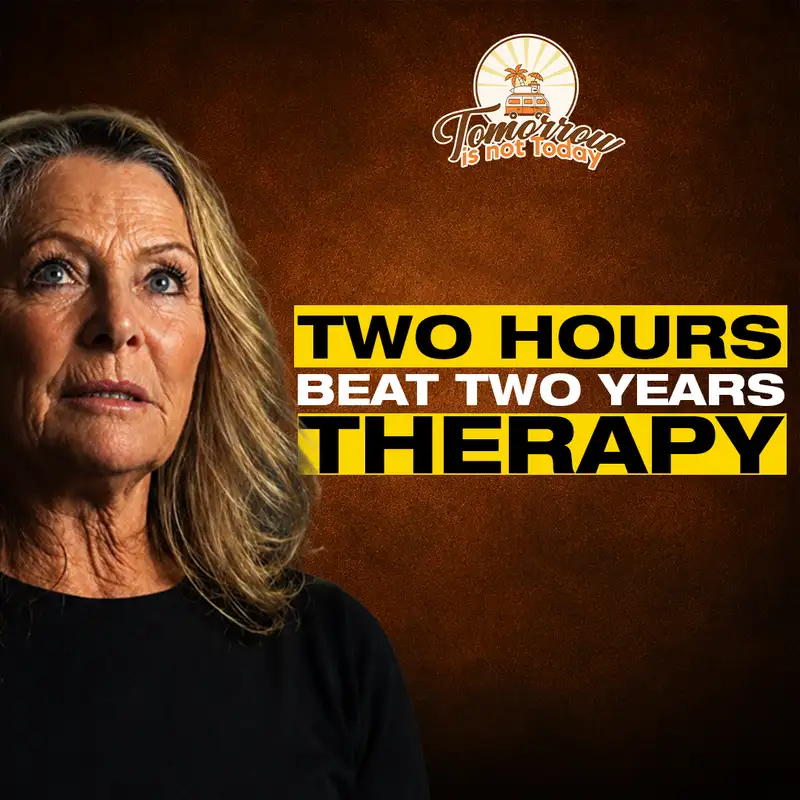
Two Hours Beat Two Years Therapy
Download MP3[00:00:00] Grew up in poverty, and my parents were unemployed. My father's a violent man, and I grew up actually not having much respect for my mother because she was getting hit anyway. And all he did was grab me by the legs and pile drive me- Oh ... with my head into the ground. And I've never hated anyone, Kingsley.
I've just tried to understand, 'cause I read a very long time ago, "Seek first to understand, then be understood." So I started studying at 14 years old, um, human behavior and the psychology of the mind and all of those things, so. That's a very advanced 14-year-old. It was, but I spent all my time in the library.
There wa- it would, kept me safe. Right. I had three families. Now, my family, that which are totally dysfunctional, we didn't have any food. You stole what you wanted. Not that my family stole much, but we did used to take the milk from the next door neighbor's doorstep, and the cheese from somebody up the road or whatever, 'cause it was delivered to doorsteps.
You never hated anybody. No. What, what did you do? Because for most of the rest of the population, we are, we would go there. Yeah. We would actually hate that [00:01:00] person. I, I, I believe that-
I'm a big believer that there is no failure, there's only feedback. I like to think that I help people change the identity that they're living by. Look what you've been running your life by, and your results are reflected in that, in that belief. What would happen if we changed that? I love those, those questions and those statements.
Mm. I think they're the ones that actually really get to the heart of who we are and what's really going on inside of us. I think most of us are actually scared to ask those questions. Most people aren't honest. Mm. They'd rather go, "You know what? This is just who I am." Mm. And it isn't who you are, because you weren't born that way.
I love the way you put that. Mm. Because our identity really,
it does, doesn't it? That's where we form everything, our thoughts, our beliefs, our decisions. Like you said, everything comes from that. So I think that the question, to come right back to full circle, is... How do you create the life you want and leave a legacy behind? First, by [00:02:00] becoming aware of
Welcome to the Tomorrow Is Not Today podcast. I'm really excited to have Pam, Pamela. Which one do you like? You know, Pam, Pamela. Either one? Either one. Okay, fine. Okay, Pam and Pamela here- ... in the studio. And we only met a few weeks ago, couple of weeks ago. Yes. Um, which I think is really cool because you were speaking at a seminar I found on Facebook.
Um, and went along to, and I just loved your whole approach to life and to people Thank you ... uh, and hearing a bit of your story in there as well. Yeah. I'm like, "This is my type of person," because you go through life, and you turn that around, and your whole focus now is, what can I do to help other people?
Absolutely. And I absolutely love that. Mm. Uh, and the reality is, that's what this podcast is all about. Yeah. I love that. Um, and you're gonna leave a legacy for people. Mm-hmm. Um, [00:03:00] and so we've all got a story. So tell us a little bit, before we go into your story, how are you making the world a better place at the moment?
You know, that's a really good question, and I like to think that I help people change the identity that they're living by. Mm. Because we all gather beliefs. We don't... We come into this world as a blank slate, and then through our conditioning and our programming that we, we create through our childhood experiences, you know, we, we have no time on the planet.
We have no, uh, nothing to compare it to, no litmus test. So- Mm ... rather than having something to refer to, we just make a decision right there and then that that means that. And whether it does or not, it's irrelevant. It just, in your mind, it does. And then we keep doing that, keep doing that until we're able to make decisions when we're a little bit older, and we've got a bit more information, say 12 or 13, and we start getting our own ideas, the trouble, teenagers thing.
You know, when your teenagers start disagreeing with you. But before that, you've lived this whole 12 or 13 years with beliefs that you've gathered and the conclusions that you've made about those [00:04:00] beliefs, and you live your whole life by that. Mm. And that becomes your identity. And then you live by that identity, true or false, it just is, and I don't believe in wrong or right.
I believe things just are. And so then you bring experiences into your life that confirm that identity, which changes the decisions that you make and the results that you get. So my whole philosophy is, because of the way I grew up, and w- I'm sure we're gonna talk about that, is to find out where those beliefs came from and dismantle them because they're not true.
They're just a belief that you made- Mm ... when you had no other idea of what was going on. You just came to a conclusion, like I said. So I think my biggest thing is to help people switch that around and go, "Look what you've been running your life by, and your results are reflected in that, in that belief.
What would happen if we change that? What, what would be possible for you now if we change that?" Yeah, that is so... I love the way you put that. Mm. Because our identity really, it does, doesn't it? That's where we form everything, our thoughts, [00:05:00] our beliefs, our decisions. Like you said, everything comes from that.
Yeah. And quite often, es- depending on how we're brought up, where we're brought up, all sorts of stuff- Yeah ... our identity's formed there, and we create right or wrong- Not right or... I'm with, I'm with you. I'm not really into right or wrong as much. Mm-hmm, mm-hmm. But decisions at the time- Yeah ... that may be the best or not so much the best- Yeah
for us. Well, there could be a better decision, you know? Yeah. And it doesn't matter whether you grew up in, in trauma like I did or in, in poverty like I did. You can grow up being the princess of the family- Mm ... where, you know, you're absolutely loved to bits, but that has its own set of challenges. Yeah.
'Cause a lot of the time then you expect everyone else to treat you that way. Yeah, we know people like that, don't we? Yeah, we do. Yeah. And one of my clients is like, she's, she's beautiful, and her family absolutely adore her, but they did all her thinking for her. Right. So now when it comes to trying to make a decision for herself, she's too scared to make the wrong one.
Mm. And she always is, she's always phoning someone to say, "What do you think? What do you think?" Wow. So we've been working for the last few months on trusting her own decision, and it's [00:06:00] either gonna go the way you want it to or it's not, and either way you learn something. Because I'm a big believer that there is no failure, there's only feedback.
Yeah, yeah. Mm-hmm. Mm-hmm. So that, that's an interesting thing there that sort of takes us on a little tangent, but I'm gonna go there- I know. ... while we're here. Yeah. Is it sounds like she doesn't have confidence in herself to make decisions. Yeah, absolutely, because all her decisions were made for her. So you, when you're told how to think and when to think and why to think, you don't question that.
And because you're so loved and adored, and, and that's a beautiful way to grow up, but it's also a tough one. Mm. And I used to say to my children, "You can do it easy now and get it hard later, or you can do it hard now and do it easy later." Mm. That choice is yours. So when you're constantly avoiding the challenges that come up, they're gonna keep coming.
They're gonna keep getting louder. Yeah. So I think for me, I have a very, I have a beautiful life right now, and not because I'm really wealthy and I live in a mansion, but because I'm really at peace with myself. Mm. And I think that's where we're trying to come back to- Mm ... is being at peace with ourself and loving what I'm doing every minute of the day, [00:07:00] and I love your, um, tomorrow's not today.
It's like, you know, today's not tomorrow. It's the same thing. Mm. It's, where you are is where you are. Yeah. Exact- exactly. Yeah. And it's gonna change. Yeah. Um, now it's interesting on that whole parenting thing, 'cause I know a lot of parents get stuck up on doing the right thing or- Mm ... doing the wrong thing.
Am I a good parent? Am I a bad parent? Yeah. I'll guarantee you're both. 100%, yeah. Because it, it doesn't mat- It's a learning curve. It is. Like, you can have, like your client there, who's had- Mm ... the most wonderful upbringing- Mm ... and obviously incredibly loved by her parents. 100%, yeah. But that love come out in a way that actually brought unconsciously- Mm, limited her
a lack of confidence. Yeah, limited her. And limited, yeah. Yeah. Where- 'Cause she didn't trust herself then ... e- exactly. Mm. Exactly. Whereas you can do the exact opposite- Yeah ... and have other issues as well. So it doesn't matter what happens. It doesn't. We're all here. None of us are perfect. We're all here for soul correction.
Exactly. Exactly. And, you know, and it's not about what you did as a parent, because you can only parent any way to [00:08:00] the degree that you've healed your unhealed wounds. Mm. So, and you know, when I'm, you know, I'm 64, so these... When my parents, there wasn't, no such thing as, like, self-help and, and stuff like that.
And- No ... you know, it's become a lot more prevalent now, and I love that. There's a lot more awareness. Mm. And, you know, people only understand that they've even got an issue when they're triggered by something, and they go from being really happy to going zero to hero in five minutes flat. All of a sudden they wanna punch someone or get angry-
about something. Do you know what I mean? I do. It's like, whoa, what happened? And that's where people like you come in really handy, because people don't know what happened. No. But finding that- Mm ... and trying to deal with it, heal it- Yeah ... and make it so those things don't trigger us or trigger us less, I probably should say.
Yeah. Um, maybe you get to the point where it doesn't trigger you. Well, I think it's always, it could, it won't trigger you in the same way. I think you can't change the past. It, the past is the past- Yeah ... and it happened, but you can change the emotional attachment- Yeah ... that, that creates that, that angst or that angriness or that hurt or [00:09:00] whatever it is that you're feeling.
And, and also you can, um, rewrite that story, because- Mm ... you're only reacting because you've got a story attached to that. Yeah. So when we find the story that's attached to that and the belief that you've got attached to your story which has created your identity, which has created the results or which creates a reaction- All of a sudden you unpack it all like that and you go, "Wow, my life is, could be so much better now," because that's...
And I'll give you an example actually. Um, I love helping people and that, that's my whole philosophy is do what you can for everybody else and that all comes back to you multiplied. Not because I'm doing it for me, but because that's, I'm just driven that way. If you want my time- That's how it works ... 100%, I give it to you.
So, um, I spoke to someone yesterday and, and I won't name any names 'cause that's, that's not right, but they've got a charity for children. And because I grew up the way I did, it's obviously a passion of mine to be able to give children the tools to self-regulate, to be able to relate to themselves in a way that's c- positive [00:10:00] and constructive rather than believing the story that they may have been wearing.
You know, remember I put the, all those clothes on about the story. So we gather all the beliefs that you've gathered, and he just was all up in my face, and I just, "Oh, I would love to be a part of that. How can I help?" And he was like, "Oh, we're very specific and very particular about who we have, and, and, and we're all breath workers, and we're all this."
And I'm like, "Whoa, dude, you don't know anything about me." Normally, that would've, that would've triggered my old, "I'm not worthy, I'm not good enough. He doesn't... You know, poor me even." Right? Why me? Why, why... You don't even know anything about me. But I didn't go there. I just thought, "Well, there's arrogance for you.
You have no idea what I can offer you. But anyway, okay, fair enough. There's plenty of people out there- Mm ... that will accept some help from me." Um, I wasn't trying to charge for it. I was-- I wanted to- Mm ... to give and, and share everything I had. If that's gonna help a child, perfect. But because of the way that he was, a couple of months ago even, maybe six months ago, I would've still got hurt by that.
Mm. So you can't [00:11:00] change those kind of people or the incidences that are coming in, but you can change the emotional charge so that you react differently. And, and that's where it is. It's finding your peace again. Yeah, exactly. If, if that makes sense. Mm. And it's interesting because, like, he said something, and it triggered, or would have previously triggered something in you.
100%. Mm. And then often we'll go, "Well, it- he shouldn't have said that." Yeah. But maybe, maybe not. But I'm responsible for me, Correct ... not him. Yeah. And that's, it's fixing the me bit, which is really hard sometimes. Yeah. Well, it is. Actually, always. Well, it is. Well, hard, see, I don't like the word hard. I think it's just a challenge.
Yeah, it is. And I think we're here for soul corrections, and we- Yeah ... I believe that h- life happens for us, not to us. Yeah. So I think everything that comes into our life is, is designed by our creator. And, and I don't mean that in a religious way. Um, you can call it creator, call it God, you can call it soul.
Call it whatever you want, but I believe things come into our life to actually bring out the better part of ourselves. To, to, to, uh, dig deep and [00:12:00] go, "What are you really capable of? What do you really believe in?" Yeah. "Who are you?" You know? And, you know, I pray to God every day. It's like, "Thank you for the courage to face these things head-on," rather than, um, avoid them.
Because they only- Yeah ... get louder, and they're there just to bring out the best in us, like I said. So- Um, and no one has the power to make you feel anything. All they can do- Mm ... is trigger some emotional wound that you have inside. Yeah. And they're doing you a favor, so when someone now, um, triggers me, which was happening quite frequently on the golf course for a little while Seriously, um The golf course triggers me any time, let me tell you.
100%. My friend's like, "What are you getting so, v- you know, worked up about? It's just a little ball chasing around a paddock. What are you doing that for anyway?" But it's one of those games, you're either obsessed with it or you're not. Yeah. And I, I am obsessed with it. But it was bringing out all of these unhealed wounds, all these ideas that were very, very deep- Mm
that I had about myself. So I actually like to take some of my clients out on the golf course- Mm ... and work with them in real time. Yeah, wow. 'Cause when they miss the [00:13:00] ball over and over and over, then it all comes out. That's a great way to mix business and pleasure, isn't it? Absolutely. 'Cause I stand back I go, "Ooh, stop worrying me.
What's the problem with you?" Yeah. Especially if you like golf. Yep. I'm pretty much the opposite end of the spectrum. True. Yeah. Not a big fan. Well, I'm gonna have to take you out now, can't we? I don't know why. I love sport and I love playing sport, just golf has never quite grabbed me. Well, see maybe it's a challenge for you.
Now you're gonna have to do a Play it in Works through that. I actually had three invitations to play golf last week. I'm like- True ... seriously? Yeah. Someone's trying to tell you something. Yeah, yeah. You're a creator. I'll have to get out there and see what happens. Mm-hmm. So tell me a little bit about, obviously you've overcome a l- a lot of past and traumas and things like that, which is fantastic.
I love that. Mm. Um, tell us a little bit about where some of that come from. Okay. So I grew up, I'm English, and I grew up in one of the worst estates, uh, in England, and... but you don't know that at the time, you're just, you're there for survival mode. Yeah. And, um, yeah, we grew up in poverty, [00:14:00] and my parents were unemployed.
And my father's a violent man, and my mother was just the typical chain-smoking, like, the long cigarettes and just swearing at everybody in the garden. It was just embarrassing. And, but you know, she didn't know anyth- anything else, and she came from a vi- a violent, um, background too. So she obviously married my father because, or a- uh, he was my stepfather anyway, but she was in a relationship with him because that was her pattern that she needed to- Mm
just transcend. But like I said, 60 years ago, that wasn't a thing, so they're just working through it and they think that's what life is. So violence was commonplace, you know. Um, and I grew up actually not having much respect for my mother because she was getting hit anyway and knocked around, and quite severely.
You know, my father'd have her head and was, be cracking it up against the wall and, and I'd be like, "Why don't you fight back?" So at eight years old was the first time I ran in and just g- started kicking him in... not that I could make foot, my foot was about this big- Yeah. ... so it wasn't really making much i- impact.
But I did bash him on the leg, and [00:15:00] all he did was grab me by the legs and pile drive me- Oh ... with my head into the ground. And it didn't stop me, it made me just so- I don't know, angry, but just like, "Oh," just, you know- Mm ... determined. And then when he was knocking me around, I wouldn't cry. I'm like, "I'm not showing you-" Mm.
that this is hurting me." So that became my whole life. I was just, like, not showing it, my, that I'm angry with you or that I'm upset and you're not hurting me. And, and you know, we used to... My mother was always sending us out, "Go and borrow this. Go and borrow that." So we became the, the family that were the scroungers and, and stuff like that.
So there was a lot of humiliation there. And then the things that went on from that, you weren't accepted at school because you came from a rough, um, background and always scrounging for food. And the family allowance, which was supposed to buy our school uniform, actually went on cigarettes and pale ale.
Wow. So we wore the same clothes for years, and I remember wearing... They were a beautiful pair of shoes when I first got them but sooner or later the, the soles wore down on the, [00:16:00] underneath the toes and I had to put bags over my socks inside my shoe to keep my socks dry because England, there's always, we have a lot of rain.
Mm. And then the backs had to become folded down as my feet grew. But then the, the kids at school could be very cruel, and they, they saw that. I used to be, try to go into the changing rooms and when we had sport and hide all that. But one day I didn't, and the, the humiliation was... But you know, it made me tougher because I don't really, it doesn't bother me anymore.
But again, I had to work through all of those things, too. And food was, the school meals were my main staple. So that's kind of the environment I grew up in until my mother decided, and I think it's very brave of her now, I didn't at the time. I had a half-brother and a half-sister. And, um, my mother, I came home from school one day and my mother had left and take, took my sister with her.
So then I'm left with my father and my stepbrother- Mm ... and it's like, "Well, what's gonna happen to me now?" Um, so anyway, I became the chief cook and bottle washer [00:17:00] and did all of the chores. But I copped a lot more beatings until my brother and I decided we need to get Dad a companion. So we put an ad in the paper.
And it's actually one of the funniest things, 'cause my brother and I are very similar, and we've both got very good senses of humor, very English, very dry. And all these letters kept coming through the... Oops, sorry, coming through the post then. And, um, we, a lot of his friends' moms were applying for, to be my father's.
And he's like, "I'm not having Barney's mum be my stepmum." She's not coming in this house. And we had a laugh. But it was really quite funny. But before I tell you what happened there, um, to avoid all the violence and, um, the hurt that went with that, I spent all my time in the library. So by the time I was 15, I was very well educated because I'd read- Mm
so many of the books, some of them twice, and I'd studied human behavior and psychology of the mind. And the reason I even went that route is because there was an Irish couple that lived down the road. They were as poor as we were, but they loved each [00:18:00] other. Mm. And they really did love each other, and it's like
And they would treat me with, uh, such a lot of kindness. So I couldn't be the f- the, the things that my father was telling me I was, a useless waste of space, blah, blah, blah. Um, you know, all those things. Mm. Um, I'll never be anything. Until actually I just used to clench my little fist and just think, "I'll show you.
I'll show you." And I did show him. I got a law degree, and then I studied d- psychology to degree level and started gathering qualifications, which was my identity. Mm. How many qualifications can I get? But then I w- started going out with a boy that came from the right side of the tracks. It's the opposite of the Billy Joel song, you know?
Uptown, Uptown Boy, Downtown Girl. His parents didn't approve, but we got on really well, and I was allowed to go on holiday with him. And, uh, that's another link in the story. But before that ... So what I'd seen was a side of the family that were working and educated, an Irish family that were as poor as we were that still loved each other.
Both of those families treated me with kindness and respect, [00:19:00] so I think they were my saving grace. Mm. Because if I had three families. Now, my family that, which are totally dysfunctional. We didn't have any food. You know, money was just not a thing. You, you stole what you wanted or you, whatever. Um, not that my family stole much, but we did used to take the milk from the next door neighbor's doorstep and the cheese from somebody up the road or whatever 'cause it was delivered to doorsteps then.
Yeah. And, um, thankfully that didn't become my life. But you know, so it could, it actually could have done. But so I had these three families, so I wanted to know what was so wrong with my family that they weren't like these other people. Was it education? Was it wealth? What? Mm. So I started studying at 14 years old, um, human behavior and the psychology of the mind and all of those things, so.
That's a very advanced 14-year-old. It was, but I spent all my time in the library. There wa- It would, kept me safe. Right. The librarian loved me. She always brought biscuits, so you know. And, um, I'm like, I actually just, I love learning, and I still learn. I'm still learning now. Mm. [00:20:00] And I'm always studying something, but not now because I have to to prove something.
Yeah. Because I just really enjoy education because I, I realize the more we know, the less we know. Mm-hmm. You know, the less we know we know. And so there's, there's so much out there, so much awareness for people to have, but again, that's another story. But so coming back to this woman- My brother and I, she came, and she came in and she, uh
Remember, we were in poverty and we, uh, we, we had to tidy the house up because she was coming. She came in like Madame Bouquet. I don't know. Do you know who Madame Bouquet is? Yes. Yes. She came in like Madame Bouquet with a little handbag on, with all these contrived big words. Now, me being a smarty pants, 'cause I'd spent all my time in the library going, "Oh, I know what that is," and I could give her three different dictionary definitions- Wow
whether it was Web- Webster or Collins or whatever. So her and I did not like each other at all. Because everyone else she could manipulate, but me, I, I'm like, "Mm, I don't think so." So I didn't like her. And then, um, Ian's family, I can say his name, I'm not worried, [00:21:00] um, they were all going on holiday, and he wouldn't go unless I could go.
So I thought, "Pff, I'm not gonna be allowed to go. I'm doing, I'm chief cook and bottle washer right now." But she'd ... And my dad had started seeing her, Jean, her name was, and she, uh, t- had made him, convinced him that I could go, I should go. It didn't feel right. In my gut it just didn't feel right. Mm. And, but you know, living in poverty, no food, and I'm going on a, on a holiday where we're going to seven different countries.
Oh, I just, you push that away, just- Yeah, yeah ... you know, I'm worried, I'm not worried about it, I'm just, whatever it is. But so what had happened, she'd got me out the way so that whilst I was on that holiday, they emptied the house out and moved my father and my brother in with her. In fact, I actually found out when I was writing my book, Making Broken Beautiful, that she'd actually abandoned my brother too, and he was 11.
Wow. And he slept on the doorstep outside the old house for a couple of days until someone reported him to the police and, or reported the police that there was a, a child out there. Wow. And then they had to come and get [00:22:00] him. But so she was able to do that. She wouldn't have been able to do that if I'd been around, 'cause, you know, I was a stubborn little thing.
And it's like, "No way," ma'am. But everything I owned then had been thrown out- Mm ... into the garden. And I came home from that holiday with ... And so, you know, what really happened there for me was one of, probably the biggest moment of my life, Kingsley, was I made ... I've got goosebumps just even talking about that, how interesting, that the greatest thing that could happen to me- I don't know if I want that because, now it's gonna make me emotional, because the worst thing that happened to me, I came up to an empty house and, and nowhere to s- to be.
Mm. Nowhere to live, nowhere to go, nowhere. With all I had was the clothes in my bag. So for a long time, it's taken me a long time, and I think to some degree I still don't allow amazing things to happen to me without me having to work my tail off for it. Sorry. No. But that's, and that's the stories we create.
Mm. Because my father went with my brother, my mother went with my sister, what's so wrong with me? [00:23:00] And we don't make it about what's wrong with those people. Mm. We make it, "What's wrong with me? Something must be so wrong with me." And we internalize that, and then we create that story for ourselves, and that's how you live your life then.
And it's not conscious. You don't know you're doing that. So I ingratiated myself to anyone that would make me a part of their family. I was like, I haven't wasted no time calling Mom and Dad, Mom and Dad, Mom and Dad, Mom and Dad. So it's interesting. It, it's so true that that's what happens, isn't it? Mm. We don't look at the other people quite often.
No. We look at, "What's wrong with me? Why did you abandon me? Why all this sort of stuff happen?" Mm. And I think a lot of people as well go through life then, and they don't forgive themselves. No. No And then if you don't forgive yourself, you can't forgive anybody else. No, 100%. And if you're not gonna love yourself, you can't love anybody else properly.
No. You can only love someone to the degree you love yourself. Exactly. Exactly. Mm. And I think that's where a lot of people get hung up. Yeah. Uh, like doing this podcast, I talked to some people that have been through the [00:24:00] most horrendous things in life that I could not even imagine. Mm-hmm. Yet they are the most loving, empathetic, kind people I've ever met- Yeah
at the same time. Yeah. Um- I find that ... and, and it's being able to get through... And, and one of the things as well, I think is important for people to know is, like, you just got emotional about that story for really good reason. Mm. But that doesn't mean that that's now driving your decisions. No. A- But it does if you don't do the work.
Exactly. Mm. Exactly. And that's the thing, that even though we can get help, we can get to a point, the emotion can still be there. Yes. But that's not a bad thing. No. It can actually be a- It means it meant something ... exactly. Exactly. Yeah. Mm. And, and I, I think on this podcast, I really want people to understand that all these things that they c- they can be confusing.
Yeah, 100%. Why have I got these emotions? That was ages ago. I didn't... I, I'm over that now. It still can be there. Yeah. And because it has affected... And like you said, it means something. Yeah. And it was part of your life, which is, [00:25:00] 'cause actually now for you, this is an em- fantastic thing that you've turned it into- Yeah
because of the way that you help other people, and you, the, your way that you help get them out. And like you said right at the very beginning of the podcast, identity. Yes. Yeah. So something like that's gonna create an identity of, "I'm not worthy. I'm not wanted. Nobody loves me," all that sort of thing. Yeah.
But you've turned that around now to go, "I'm gonna help you see how you are no matter what's happened." Yeah. "You are worthy. You are lovely. You are beautiful." And that takes a while- "You do have potential" ... for people to get there. It does. You know. It does. It's, it's a journey. It, it is a journey. And, but I think that's what we're here for.
Yes. I think our whole soul correction is to move to come in as a clean slate. Put... Do you remember in my, on my keynote, I was talking about the beliefs I gathered. I got this belief and this belief. Mm. And I was putting clothes on, and I w- standing up there with all those clothes on. Yeah. Because that's what we do.
We collect all these beliefs, and we wear them. Now if you walk around your bedroom at home, [00:26:00] and you put on a, a piece of clothing for every belief that you have that's erroneous, so not yours, or where did it come from- Mm ... if it's hurting you in any way- Put it on and see how many pieces of clothing. Now walk around in that in the heat of the day and just go- Yeah
that's, you're just gonna struggle, and they're not yours anyway. Yeah, that's right. That's right. They belong to someone else, and they're not even a true belief. They're just an idea that you created, that, your conclusion you came to. Yes. So like me with my, I can't allow amazing things to happen for me, 'cause I, I came home from that holiday so excited and wanted to share all these amazing things because we dro- they, it was a driving holiday.
We drove through seven different countries. Mm. And one of the countries we went through was Luxembourg. So we did the whole of Europe. And Luxembourg, I used, I used to have a radio underneath my pillow, and I'd re- listen to Radio Luxembourg. Mm. And, um, we went through that country, and it was pirate radio.
And I'm like, "Oh, this is the country that I'm listening to." And for, as a 15-year-old growing up the way I did, that was, it was amazing. Yeah. You know? But, you know, the, I didn't have the radio for [00:27:00] very long because my father found it and smashed it like he did everything else. But, and, uh, my mother used to sell things, whatever.
If I was able to save and save and save and buy things, I'd come home from school, and she would've sold it for cigarettes. So again, that was another belief, just by what they do. So it's not always by what people say. It's what they do too. Mm-hmm. So there's no point in me saving and saving and saving.
Someone's gonna take it away, and I'm going through something really deeply personal right now with that very thing in mind. You know, like I've, I've worked really hard, and all of a sudden someone's trying to take it away. And maybe we'll do that on another podcast when it's all over. But you know. Um, but that's how we live our life, and it's not even conscious, is it, Kingsley?
We- Yeah ... we live out what we believe, and the, the universe doesn't respond to what we want, and that's why positive affirmations don't work. It responds to who we're being. And, and that's the, that's it in a nutshell. You've gotta ask yourself, "Who am I being?" And you can tell what, who you're being by the people around you and the events that are happening around you.
Mm-hmm. [00:28:00] Yeah. And, and the decisions you make. And the decisions you make because of who you believe you are. Yeah. Yeah. 100%. Mm-hmm. So then you come home. You're all excited. You're happy as. Can't wait to tell people, your brother, your dad, all the excitement and how much fun it was. Yeah. The house is empty.
Yeah. There's no one there. It's go- they're gone. Mm. What do you do? Well, it's interesting because I've always been deeply intuitive, and just driving up within the car when they were dropping me off, I've just, I had a, a feeling. You know, the... We had a cat and a dog, and they weren't where they normally were.
The cat normally used to sit in the window, and she wasn't there, and there was all this white window lean stuff over the windows. And I just, I just knew, and then it just- Mm ... it was that feeling I'd had before I'd gone on holiday. And then I'm looking through the cracks in the window and- I kind of didn't wanna admit that they'd gone, but it was- Mm.
So I knew where she lived, so I kind of, um, [00:29:00] I walked up with my little suitcase, took me about, I think, an hour and a half in the rain to find her. And I knock on the door and said, "What's going on? The house is empty." And she said, "Arthur's moved in with me." And I could look down the The alley. Not the alley, the, uh, corridor.
And there's those big wing, English wing-back chairs, like Windsor chairs that are... And I could see my dad's head above it, so I'm shouted, you know, "Hey, Dad, what's going on? What, you know, what about me?" And she's like, "Oh, there's no room for you." And I'm like, "Well, where do I go?" She goes, "Not my problem." So then I shout to my dad like, "What's happening?"
And she goes, "That's the thing, he's not your father." And so, and I'd always thought that he probably wasn't, just but then I knew. Mm. You know, so. Wow. Um, and I basically wanted to get her head and crack it up against- Yeah ... the wall then. So I'm glad I didn't. Um, and she wouldn't let me in. It was raining. I said, "Well, I've...
Where do I go now?" And so she's, "Not my problem." And she shut the door, and I kicked the door and threw some rocks at the windows. And then, then went, "Okay." And it's interesting [00:30:00] because, again, this is making me emotional. My mother always used to sing this song, Walk Tall and Look the World Right in the Eye.
And, uh, so I picked myself up and grabbed my case and went to the Irish family's house and told them what had happened. And they said, "You can stay here for a, a couple nights." And then I spoke to my boyfriend who I'd gone on holiday with, and it, there was not really... I was not gonna be able to stay there.
I, I think I might've stayed there for a couple of nights, but... And then I ended up living, they... I don't know who found it, but someone found me a space in, uh, someone's attic. So I had to climb up these little stairs, and I bought a big poster of a cat to hide the holes in the wall and stuff like that. And I made that my home for a while.
And my brother found out where I was living, and has this sort of serendipity when I came to Australia, uh, 30 years ago. Someone found me about 10 years ago and said, "I remember you. You... I used to let your brother into the house that you were living in the attic, and he used to- Wow ... bring [00:31:00] you food." Wow. "And he lives in Hope Island."
No way. Yeah, so I'm like, "Wow." He goes, "Do you remember me?" I'm like, I have to say, "No, I don't, but thank you for letting, letting him in." Yeah. Wow. And, um, and what was interesting, my brother was really, really good with cars, and I didn't know this until we spoke when I was writing my, my book. Um, they made him sleep in the, uh, garage.
Jean made him sleep in the garage like a dog, so he used to do things to her car, and then she knew he was good with cars, so he would say, "Well, I'll fix it for you if you give me this much, or it's gonna cost you that much at the garage." Get on him smart. So it's like, yeah, well, it was like job creation and, and then he was just stealing food from their house and bringing it to me and- Wow
mm, until I was 16, and then I went and got a job, and then I moved in with another family, and I kind of did that for a little while. Mm. So, and you've taken all that, obviously- You know, not a, not a nice childhood to be, um, massive [00:32:00] understatement. Yeah. And but you somehow knew, "If I go to the library..." Is that was because it was safe?
Yeah, 100%. And because you enjoyed learning? Both. Both. It w- it, I went there first because it was my safe space. Mm. Um, I knew if I got home early, that I used to... I become really good at watching people, and I know a twitch of an eye, what, what, what, what's gonna happen. And I used to always say to my brother or my little sister, "Okay, you need to, guys need to go, 'cause the dad's gonna blow up in a second."
And I've covered my sister up before and just coiled myself over her, so I took the beating that she was gonna get, and because I was the oldest. My mother's brother was sexually abusing both my sister and I, and I think my being in the library and learning about all these people doing these things helped me understand that it wasn't right.
And but I didn't, I've never hated anyone, Kingsy. I've just tried to understand, 'cause I read a very long time ago, "Seek first to understand, then be understood." Mm. [00:33:00] And I ran that philosophy my whole life, and obviously those beliefs are gonna take a hold, because by the time I'm 14, 15, I've already created my identity for myself unconsciously.
So you spend the rest of your life then trying to unravel that and what else do I believe, and you don't know what you believe until you're triggered, like I said earlier. Yeah, yeah. But I think the real tragedy is not that it happened, 'cause I had some horrific things happen to me, was the fact that I believed the stories that I'd made up and the conclusions I'd come to.
I believed that, and I lived my life by that. So it's taken me a very long time to be able to go, "That's not my story." Yeah. "That's not real. That's not... I don't believe that anymore." When you say you never hated anybody- Mm ... what, what did you do? Because for most of the rest of the population, we are, we would go there.
Yeah. We would actually hate that person. Yeah. You know- What- ... I don't know why I didn't go there, and I, I, I, I believe that God [00:34:00] creates situations for us to be able to grow through so we can help others. Mm. I think hate I ca- I couldn't, I can't hate anyone. And, you know, the situation I'm going through, and I'm not hating that person either.
It's just, it's there and it's teaching me something. Because everything teaches us something. Everybody teaches you something. And it's up to you whether you accept what they're teaching you. It can be a negative thing or a positive thing, if you wanna put it in those terms. I, I just think it just is.
It's a situation. Does that serve me or does it not serve me? Does that make me happy or does it make me sad? Does it make me angry? And I'm not saying I wasn't angry. I was a very angry young girl, but I was always frightened of my temper because I w- I had so much pent-up anger and, you know, and that came out when I was 15, and my father had trapped me in a corner and was laying into me.
He just kicking, kicking me. And I was curled in a ball. My little brother then was 11, and he'd ran and jumped on my father's back and was stabbing him with a butter knife. And- Mm ... at that moment I turned [00:35:00] and, and I started fighting back and I punched him in the, the nuts. Which I'd seen. That was supposed to be really good, and it works.
Can attest to that. And, um, no, I did, and I started fighting back and I thought... And that day was the day I decided enough's enough. Mm. And, but I tried to understand my father, like, 'cause his mother, Olive, um, used to have, used to beat him up and she used to have a, a walking stick, and she used to beat us kids up.
And I've got a big scar on my head here where, uh, she set the Alsatian on me. She had a ex, uh, one of her sons was a policeman, and they had a police dog, and it was, you know, a German shepherd. So she set it on me because I was apparently being cheeky, and it just ripped my head open. Mm. Nice. And, you know, I had to have 30 internal and external stitches, so I've got this big groove going on here.
And interestingly enough, I got beaten because then they had to take me to the hospital, so I got beaten for the time I had to waste to go there, and the dog got put down, so I got another beating for the dog being put down 'cause it was my fault. 'Cause, oh, if I hadn't... But it's, it's very [00:36:00] messy. It is. You know?
And I remember finding a fat cat and just loving it to bits, and really it wasn't fat at all, it was pregnant. And my father found the kittens, which I was desperately trying to hide, and made me hand them to him one at a time and flush them down the toilet. So he was a very m- mixed-up man. But people aren't born like that, Kingsley.
They- Mm ... they acquire those beliefs, and if you spend your time in hate and anger, you're never gonna grow yourself. You're only gonna end up hurting... Like, hurt people hurt people. You know, my, my sister went into that kind of abusive relationship. And for me it's like, "No, this stops with me. This is not happening."
So that's why I spent all my time there, to try and understand why people think the way they think, why they believe what they believe, and how you can change that. So, and then when you got through- Like, that's a lot to get through and a lot to process. And- Mm-hmm ... and for a 14, 15, 16-year-old to be able to go and study and learn- Mm
all [00:37:00] these sorts of things, that, that's not normal. That's- Take this the right way, but you are not normal. Yeah. Well, I get told that a lot. Yeah. I did a law degree just to prove my father w- was wrong, but, so I get that. Well, that's the thing. So like- Yeah ... like, you've gone then- Mm ... uh, you've done school.
Somehow you got through school. Yeah. And then you went on to study. Uh, was law the first degree you got? Or what was the first- The first degree I actually finished. Okay. Because psychology, I studied psychology at a degree level, but I was working with a psychologist at the same time, or they were in the same building.
And though, even though they were coming to me and their family were coming to me, they couldn't recommend their clients come to me, because the way that I thought and then my perspective was outside the umbrella of- Mm ... regular psychology. So they said, "I can't recommend you." But I said, "You're coming to me, and so is everyone in your family."
But that was it. So I wasn't gonna be trapped under an umbrella- Yeah ... that would stop me getting the results I get. Because unfortunately, you know, psychology has its place, but it, it's, it's very narrow, [00:38:00] I believe. It's talk therapy, and people go for years. Mm. You know, I have, um, uh, several clients that, um...
One guy was the victim of a pedophile ring, a, a very famous person, and it was all in Sydney, and they were chasing this person all over the world, and they needed him to testify, and he wouldn't because the person had been apprehended, put into prison, and he was even calling him in prison going, "I hope you're okay in there."
Wow. And he'd been seeing a psych- a psychotherapist for two years. And he says this, so I can tell you because he's given me a video for this, so I'm not breaking any privilege here. But he... W- within two hours, I completely turned him around. Mm. And, um, and my methods, you know, I'm, I'm no... I don't muck around.
I don't... You know, like, no BS coach. Um, but I get results, and you know, if you really wanna do the work and you want results, I can get... I can turn your life around in a couple of hours, and I did with him, too. Mm. Then all of a sudden he's testifying and, and he even says that, "I got more out of her in two hours than in two years of counseling."
So I'm only sharing what [00:39:00] he shared with me, and I, obviously, I know how I did that. But, um, I think, like I said before, the tragedy is that we believe what's happening to us is because we're not good, we're not- Mm ... nice or we're not lovable or we're not wanted or we're not important. And, um- Which brings it back to identity again.
Correct. Yeah. Yeah, and we form that ident- That's why my whole philosophy is reset. Reset your identity because you're not what happened to you. You are the stories that you created. You know, that's how you live your life, but you can change that story 'cause you made it up in the first place. Yeah, exactly.
Mm. So going through that, so everything you went through at school as a teenager, going and studying- Mm ... did that, what, what effects did that have moving on further into life? Because obviously we don't just get over stuff. 100%, no. Um- No ... what, what effects did that have, and how that, that influence your decisions moving forward?
Um, I became a typical overachiever. [00:40:00] I had to be the best at everything. And because I was obviously not feeling like I was valued or worthy, so I became... Whatever I had to do, I had to become the top at it. So, you know, I was coming home with straight A and A+ reports from school, and my, my mother would just twist them up and light the fire with them, and then I'd get beaten for being a big head and a show-off.
So again, that actually set me up for the fact that it didn't matter what I succeeded at, I wasn't gonna value it- Mm ... because it wasn't valued by my family. So unconsciously, I was driven to succeed, you know? And I think I said at, on my keynote on Sunday, I succeed at everything I do, but it was like when I did my law degree, it was, "Okay, next.
I'm gonna become a sports injury therapist two years later. Whoops. Next." Although I did that in 18, uh, in eight months. I just- Mm ... went through and did a two-year diploma in eight months, and I was working full time as a snowboard and ski coach. And again, I wasn't happy being an instructor. I had to go level one, level two, level three.
And then there was a trainer examiner, so I go level one, level two. And then the tech team, "Oh, I'm gonna be..." So I was always driven- [00:41:00] Mm ... to people please and to be the best 'cause I was... My worth came through my, uh, qualifications, came through my achievements. So I told my f- girlfriend once, I was... I think I was in my 20s.
No, 27 when I won, I think. No, I can't remember how old I was. I'll come back to that if I remember. It's irrelevant anyway. I said to my girl, "I'm gonna win the European surfing titles." And she goes, "What surfing titles?" I said, "There's a waveski championship and it's gonna be held in France." And for some reason, I, I love French and I can speak fairly well.
I wanna go and I'm gonna win it." And she's, "But you don't surf." I'm like, "I know." "Well, how are you gonna do that?" "I don't know. I'm gonna get a board and then, then I'm gonna go out and practice and then..." And that is, that's exactly what I did. Within 12 months I'd won, I'd won the British, the Welsh, the Cornish.
I'd come from being in the mixed division to being in the, the only lady in the, the male division, and I think I ended up being 14th or something like that in the first division. And then I got sixth place at the world place, World Cup, and I won the European titles. [00:42:00] Mm. And all within 12 months of learning to surf.
Now, that doesn't make me better than anyone else. It just means I was driven to prove myself. So I was constantly proving myself, and people pleasing, and doing... And the biggest thing I think was not validating what I was achieving myself, not seeing what I was achieving as success, just as a another one, another one, another one, another one.
Just, I just put... I didn't even get my law degree out of its packet. I just went, "Oh, yeah. Cool. That's the results. Good. Passed. Brilliant." You know, I spent months looking for the, the percentage that I didn't get, and it's silly. And I look at it now and it's like, well, it's not silly. I was just driven to keep proving myself, and my whole worth was around whatever I achieved.
But then I wasn't valuing that, so of course the people around me- Yeah ... weren't valuing it either. Does that make sense? Yeah, totally. Mm. Mm. Um, I wanna dig into that a little bit. Mm. So with the work that you do, which is with a very broad [00:43:00] range of people- Yeah ... do you think there's a lot of people who are driven to be the achievers for similar reasons?
'Cause you see, uh, particularly in sports- Yeah ... people who go and achieve in sports, and then bang, everything crashes. Yeah. Or they literally might actually end things. 100%. That, that happens very commonly. It does. Especially in Australia. Well, you look at people like John McEnroe. He was, I, was, I, um, that's probably showing my age a bit but as a tennis player he was phenomenal.
Yeah. But if things didn't go right, he was l- angry. Yeah. You know, shouting at the umpire, throwing his racket, and, but because talent alone's not gonna, it's, it gets you so far, but it doesn't keep you there. E- exactly. And there, there's people who achieve great things. Mm. And they, with the people you've worked with and that you've known- Mm People who do these things, do you think many are actually driven, just driven, they have to do this, not out of a peace or a want to, but out, [00:44:00] I'm driven to because there's something like was in you that drove you to actually do this?
And quite often it may not be a, a peaceful thing inside of a... Obviously there's nothing wrong with achieving and being the best and doing that. Correct. That's a, that's a great thing. It is. But then there's the other side of it where it's not about achieving because I'm going to do this to achieve it, I'm driven by something- Yeah
that's actually a negative thing. Well, I'm not worthy if I don't. Yeah. And if I don't achieve... Yeah, so I g- that's a, that's quite a broad thing too because it's, I think people do things for different reasons. But I think the, the question is, that actually should be a question to ask yourself is, "I'm achieving because I want to."
Like, I still achieve right now, and I still achieve to a high degree because I want to, and if I don't... Like golf. You know, I play golf every, you know, like four or five times a week if I can. Three times mostly. Um, I'm just putting it out there, four or five so the invest- Bring it back. But for the first six months of that it was a nightmare for me because I couldn't just get up and hit that ball.
Like, I hit it three [00:45:00] times, so I should be able to hit it right now. And the- Mm ... the pressure I put on myself to be able to, it's a, a hole five. It's a par five, so I should be able to get it in five shots or four. You know, I, I'm a big hitter, so I can get it up there, but then that stupid little short game where it just decides it's gonna
You know, I should just be able to chip it there and it goes over there and then it's over there, and I'm, "Okay, I've just wiped that hole." Had that happen. But that brings up, um, all your unhealed wounds, all your beliefs about yourself, because the pressure I put on myself to perform, I wasn't out playing golf, I was out performing.
Mm. I was out prof- proving to myself that I was worthy, and then if I kept someone waiting on the tee behind me, I just wouldn't even bother. I'd just hit the ball and, "Come on, let's go." And my partner will tell you for the first probably 10 months, maybe 12 months that we played, I wouldn't play in the morning.
I'd play in the afternoon when there was nobody behind me. I even played in the dark 'cause I knew I could hit the ball straight down the middle, it's gonna be down there somewhere. You know, so I couldn't stand being judged. Mm. And then that was the same as that guy [00:46:00] that judged me the other day when I was asking about the children's charity.
Mm. "I'd love to be involved." "Oh, we're very selective about who we have." It's like, "You know nothing about me." And, uh, that would've upset me and it didn't, but I just thought, "You're an asshole. Okay? 'Cause I could give you so much," and I would. But anyway, but that's another story. But for people that are gifted, even Tiger Woods said- Mm
talent gets you so far. But he didn't get as good as he was because he's naturally talented. Obviously he is very gifted, but he also put in a phenomenal amount of work in too. Mm. Of practice and training. He used to hit a thousand balls a day. So I think if you are expecting yourself, like McEnroe was the same, just like, "I'm talented, I shouldn't have to practice."
You know, and all these people, yeah, I think the question is, why am I doing what I'm doing? Mm. Is it really what I wanna do? Am I doing it for me or am I doing it for, um, other people? And if I'm doing it for other people, what would happen if I stopped? Mm. And where would I be then? And- It's a really good question.
Yeah. So, you know, where... [00:47:00] If I stopped believing I needed to please you, if you're my father and I stopped needing to please you, what am I afraid is gonna happen? And then if that's, why is that a problem? And if, then you work through that. Why is that a problem? And you ask yourself, "Okay, who would I be without this?"
For me, who would I be without people pleasing? I work with a lot of people that people please, and they are naturally gifted at things, 'cause I work with a lot of athletes, but they still need to practice, as Tiger says. And I teach a lot of golfers too, 'cause I love, I love being able to teach people with the mental game.
I'm not teaching you to play golf. I'm teaching you how to handle hole after hole after hole when you get it. Like I had one round where I played the first nine holes, I wiped the first eight and I finished the first, last nine, ninth hole with one point. Mm. Most people would've gone home apparently. And I'm just like, "This is not gonna beat me."
So I went to the next nine hole and I finished with 24 points. So I really pulled it back. So what was the difference between that first nine and the second nine? You know, it's 90 minutes and 90 minutes, but two very different [00:48:00] games because I kept challenging my mindset and the stories that golf was bringing up in me that I'm not worthless.
'Cause when we miss the ball, we don't make it, that was a bad shot, or I wasn't focused, or temporarily w- brain was somewhere else then. We make it that we're stupid, that I'm stupid, I'm useless, I'm hopeless, I don't know why I'm playing the game. Mm. So we internalize it and make it personal So I think that the question, to come right back to full circle, is why are you doing what you're doing and achieving what you're doing?
Are you loving it because it fills you up and lights you up, or are you doing it to prove a point, I think. I love those, those questions and those statements. Mm. I think they're the ones that actually really get to the heart of who we are- Mm ... and what's really going on inside of us. I think most of us are actually scared to ask those questions.
Yeah. Because as soon as we start, and every one of us is, none of us are perfect. 100%. None of us has got it done. It's not about being perfect. Yeah, that, no, that's right. Yeah. But as soon as you start asking those questions, I think what happens is we ask, "What would happen to me? Who [00:49:00] was I if this happened?"
Yeah. And we get to that point and go, "You know, that's enough of that." Yeah. "I'm gonna, I'm gonna leave that just there because I don't wanna go down into that." But until we do go down into that- Yeah ... that healing, that, that change in mindset, the, the move in our mind and our heart doesn't change- No ... until we actually confront those things.
Yeah. But the trouble is it can change your whole life then. Yeah. And most people, it's like it's with familiarity. You know? They're, it's so familiar and it's so comfortable. People would rather be comfortable- Mm ... than turn and just be a little bit uncomfortable so that they can have more and be more and do more.
But no, that's just, that's just too, I haven't got time right now. Mm. And they'll find a million and one excuses with, "No, I haven't got the money. I haven't got the time. I haven't got the, the, the capacity. I'm too busy. I'm a mom. I'm a this." And they, you know, they find all sorts of reasons not to deal with that.
Mm. Because sometimes it's like people that stay in domestic violence relationships. It's not where they wanna be and it's not what they're loving, but it's what they [00:50:00] know. Mm. And my mother stayed there for the first 15 years of our life, you know? She didn't wanna be there. And then till one day she obviously went, she met the g- she, she ran off with the gardener, which is kind of funny.
And, um, not that we could afford a gardener, but I think he was working for, whatever he was working for anyway. I don't even go down there, but he's w- he was, had one of those Rota things that turn the- Yeah, yeah, yeah ... the things that were... And he came in a couple times and she ran off with him. Um- But I think people need to be at a state where they go and be honest with themselves, but most people aren't honest.
Mm. They'd rather go, "And you know what? This is just who I am." Mm. And it isn't who you are, 'cause you weren't born that way. That's right. So it's asking yourself the hard questions. I think people don't wanna do it because it's like, "Once I start doing that, then who do I relate to? I've been identifying with that people pleaser, loving, you know, not being good enough and, and whatever my whole life, so now what?
Now who am I and how do I act? And everybody around me that needed me to be that people pleaser, [00:51:00] to be that person that was worthless so they can bully me or do whatever, well, they're not needed anymore because I'm not believing that, so now what? I'm out by myself again." That's a really interesting point.
That- that's... I love how you said that. Mm. Because when that does happen and the people aren't satisfied because you're not satisfying what they need- Yeah. Yeah, they can't- It's not about you, it's about them- Yeah, correct ... half the time. Yeah. Mm. Unless they're, obviously we've got these beautiful, incredible friends who actually love us and care about us in, in a great way, but quite often there are people around who it's not about them, it's, it's different.
Yeah. So what do you do at that point, where that does become there? Where you do get to that point where, "I don't need these anymore. I'm not people pleasing anymore." And it's like, "Okay, now who's around me? Who's..." And then you find out who really is your friends. Yeah. You know, you, uh, go, "So why are you in my life?
Why are you in my life? Why are you in my life?" And, you know, people love misery, and so am I there just [00:52:00] to listen to your story? Are you actually ever listening to mine? And, you know, when we tell our stories all the time, we just, we relive it all the time and we- Mm ... re-energize it all the time. And rather than looking at it going, "That is just a story, do I, what parts of it do I wanna keep?"
And sorry, you're a part of that story, I'm gonna have to get comfortable without you being around anymore, because I would've got something from you, too. So for instance, if you are my friend, and you need me to, because you feel superior to me, you feel better than me, and, and I'm happy to people please you and I'll do whatever you need, Kingsley, to keep you happy.
And all of a sudden I think, "You know, I'm done with that." Well, I've gotta put up with the fact that I felt needed by you. Mm. And now I've gotta deal with that. I felt needed by you, I actually felt like I belonged somewhere. Which is why some parents do everything for their kids. Mm. Because they want to feel loved, they wanna feel a part of something, they wanna feel part of someone's life, like they mean something.
So if I suddenly say, "Kingsley, you and I, you know, this friendship's done," now who do I get my validation from if I'm not v- validating myself because you, you know, I felt really [00:53:00] important because Kingsley needs me. Do you know what I'm saying? Mm. Totally. So, and people do that all the time. It's like- You have to be comfortable with being uncomfortable and be on your own for a little while.
Yeah. And, and notice when you're on your own, where does your mind go? Mm. What do you want to do? You wanna ring up someone and just have a whinge and a moan and... You see, I don't do gossip either. I hate gossip. But people gossip all the time. They do. And all you're doing is just, like, reliving old things and telling stories, and whenever we're out here trying to find validation out there, we're, we're, uh, we're cutting ourselves off from ourselves.
So what do you do then when... 'Cause obviously you've been through this process, and maybe you're still doing it. I think we- Mm-hmm. I think you're always going to be ... we all keep evolve as people- 100% ... and growing. Yeah. Um, how, how do you put yourself in a place where there's new friends that are gonna take you to a- a better place.
Mm. Um, still, and, and some people, we don't wanna completely discard them, obviously. No. [00:54:00] Some people, there is the odd occasion where that has to happen- Yeah ... uh, for various reasons. Mm. But most people are, are good people or they wouldn't have been friends in the first place. Well, it, well, yeah- And- ... that's, that can be or can be true, but carry on.
Yeah. Yeah. So some people, obviously, are in that place. Some people are not there, and they, so that needs a, "See you later. Thanks, but bye." Yeah. Um, and then move on to, to new friendships, and how do you know that they're actually gonna be good friends? Well, I think first answer to your other sa- question that they wouldn't be friends in the first place, I don't actually buy into that as much as why are you my friend?
Right. You know, what is w- you know... And it's not just a one-way street. Like, you need me, so you're gonna keep asking me. This is what we were just talking about. The minute I no longer s- I keep saying no. So how many times do people say yes? You know, "Oh, yes, I'll do that." I become a yes person when they really wanna say no, but if I don't wanna, if I say no, it's gonna offend them, they're gonna be unhappy.
Like, you know, I'll just make it work. Mm. Mm. And they bend over backwards. Well, what happens to that friend [00:55:00] if I suddenly start saying no? Then you find out if they're really a friend. Mm. If they're really a friend, they'll go, "Yeah, don't worry about it. I'll get someone else to do it." Or if they get annoyed with you and upset with you, then you know they're really, you're there serving a purpose.
Yeah. And you're serving a purpose for them, and they're serving a purpose for you because you feel needed by that person, so you feel wanted, you feel loved and cared about. Mm. So I think you gotta, you gotta look honestly at every relationship in your, in your life and go, "How am... Is this a, a relationship that's healthy?
You know, am I, am I... Of that person in my life because I need them? Because if I said no to them, how would they feel?" For ex- as an example. There's various aspects of relationships, and you- Mm ... why are they there? How do you help each other? How do you serve each other? And I only had one really good friend that, honestly, that was really an honest friend, that I could say, "I can't be bothered to come out today."
She goes, "Yeah, don't worry about it." I go... And I didn't feel the need to go, "I've got a headache," or, you know, "I'm having my period," or, um, you know, whatever, or it's raining and whatever. I could just say, "I really can't [00:56:00] be bothered." You know? And so, and she was fine, too. Mm. And that... So how much- It's genuine
honesty... Yeah. How much honesty do you have in that relationship, and how much can I say to you, "Do you know what, Kingsa? I can't be bothered, sorry. Like, I'll call you again another time." Yeah. And I don't have to call you tomorrow. Yeah, yeah. Do you know? Yeah. That I don't have to. Yeah. But w- with friends that try and tie you down, and then they go, "Well, what's wrong with you?"
And you know, it's like I remember about the gossip thing. I moved into a house in, um, Sandy Beach, and we were painting and renovating, and I went around the corner to get some coffees. And she goes, "Oh, have you heard?" And I'm like, "Have you heard about... " And I go, "Stop." If you're about to gossip, I've got three rules about gossip.
Firstly, is it true? Secondly, will I benefit by knowing this? And thirdly, will the person that you're gonna talk about benefit? And she's like, "Ooh, someone got out the wrong side of the bed." It's funny, isn't it? Yeah. Yeah. And I'm like, "No, um, Sue, I just don't do gossip." And- Yeah. You're the problem if you don't wanna listen to my gossip.
That's correct. Yeah. So, and that's what I'm saying. So you gotta look at everyone around you, and like, how are they, [00:57:00] you know, how are they being in your relationship? Yeah. And I think sometimes you've just gotta go, "I gotta be prepared to lose my circle." Mm. It's a bit like I've worked as a hypnotherapist to, um, smokers.
You know, they're used to being part of the crowd that go downstairs every 10 minutes and have a cigarette and talk the n- rubbish and whatever they talk about, and then go back up. So they've got... And they go to the pub and they do the same thing or where, you know, if your alcohol is your problem. So all of a sudden you've gotta move yourself away from that.
Mm. And move yourself away from the smokers group, and you go, and now you're gonna feel lost. Mm. And when you feel lost, all sorts of feelings come up. And when those feelings come up, I mean, it's easier if you've got some help. You know, you're a coach, too. I'm a coach. With people like us that can facilitate that and keep you on track.
You know, if you can, if you can get some help, go to a psychotherapist, go to a counselor, go to someone so that you're not trying to do it on your own, and help you make sense of it, what you're feeling and what you're thinking, and help you process it. Yeah. I think that's where you go. I think- You can't do it by [00:58:00] yourself.
It's pointless. None of us can do it by ourselves. No, no. You know? And, and it's an ever-evolving thing. We should always be changing, and that's where we talked- Mm ... about before, the whole comfort side of things. Yes. You know what I mean? Like- Mm ... if you're comfortable there- Yeah, mm ... it, I think comfort can turn into a negative thing very quickly.
Very quickly. I agree. Uh, if we, if we just stay there. Yeah. We always gotta be growing and evolving and deve- Yeah ... we're made to be having something to look forward to, to go after. Yeah. To become better. Yes. Um, and so being in comfort is not good. And, and the thing is, like you said before, you might be in a horrendous situation, but it's comfortable.
It's what you know. Yes. When you get out of there, you don't like that. Even though it's good for you, you might not like it. No, it's unfamiliar. It, it's unfamiliar, and it's- Mm ... it's bad for you. Mm. I mean, it's good for you- Yeah ... but you prefer what's bad for you 'cause you know it. Yes. Well, you know how to be, and you know who you are, and you know- Yeah
what your place is. And, and that's the same with relationships, you know? Mm. My relationship that I have with [00:59:00] Tony right now, he's the best thing that ever happened to me. And we've, and you know, I was totally ruining his golf. He's a brilliant golfer. And I was ruining his golf because I was having my hissy fits out there, 'cause I'm an overachiever and I had to like, why haven't I, why aren't I getting under par and, you know, hitting 300 yards and whatever with my ball and whatever.
And it's a process. And- You know, we've worked through everything together and, and I've actually... And when we first got together, I said, "You know, I will struggle with you, but I won't- Mm ... struggle because of you." Yeah, that's very cool. And that's being comfortable with me being on my own. I don't mind, I love being with him, but I love being on my own, too.
Mm. You know, he's been away for a, a four-day boy weekend and just doing all the things that boys do, and just, you know, talk rubbish and drink and whatever, watching footy. It's like, and play golf, and that's fantastic. Not my idea of a, of a vacation, b- but who cares? Mm. It's like, that's, you know, you come back, so long as it's not your, uh, if that's your vision of a, a holiday, fantastic.
Mm. So long as it's not your vision for life, because then we're not compatible. You know? But the point is, it's like you can struggle with [01:00:00] someone- Mm ... so long as you're on the same page, and you understand when they're firing at you, it's not about you, but you're their safe space. And what you have to do- Mm
is hold space for that person. That's a great thing to remember, isn't it? 100%. If they're doing that, the chances are it's because you are safe. Correct. They feel comfortable. That's why kids say the same. Yeah. The kids shout and scream at you, they know you love them to bits, and doesn't matter how obnoxious they are, the little rats, you're gonna love them anyway.
Mm. Tell me more about your, as much as I'm not a big golfing fan, as I think people have probably gathered- ... I, I do go out. I get out there probably once every year or two. Every year or two. And I get very good value for money, I'll guarantee you that. Oh, I'd like to dig into that. We'll have a podcast on Kingsy sometime.
No, I get very good value for money. Now, sometimes I do actually hit okay. Yeah. And everyone's, like, totally shocked. Yeah, what happened? None more than me, but- Yeah ... it's a bit of a- Wow. Um, but you use, and it, and it's interesting how you use this to actually work out for yourself, [01:01:00] for your clients as well, but let's stick with you for now.
Yeah. What's triggering you? What's going on inside of you if you're not hitting well or whatever's like that? How do you- internally view yourself, be self-aware and go, "Okay, what is this trigger in me? What's going on?" Yeah, that's a, a good question too, and it's taken me a while to do this, but I've, I, I kinda coach myself and, um, I create a lot of audio hypnosis with different commands on them that I want for the life that I want, and I've got set points now that I listen to them every day.
And when this happens, I've gotta stop, pause, and that, I put that in, and then I'm like, I try and name the emotion. And I have all the self-regulation tools. You know, I've got the bilateral... Oops, sorry, the tapping here, and I do the box breath. When you breathe out twice as long as you breathe in, it settles your nervous system down.
It says it's okay, it's safe. 'Cause for me, everything was about [01:02:00] safety. Um, e- everything boiled down to that, I, I realized. Mm. So I worked that out by going... The first couple of months I didn't. I was just getting really angry, and Tony was, you know, bless him. He'd just come along and he'd go, "I don't know if I wanna play golf anymore."
I'm like, "Me neither." You know? And then we talk about it, and I go, "You know, I'm really sorry." And you have to have that, the humility to be able to apologize when you've done something wrong that wasn't about you. And I've explained when I, when I was going through some of my worst stuff, "If I'm gonna take this lid off, this child abuse, and abandonment, and poverty, it may not be pleasant for you."
So I already pre-framed- Mm ... with him. And when this happens, we had an agreement, "I just need you to do this, and I need you to know it's not about you. So I may, I aim it at you because I love you, and I know you love me." And, um, that's funny. Tap, tap. Um, so I felt comfortable, safe. He's the first man I've ever felt safe with to be able to really take the lid off and look in my Pandora's box and go, "Shit, that's [01:03:00] ugly in there."
Mm. And the, to put the lid back on would've been easy. I've done that my whole life. Mm. So I'm 64, and it's only been the last couple years since Tony's been around that I've thought, "This man really does love me, and he's not just saying he loves me because it's what he can get." And I've experienced that my whole life.
People love you, or say they love you or whatever, but they, they need you for what they can get out of you. Mm. And when you stop giving that, and which is the situation I'm finding myself in now, I've told you, that everything goes wrong, and it all gets nasty and spiteful. Not because you've sto- you've changed, but you've stopped being what they wanted you to be and needed you to be, and giving them what you were giving them.
And it doesn't matter how much you gave, and I think that was the thing that hurt me the most was how much I gave to that person and that family. It wasn't gonna make any difference. Mm. And I thought it would. So completely turned that person and their family and life around, but it didn't make any difference, and that [01:04:00] started coming out in golf.
So when I was hitting a ball, it didn't matter how much effort I was putting in, how much practice I was doing, I couldn't hit the ball the way I wanted to because in the background, "It doesn't matter what you give, Pam. It's not gonna make a difference. Nobody cares. You've stopped giving it now, so you're a nobody again, and you're nothing again, and not valued again."
And it made me realize that I just wasn't valuing what I gave. So for the last two years, and No, I'm gonna say the last, what, the two years is what, how long it's been going on. But the last year I've really dug deep and go, "Why don't I believe in me?" I, I got all my qualifications out and I put them all over the floor, and I've got tons of s- things because that was how I was getting my validation.
I thought, "I need to get this and I'll just get another qualification. I'll just get this, I'll just get that, I'll just do this." And I got them all out and I th- you know, I looked at it and I thought, "If anyone else had shown me this, any one of my clients had shown me that, I'd be like, 'Wow-' Mm. '... that's fantastic.'"
So why wasn't I saying that to me? So I started creating my tapping scripts, my switch words, [01:05:00] and my hypnosis, and I, um, tr- I'm a master in NLP, and I used all the right languaging to be able to go, when I was starting to feel that emotion come up, like watching a wave, and I actually always make parallels with things like that.
Like imagine watching a wave and then it crashes. That's how I would feel. And, uh, I did my training with Tony Robbins and Chloe Mandanis as a Core 100 coach. Brilliant training. If anyone wants to do some training, they should do that. It's, it's fantastic. But he calls it the Crazy Eight, so that you come over here and you, you get, um, angry and you get, you wanna just like throw something, hurt something and hurt somebody.
And then you say all things that you don't wanna say and didn't really mean, but you're just in the moment, and then you come crashing down and you start getting sad and apologetic and self-hate and all the rest of it. And then that's a weak place to be, so you get angry about being weak, so you start getting angry again because angry is being strong, and then you get this like-
this thing like this. Yeah. So I think what I did was build [01:06:00] in my hypnosis, um, stops and pauses, and to remind myself to breathe and to label. And Tony would say to me, "Tell me five things you can see." And even if I didn't want to, I would do it anyway. "Tell me five things you can hear, five things you can feel, five things you can touch."
And when you're doing that, you're bringing yourself back from the story, back from the trauma, into the present moment Right here, right now. And right now there's no... And you're, you're safe now Mm. And then he would just look at me and just say, "I love you so much, and I'm so proud of you for, um, having the courage to go through this."
How good is it to have people in our lives- Mm-hmm ... who we can be open, vulnerable with- Yeah ... and know that we're safe? Yeah, 100%. They know that we've got issues, they know that we've got problems, they know that we're not perfect. Mm. And they see our flaws and go, "I don't care about your flaws, 'cause you're worthy."
Yeah. [01:07:00] "You are loved, and I love you." Yeah. And sometimes that's hard to accept, and you have to test that. Mm. And you test it, and you test it. And, you know, and the same with Tony. I'm his rock, too. Mm. And, you know, he would quite openly say that. So it worked both ways. Yeah. You know, when he was having his moments, which he did, he, how I dealt with him was, "Teach me how to deal with that.
Teach, teach me how to be there for you the way you are for me." So we worked on it together. That's so cool. It is, and it's beautiful. It is. And- And you know, one of the things I wanna, I think, point out at the moment is- that you've been coaching and working with people for years and years and years. Mm.
But you just said the last two years you've been making progress, and the last 12 months you've been making this other progress and changes and things. Mm. It's a never-ending game. Yeah. I mean, there's always, like you said before, there's always more to learn, and the more you do learn, the more you realise there is so much more to learn.
Yeah. But I want, I want people, I think, to understand as [01:08:00] well that wherever you are on, at the stage of your journey, and it doesn't matter if you're just starting and if life feels like hell right now- Yeah ... or if you're getting really, really good and you're really starting to make some great strides, it's alway- there's always more, and there's always growth.
Yeah. And be proud of who you are and how far you've come. 100%. Be proud of the effort you've put in. Yeah. Definitely. Don't stop. Just keep going, because you will get there. Yeah. And life is a never-ending growth. Yeah. There's always another level. Yeah. Exactly. And you know, and you just, you never know what you're capable of until you test yourself.
Yeah. And you know, you c- the trouble is we get to a certain point sometimes, and we're so complacent. There's so many people that are happy with where they're at. Mm. They don't know they could have more, they could be more, they could do more, and a lot of people don't want to, and that's okay. Yeah. You know, if that's where they're happy.
But if you have that little nudge, you know, that says, you know. Then you got a that little voice that goes, "Well, you know what? You could do be- better than this." Yeah. Whatever. [01:09:00] Listen. Then listen. Listen. Yeah, because if, you wouldn't be having those thoughts if you weren't supposed to be doing a little bit more or- Yeah
going a little bit further or just testing yourself, and I think it's like knowing what you're capable of. I wanna know what I'm capable of. Mm. And I never wanna stop growing either. I think when people stop growing and stop working, that's why I think retirement's a, a myth. I think, you know, I think you shouldn't retire.
I think you should always be doing something- Always, yeah. ... whether it's like tending a garden, pl- looking after animals or- Mm ... creating something with flowers or doing something that keeps your brain moving because so many people- Yeah ... that when they get old, they just sit in a chair and they're waiting for their time to be up.
Mm. And that's kinda sad because they've lost their purpose. Yeah. Absolutely. You know? We need that. We need that. Yeah. Pam- Today has been, like, fantastic. You have just, you've taken us on a whole journey of how to fix your life and move on with it. Some on the golf course, some not. Um- I'm getting better on the golf course.
Now I [01:10:00] just have to, like, I can play a game now without losing my plot and, uh - ... I'm actually scoring well now. I'm gonna test myself next time when I go out there again. Oh, I'm coming along with you. It's gonna be interesting. I'm following you with a camera. Um, how can people get in touch with you if they want, if they wanna get involved in...
Because obviously you're changing people's lives. Yeah. And if there's people listening, "You know what? I need a bit of that." Yeah. How can they get in touch with you? Um, well, I have my website, um, www.pamelamilliken.com. I'm also resetwithpamela on Instagram. I believe it's resetwithpamela on TikTok. I have my VA that does all my socials, 'cause - Yeah
I'm not real good at that. I really, you know, that's one thing actually I can't stand, is going into all those groups, pretending to have contrived conversations because, you know, I w- I'm really only talking to you, and I know I'm talking to you 'cause I want, want you to come work with me. Yeah. So I, I find social media a bit challenging, but, so my, my VA does, um, all my posts for me.
'Cause I've been doing posts every, twice on Monday and a Friday in LinkedIn and Facebook, my Lessons at 64 from Golf. Apparently it's been [01:11:00] quite eye-opening for a lot of people, so - It'd be very interesting ... jump on Facebook and have a look at, uh, I think I'm like Pamela Milliken or Pamela Hartnell, or Reset with Pamela.
And the same on YouTube. I actually have about 100 and something free videos on YouTube for- Oh, wow ... so training p- training videos for, you know, self-love and, um, confidence and all those kind of things. So- So what's your YouTube channel? Again, I think it's Reset with Pamela. Reset with Pamela. Yeah. Okay, awesome.
Yeah. Now, I always end the podcast with a question. Uh-oh. Ambush, here it comes. It's not that bad. Okay. It's sort of two questions in one. Just get my lawyer ready. Yeah. Yeah. So the question is, how do you create the life you want and leave a legacy you're proud of? Yeah, I love that as a question actually.
How do you create the life you want? I think first by becoming aware of where it's not working the way you want it to. Mm. You know, so like what's working in my life? So sometimes you can have a really fantastic relationship, but your work is, you're just going through the [01:12:00] motions, and sometimes it can be the other way around.
You know, you g- you love your job, you've got your validation at work because maybe you're in a good position or whatever, but your relationship is not working. So I think it's look at all areas of your life, what's working and what isn't, and what are you doing in the one that is that you aren't doing in the one that isn't.
That's a good place to start. And to create the life you want is, if I could have a better relationship, what do I need to stop doing and what do I need to start doing? Mm. And do I have the relationship, you know, this is the first time in my life I've got the relationship that I, that I have right now.
And that's because after everything that I went through, it's like, "I'm not doing this again." I was married for 30 years, and then I left that marriage, not because it was, uh, toxic or anything like that, but because I wasn't loving that person the way I thought a woman, a wife should love a husband. But, and I was staying there because I wanted to, to belong.
I wanted to have a family. I wanted to, to feel I belonged somewhere and was important, so we've got children, and I felt like I was a somebody then. Um, but [01:13:00] at the end of the day, I knew I was living a lie. And, uh, though we had a great life, we were skiing and snowboarding and traveling around the world for, for 17 years, we coached skiing and snowboarding.
It was a fantastic job. We mountain biked, we climbed. I'm an outdoors girl, so it was lovely. But at the end of the day, I knew I wasn't there for the right reasons. So I made a big decision there to go, "I need to leave," and not because I'm not loving my children or I want to break up my family, 'cause that's like the, the furthest thing from me.
That's just one of my other, like, the 15-year-old coming home to an empty house. It was another moment like that. Mm. 'Cause, because I'd spent my whole life creating a family for myself, and now I was gonna leave it. I had a beautiful house, I was gonna leave it. So I think you gotta look at your life honestly and say, and stop just accepting mediocrity.
Mm. It's like, "Where could I be happier?" It's not about wealth. It's not about being the richest person in the room. It's about, am I the happiest and am I at peace? And I think to leave a legacy is... I think for me, leaving a [01:14:00] legacy is how many people have I helped become better versions of themselves, to change their identity so that they can live that version and because they want to, not because they need to, I think.
Love that. Yeah. Yeah, absolutely. That's fantastic. Mm. Pam, thank you so much for coming in. I'm glad that our paths crossed- Same ... uh, at a good time, and phenomenal stuff. I think this podcast is definitely worth at least one listen. Probably a few more, 'cause there's so much in there- 100% ... to grab and apply straight away.
So thank you so much for coming in. Thank you for having me. Pleasure. Mm-hmm.
Creators and Guests