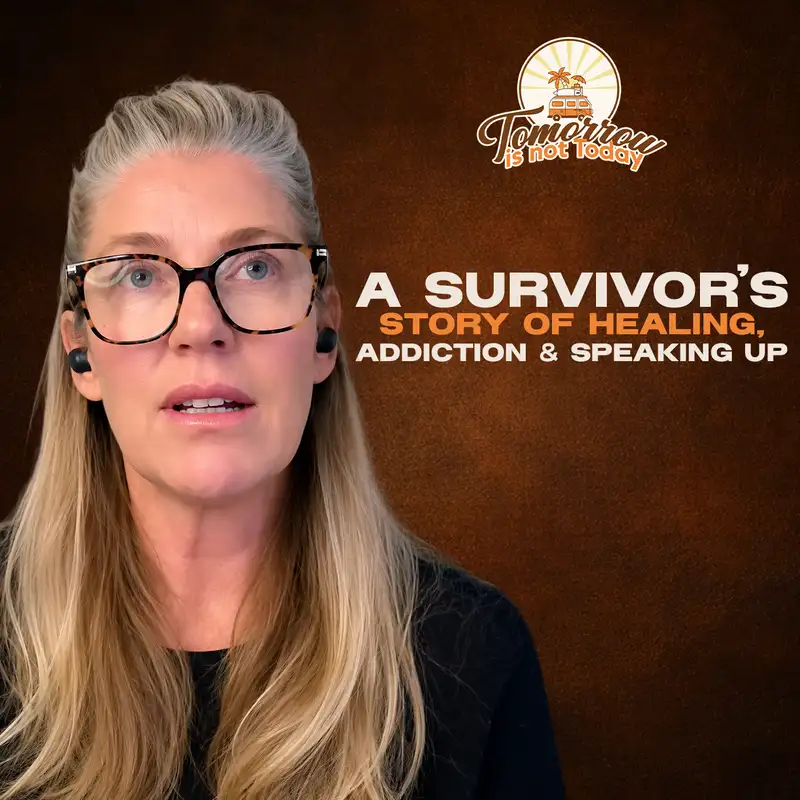
A Survivor's Story of Healing, Addiction & Speaking Up
Download MP3[00:00:00] Welcome to the Tomorrow's Not Today podcast. I'm actually really excited about today. I probably say that with every podcast, but that's because we have incredible guests come on here. Today, I have a beautiful lady from South Australia who has quite a story to tell, something she can share with, uh, very well with a lot of other people.
And it's not just about her story, but it's about how it affects other people and what she's doing, obviously, to help other people as well, and in particular, at the moment, one very special boy that she's helping, which we'll get to down the track. But Rebecca, introduce us. Who are you? What are you doing to help the world, make the world a better place?
Thank you so much, Kingsley, and thank you for having me. my name is Bec Kevis. Um, I'm 53 years old and living in South Australia. of my own healing journey, I've spent the last five years studying, so I am now a qualified holistic [00:01:00] counselor, an emotional freedom technique practitioner. I'm a counselor for children and adolescents, and I'm also now a breathwork facilitator as well. And my goal with all of those is to help people with trauma, help people with mental health issues, uh, people in recovery specifically as well, and also all of those play a big part in my respite foster care for that amazing little boy as well.
I, I love what you just said because you have had an interesting life, which we're gonna get into. Interesting's, uh, uh, one way to put it. Uh, it's sort of non-descriptive descriptive word, that, uh, you have now taken that, and what you're doing is completely changing the lives of so many other people, which is very, very exciting.
Uh, and you've, what you've been through, you've studied on what's happened, how you can actually now take that and help other people. So can you take us back a little bit? Let, let's [00:02:00] go back to your childhood, what that was like, and what put you in a position, I guess, where you did some things that probably aren't the most healthy things, but now you've taken those and using help so many other people
Absolutely. Um, and I think that's where it all starts because your database is made up of many, many years of your childhood, kind of, uh, kind of molds you into the person that you are to some extent, and then it's up to you to make those changes. Um, so it was quite volatile growing up in, in the household that I was in.
My stepdad was, um, quite an angry man. He'd had his fair share of trauma himself, and it was a lot of living in fight or flight mode. I certainly lent on trying to be funny and humorous. Um, it was... I kind of took it upon myself [00:03:00] to try and make him happy, um, because when he was happy, we were all happy. Uh, and you definitely knew from the moment he opened the door from work what kind of, uh, night it was gonna be for all of us and what kind of day it was going to be. And, uh, so it was very, uh, up and down for a lot of that, and it was upsetting, I think. Um, peaceful for the first few of the years of my life before my mum met him, and kind of turned my little world upside down a little bit, and my first memory is waking up on a Greyhound bus actually, and, uh, I was alone on there.
Everyone had gone in to get something to eat, and I remember kind of waking up thinking, "Where are we going?" And apparently I was telling everybody on the bus, um, that we were running away from him because he was hitting my mum, memory that I don't remember, but, but that was told to [00:04:00] me, and it kinda broke my heart a little bit at, you know, three years old to be sharing that information with a bus of strangers. Um, but he then reentered our life with a lot of kind of apologies and promise to change, so he followed us out to South Australia and I think I was seven or eight when the social worker came into my class to remove me to take us to emergency housing 'cause he would hospitalized my mum and, um, you know, one of the things that's very pivotal about that is the people from that emergency housing I've never forgotten. So done a lot of volunteer work over the years because I never forget what those people did for us and how safe I felt in that environment and how kind they were to us. You know, as, uh, as young kids going into an environment away from your home, that was so extremely important to me. Um, [00:05:00] and so of, uh- My stepdad then gave up drinking after that.
Um, uh, but he then took up smoking marijuana. Um, and that was not just, you know, a little bit here and there. That was starting the day, that was the middle of the day, it was nighttime. So it meant that, you know, family holidays were not an option because he couldn't drive. It meant that we could play sport if we could wander up the road and get ourselves there.
So I feel like we kind of missed out on a lot of those you know, those, those memories because instead of dealing with his own trauma, he replaced one addiction with another, and that increased his paranoia. Uh, he started putting hairs around the house, um, to see what you'd touched, see what, um, where you'd been and, uh, you'd been looking at, I [00:06:00] guess.
Um, but he also was very controlling cohesively. So, you know, my mom could only work certain hours because after certain hours, that would mean that she might be up to something. she could only work in certain places. Uh, he wanted to keep us in this little bubble, so he wanted this little family and, and I understand that.
And I mean, you know, at the time, he was the only, only dad I had in the house. So, you know, I loved him and, uh, that's all I knew. Um, but, you know, he wanted us to tell everyone he was our real dad, and that was really difficult 'cause it was clear that he wasn't. Uh, he didn't want anyone coming to the house, and this was the biggest thing, I think.
And the hardest thing to watch that when somebody was coming to visit, the nagging would start two or three days before that would happen, and I could hear it, I could see it.
What do you mean,
destroying.
what, what do you [00:07:00] mean by the nagging?
Uh, just not wanting them to come to the house. Why do you want them to come to the house? Um, why do they need to come to the house? So this could be somebody that's coming to visit, or it could be a family member. He just didn't want anyone in our little bubble. So he would nag and nag and nag, um, in the hope
What was it about that, what was it about that, that he didn't want anyone coming? Was it a fear of being found out for who he was? Was it didn't want people around in case, uh, you know, people wanted to escape? What, what was it?
I, I don't know whether it was the paranoia or whether it was just not wanting anyone outside existing in our little world, um, because our little world was a little bit messed up, if I'm honest. It's all I knew. But sometimes I think, you know, is it not letting anybody... [00:08:00] Is it not, like, opening the door to maybe realizing that this isn't normal? You know, so if we keep this little bubble of normality, perhaps then I don't get a glimpse outside of, you know, maybe how we're living is not how you're supposed to be living as a family. That's the only way I can think about it, and I think the hardest part of that was when they would finally turn up days later, he'd be at the door, mate.
How you going? Come in." And I can't tell you what that does to your body and your mind, uh, watching my mum go through that, but also then, you know, snapping into this, you know, environment of, "Oh, okay. We're all good now." A- and I kind of, you jump on the highs when they happen, trust me, but it is the gaslighting and the, ugh Just the, constant [00:09:00] I think just i- i- it wears you out, and you completely feel, by the time that person does turn up, and even though it's that, you know, that real excitement of somebody turning up, it's also really hard then of trying to put on a persona of this happy family, um, you know, while they're there and, but actually enjoying having them there,
Yeah, exactly.
things up a little bit.
Well, you'd probably be in two minds, wouldn't you? You'd be really excited because, yay, we actually got some-- uh, home is actually happy for this time, but at the same time, you know it's gonna end. You know it's gonna come to an end, and you're probably not sure what's gonna come when that does happen So
Yeah
a- as a child, how do you...
In your mind, because obviously people listening and watching this are either in a scenario where that's happening or they are the person where that's happening, and I want people to be able to find a resource, a way out to make things better. [00:10:00] Uh, how-- A- as a child, what do you do to try and protect yourself?
Look, I think we, you know, we used to go, when I was really young, we used to go into a room and put our records, you know, our favorite records on, uh, to block out some of the noise. Uh, certainly as kids, it's very different now to what it was back then. We would, uh, you know, go outside and play or find something to distract ourselves. But, you know, it, it's strange because don't really need to escape it when you're living it, you know? That's all I knew. I didn't know any other way, so for me, that was really normal, live like that. It wasn't really until my teenage years where I started going to other people's houses, and I was so suspicious.
That's one thing that I, I, I just had this huge lack of trust, because I could see [00:11:00] these two different people in my dad. Um, and I sit- I started to look for that in other people's dads. I was like, "He can't be this nice. There's no way." And then, and I would really just for little signs that would tell me that he's the same way, that they must be living like that.
And when my confusion and my reality really kicked in to say, "This is, this is not normal. This is not normal how you've been living, and this is normal, people interacting and being kind to each other in the way they're talking to each other. There's no gaslighting, uh, there's no narcissism. And look at the way he's talking to their mom," you know? And I remember being at a, at a friend's wedding, and it was just so beautiful the way that they were speaking to each other that I, I ended up walking outside in tears. Like, it was just another realization that, that that's not what was happening in my house. [00:12:00] And
So you learn
freaked me out
At a very young age, you learnt to distrust people by the sounds of things. So every-- Did, did that, from that point of seeing that in your house, um, and then you see other people who are nice, the, the what we could term normal or what should be the normal way of a family. So e- whenever you saw somebody or met somebody, did your...
Instantly were you subconsciously looking for what was wrong or when, when the bubble was gonna burst to see the real person behind that?
Absolutely. And in every relationship that I went into for so many years, would poke and prod to see if you could break, uh, and then I'd say, "I knew it. I knew you were gonna be like that." Um, so it definitely tarnished me into the way I [00:13:00] treated people and the way I went into a relationship. Um, but, you know, at 15 years old, I was also sexually assaulted by somebody a few years older than me, and I'd been out and wasn't where I was supposed to be, and that just compounded my trust with men as well, and my self-worth.
Um, you know, 15, 16 years old was as low as it could be in terms of how I felt about myself, and then I carried that self-worth really, honestly, for the next 30 years. Um, I drowned it with alcohol and substances and numbed it. Really wasn't until I finally went into sobriety that I started to, to actually learn to love myself.
So it was a very, very long time hating myself. Honestly, I couldn't look at myself in the [00:14:00] mirror
Can I, I wanna take you back. I wanna come back there and move on a little bit from there. But before we go there, there's a couple of things I wanna touch on. Early on when, when we first started, you said how with your stepdad, he had had a lot of trauma himself, which then obviously impacts everything else.
Now, that, obviously, if it's not dealt with, it gets passed on to the next generation, and we can see the impact that that's had on you by not dealing with it. With your study that you've done and who you've become now through this, what advice could you give to people who have been through traumatic situations in their life and find it difficult to maybe face those, get healing from it, and, and, and embrace who you are as a person or who you can be [00:15:00] as a beautiful person?
Um, one thing I always say as well is you do the best you can with the tools you've been given, and then it's up to you to do the rest. Um, and I think just know that your feelings are valid, that there's a reason that you feel like this, and the courage is in speaking up and speaking out, validating your feelings, and what that, that what you went through was real, and that is, that is real, that is real trauma, and not to be ashamed of that, of feeling like that.
But also, that there is light at the end of that if you give yourself time to heal, and that, for me, was therapy. It was a psychiatrist, a psychologist. was then all the courses that I've put myself through, but also women's circles, retreats, anything and everything I could within to find who I [00:16:00] was, for starters, without numbing it, but also then to understand that I was a good person. had a problem with alcohol. Uh, underneath it all, I was actually a really good person, and when I found that out, 'cause reconciling the two people, when you, when you're stepping away from that person into the person that you're wanting to become, which is just at peace, to be honest, it's very hard. And there's a bit of a pull to start with. It's like you don't deserve to be that person. You don't deserve that happiness and that... You've been living in chaos your whole life. What are you gonna do without it? Um, and you, a- and finding out that you don't have to live in chaos to be free is just the most beautiful thing
What was the, the tipping point with that? Because I know for a lot of people, um, getting to that point where they can [00:17:00] get away from the old life, the old, "I'm horrible, I don't deserve this," that side of things, and crossing over to the, "No, I am a beautiful person. I am worthy. I am loved," that gap seems like sometimes it can be quite difficult to cross over.
What was it, the tipping point for you that enabled you to do that?
Uh, I think the way I was living in the end, um, with alcohol and substances, I think getting to the point where I didn't care if I woke up or not anymore, and realizing that I had so much to live for, and realizing how lucky I was in a lot of cases to still be alive with the situations I'd put myself in. And it kind of happened organically in [00:18:00] terms of I started saying yes to everything. You know, "Do you wanna come and do this retreat? Do you wanna come and do this?" "Yes." And then unconsciously, I just started to see this different side of myself, this awakening, this clarity. I started to see this physical change, my, my eyes brightening, my, know, my face un-swelling.
Um, and I just started to see that, that there was actually so much to live for. And also, I was starting to really enjoy life
What was it that you...
without alcohol.
Yeah. What was it that helped you do that? Because, like, there must have been a point where that happened. Was it people around you? Obviously, you went to retreats and things like that, which were no doubt helpful. Was there somebody or something that helped you see who you really were, not what was [00:19:00] being shown by the cover-up and the shame and the addiction and that sort of thing?
What was it that helped you actually realise that and go towards that rather than away from it?
I think in the start I did some really powerful healings. Um, there's an amazing woman called Arkella, um, who I did some deep healings with, uh, took me back to childhood and told myself, my younger self, uh, a few home truths about how I wanted my life to look, and absolutely purged. Like, it was just this valve releasing of all this judgment and shame that I'd held over myself for so many years.
And all of a sudden, through a lot of those healings, and I did quite a few of them, I started to see a different person. I actually-- It was kind of a, like a, a huge [00:20:00] awakening, which they say, and it was also around the people I was surrounding myself with, your circle changes and, um, has to. And I started to realise with the people that I was surrounding myself with that this life was possible and that I was worth living this life
So it, it sounds like you made a, a bunch of very wise decisions in there
Absolutely. And I think you have to. You know, nobody's coming to save you, and I love that saying. Nobody is knocking on your door to get you along to therapy. No one is knocking on your door to say, "Kingsley, come and do this retreat. Come and do this healing. Come and do this women's circle." Um, I, I joined a recovery group as well.
I surrounded myself with people that were going through something similar to [00:21:00] me to make me realise I'm not alone, for starters, which is super important. And, uh, they say the, the opposite of addiction is connection, and I stayed connected with everything, fitness, fitness groups, with recovery groups.
And slowly but surely, I started to realise, you know what? You're not the only person that's been through what you've been through, but you're also not the only person trying to recover and love themselves again. And all of a sudden, you know, you start to surround yourself in this community of people that are lifting you, and you're lifting them from your own experiences.
And that's been a, a pivotal part for me, is sharing my story with other people so they know they're not alone, and together, um, together we do this
Would you say if somebody who's trying to get through the whole trauma side of things and-- Because it's, it's very-- Sometimes it's hard enough to get out of bed or to [00:22:00] want to get out of bed, and then to actually do it is a, a whole new, brand-new thing altogether. And without having been there, y- it's really hard to understand why.
Um, but when that happens, if somebody, if they didn't want to admit what was happening, they look good on the outside, things look quite, actually quite together and quite happening in a very good way. Would you say if someone was just, "Hey, start doing some fitness. Start getting around like a group like that that's moving in a good direction, that's getting fitness, it's getting the mindset right," all that sort of thing, just by becoming part of a group like that it could make a big difference?
Oh, absolutely. Um, for me, I joined like an F45 club. It was a community. Held me accountable in the mornings. I got a hug in the mornings, which was
Sorry.
essential 'cause I was living on my own
Let me go back there. You-- Like, that, that would be very easy to just brush over for, for most [00:23:00] people. But tell me about the importance of that
It was hugely important for me, and that's sometimes what got me out of bed, was knowing that when I arrived there, that I was gonna have a hug waiting for me. I was gonna have a group of people that were expecting me, and I'll tell you what, if you didn't show up, people would reach out and ask if you were okay.
So having a community, whatever that looks like, if it's a recovery group, a fitness group, don't have to do it alone. Um, there is so many... I joined Hello Sunday Morning as well, so they are, um, the, it- it's not necessarily sobriety, but it's, it's got an anonymous community in there. So for someone that doesn't even wanna leave the house, they've got these amazing groups on there where they can say, "You know what?
I'm feeling awful today." Don't have to have your name to it, but it's a, it's, it's a chance and a place to actually express how you're feeling without judgment, the support, you'll get it from [00:24:00] everywhere. So there is so much online now that if you're not ready to leave the house, and you're not ready to talk about it, get yourself online, in some form or another.
There's AA groups, or you can even speak to a doctor online now. But do you know what? Don't suffer in silence, because I can, I can tell you well, firstly, you don't need to, and suffering in silence is unfortunately our biggest killer. Is because when people do suffer in silence and they don't speak up, that's unfortunately when we lose good people
Hmm. You know, doing these podcasts, that message has come through, I think in pretty much every podcast about doing that, how important the, the groups, the people that are around us are. Um, so that's-- I, I thank you for saying that 'cause it's obviously a big, big thing. I wanna take you back again a little bit.
There's a me- a [00:25:00] word you mentioned a little bit earlier, and it's a word that's thrown around. We love putting people in boxes and diagnosing people, and rightly so because we-- it's, it's much easier to understand, uh, that way. But the word that you said is becoming more and more popular, and I think sometimes it's a label and sometimes it's, it's reality.
You mentioned about narcissism So now that sounds like something, would you say your stepfather was narcissistic or was it more the tendencies that he had?
Probably more the tendencies that he had. Um, yeah, it was... It's really hard to describe someone, I think, that, um, was so unpredictable. Um, but I think it, it... [00:26:00] Yeah, it's, uh, uh, it's the behaviors are just, are so unique to me. Now I'm completely removed from it, um, you know, it could be more that it's cohesive control, you know, little compartments and hiding, you know, all of my mom's personal belongings and financial things and anything to stop her leaving. Um, but also just making somebody feel like, firstly, that they're, that they're going crazy or that they are crazy. Um, that's a bit of narcissism for me, uh, that behavior is actually there. And also making somebody's self-worth just diminish their self-worth of what their capabilities are. Um, I watched that happen with my mom, and that broke my heart. And in the end, I mean, I remember begging her to go because it was... I, I was worried that, um, that it would kill her eventually, and maybe not [00:27:00] physically, but mentally was at, at her rock bottom. Yeah. And that was very, very hard to watch
So then obviously that, that effect, it carries through, as you mentioned that it did. So when, when did you... 'Cause you started going to friends' houses and noticing a difference between, hey, this is what a family actually is like. There, there's no skeletons in the closet here. What's going on? Um, when did you start to, I guess, self-medicate to try and get through your issues at home?
I was drinking at, you know, 15, 16. By 18, by 18 I was living in the house with just my stepdad, 'cause the family had broken up at this stage, and, um, my mom had moved interstate, which I could have gone to, but my life and my friends and everything was in Adelaide. I was alone in the house at night, uh, 'cause he was working night shift, and [00:28:00] I was myself then smoking marijuana every night, mainly to sleep, so it was medicinal. Uh, but I was also, you know, dabbling in other things, um, harder drugs as well. Um, and that was, know, speed and meth, and lots of different things at that stage. I was self-medicating and trialing, and it kind of snowballed from there because they... There was kind of no one there to tell me not to either. Um, by this time he'd started drinking again, so he was kind of oblivious to what I was doing. So at 18 I was living pretty independent too, which was a shock to the system. Yeah.
It, so, and that, that, uh, how, how did that then affect, I guess, your, the rest of your life as far as were you studying then? Were you at school? [00:29:00] Were you working?
I was working three jobs, um, because I was living like an adult at that stage, and that's what he expected me to do. Um, so I had a full-time job during the day, and then I would, um... I worked at Pizza Hut, I think it was, at night, and then I was, um, I'd work in a club for three hours as well and get free drinks, which didn't help me at all.
So I was, yeah, fully independent, but just living in the same house with somebody that was also suffering from their own addiction. So it was a pretty toxic place, and I never knew what I was gonna come home to. So in the end, I, I kind of ended up moving and, and moved across to Sydney. But time, I guess, was... It could have gone either way for me, and unfortunately, instead of doing something amazing with my life, I fell [00:30:00] into, into partying as a, just an escape, really. And I think I, I you a couple of letters, and I've, I've got one of them here, like a little note that I'd written, and it kind of really summarized... Do you want me to read it?
Yeah, absolutely
how I was feeling at the time, and this was, you know, 17, 18 years old, and, um, "Somebody please crawl into my mind and try to understand why the pain in my heart is fucking up my head. And if you can, please make some sense of why my life is so fucked up at the moment.
And while you're there, can you please help me?" That
That,
volumes. Mm-hmm
Absolutely. I remember when you sent those through, I think you've got another one or two there as well. Um, and I'm like, "This is a 17-year-old that's drinking heavily, partying, just trying to work out the world and wanting to escape, but really didn't know how to."[00:31:00]
I've, I, I, I never remember feeling so lost like I did then. You know, getting up, sometimes I'd be at my boyfriend's house, and I'd just get up at 2:00 o'clock in the morning and, and get in the car, and drive, and scream. Like, and I mean scream at the top of my lungs. Like, my head was just I just was so confused about, um, what normality looked like, what had gone on in the house.
Was it normal? Why am I still living with him, um, when it was the most frightening day of my life getting my mom out of that house? Um, yeah, it's so confusing when you live in that environment, and it's your normality. It takes you years, years to separate yourself from that and to not feel like ... And I mean, I was still trying to get his approval and his, him happy.
I was still trying [00:32:00] to, you know, to, to tell him that he was proud of me, and all these things that, you know, you're searching for for someone that's never gonna give you that. And it was only my psychologist, honestly, in my 40s, that said to me, you know, "Stop looking in these men for what you didn't get from your stepdad."
And that was just such a realization, that I started to go down this path of dating people similar to try and get these reactions and responses that I had never kind of got from him, and that was another realization of, "Okay, this has got to stop now." Um, my psychologist was amazing. He's also the one that said to me, you know, "Bec, some people just shouldn't drink." And I truly believe that anyone that carries any kind of trauma, alcohol is not the answer, and a lot of people that to alcohol or drugs would know that in the [00:33:00] blink of an eye, an, a night can go terribly wrong when you're, when you're carrying something, and you haven't dealt with it. It can turn, know, what seems like a great night into an absolute nightmare because there's so many triggers when you've been through something. Whether it's a one-off event, or you've lived it for, you know, what I did, like, with 16 years of my life in that environment, there's a lot of triggers. And they, and they come out of nowhere. And they're heightened when you're drunk.
It's such-- What you just said then is so, so important for people to hear and to be able to go and, and get the help, because obviously you, you went until you were for- in your 40s before you really got any major help in this, in this area. What was it that held you back from getting help earlier?
Um, look, at 37 I tried my first attempt at giving up drinking, and that was only because a friend said to me, "I love you, I just don't like who you are right [00:34:00] now." That was really powerful. So just another little, a tidbit there is that if there's someone that you love and you're worried about them, lead with kindness, and that, that hits the heart, and that, that made me help.
Although that made me stop and think, "Okay, I need to do something." I was petrified of who I was if I wasn't the life of the party, if I wasn't the, if I wasn't the party girl, and that's how everybody knew me. Um, what they didn't see was the dark side of when I'd leave them and end up in, you know, dangerous places because that's...
I didn't wanna go home. But, um, I was petrified of who I actually was 'cause I had no idea. I had no idea who I was as a child, as a teenager, as a woman, as a partner. I sucked at that, um, because I was forever poking and prodding people, or I was finding the wrong ones, or I didn't believe I deserved someone [00:35:00] kind.
I would see that as boring. Um, yeah, it was just... Like I look back and it's just a trail of destruction really. And,
Do you think
it... Sorry, go on
Do you think part of that comes from the f- the lack of identity, the lack of, "I'm proud of you," from y- y- your stepfather, the lack of him loving you properly in a good way?
Mm-hmm.
as you said before, you were looking for that in other places. And so was that then an ongoing search for that from somebody else?
Absolutely. Yeah. I needed reassurance constantly. And I mean, my mom told me I could do anything, you know. I always got a lot of reassurance from my mom and a lot of love and support, and still do. She's my best friend, um, [00:36:00] still, is amazing. I have a great relationship with her. But, you know, having that male figure in the house, and it's all you know, that's what you...
That's the bar. That's the bar you've got, you know? And so I was constantly searching for someone similar, um, to, to tell me all the things that I wanted to hear from him. Um, because, you know, I looked up to my dad. Still, regardless of what I saw and what I heard, was only dad that I knew in that house, and for so many years, I just was trying to get his approval for everything. Um, and it was, it was toxic in the way that I would do that. You know, I'd, I'd sometimes take boyfriends there to meet him and, you know, he'd get them so high that they could hardly move, that, for me, was like a, oh, wow, look, you know? Like, there's me connecting. That's the way we would connect. I would buy my drugs from him sometimes. [00:37:00] I mean, it's, it, it, it's so clear to me now, and so disturbing to me now, how toxic that relationship was. Um, and I feel for him. Like, I forgive him in the way that... 'cause I, I, I know that he didn't have an easy life himself. Do I want a relationship with him? No. Because I believe that we all have the ability to change, and he chose not to
I love what you just said then. That's
And I think that's where a lot of people miss it, that without the forgiveness, you're not gonna change as a person. It's not about the other person, it's about yourself. And without the forgiveness, we don't change as people. And then forgiveness doesn't mean, though, that we need to have a relationship with them either[00:38:00]
No
It, it means you've forgiven them.
Hmm
It doesn't need to be a relationship had to there. And I think a lot of people find it hard to differentiate between the two things there
Absolutely. I, I think it's... And it's forgiving without getting an apology. Um, that's, that's tough as well, is... And that's, that takes a little bit of work, to forgive someone even though they haven't said, "You know what? I could have done things a bit better." That, that takes courage as well, but that is part of the healing process, is finding that peace with it and going, "You know what?
It, it is what it is. Um, I'm not gonna get that. Um, and I'm okay with that. I'm at peace with that."
That to, to get to that point, like, that, that's huge. Absolutely huge to be able to get to that point where you can forgive, [00:39:00] okay, it's done. There's never gonna be a relationship there, but I forgive you, and it's, it's not a hurt, it's not a bitterness that you carry around with you. Um, and I would imagine that it wasn't to the point where you actually could get to that place where you were able to let go of the vices that really helped you, held you captive
Oh, absolutely. you know, the ones that just kept me in the cycle of anger and bitterness and resentfulness and, um... But it is, the more you step into finding yourself and healing yourself, the easier that becomes. Because, um, I think when you forgive yourself first and foremost, and that was the most important thing for me, is forgiving myself, because I carried a lot of shame.
I was then able to forgive others as [00:40:00] well, because, um, I think it's putting yourself first. What do they say? Put your own oxygen mask on before you help other people. But, um, I've done a lot of work on myself, and it is just the most peaceful I've been in my whole life, and I think we're all... You know, people are trying to find their purpose.
Me, I was just trying to find some peace, because I've been living in chaos for, since I was three years old, um, till my late 40s. And so to be able to sit home on my own, no sound, no one else around, um, I can't even tell you what that feels like for me. Sorry, that's gonna make me emotional. But, um, because I longed for it for so long.
Yeah Yes. It's a, it's a beautiful place to sit.
It is
very,
improving
very grateful [00:41:00] for it.
H-
Yeah
did you find that you had to forgive yourself first to be able to forgive other people?
Absolutely. 'Cause I hated myself when I gave up drinking, because I talk about the shitty things he's done, I did a lot of shitty things myself when I was drinking and high. I was very selfish. Uh, you know, missing people's events and, know, almost missing pivotal events because I've been out all night partying.
I mean, I nearly missed my mom's 60th because I was out all night. Um, I just didn't care. After so many drinks, the button was pushed, and any kind of, any kind of thought for anyone else went out the window. I would leave you wherever you were. If you wanted to go home, I'd backdoor it, and I'd be out the rest of the night.
I'd turn my phone off so you couldn't contact me. Um, you know, my friends were worried [00:42:00] if I was alive or not, family trying to find me and find my friends. I just didn't care, and this is the problem with alcohol and trauma. You mix those two together, and it just becomes this monster of a person, is the only way I can put it, and it took me a long time.
I had a lot of flashbacks. I had a lot of drinking dreams. had a lot of you're, you're not worthy of getting better, and you do not deserve this life. Um, it took a long time. It look- took me at least 12 months in sobriety before I could truly look at myself in the mirror, and it was only, um, honestly, that I ended up randomly making a whole heap of pajamas with affirmations on them, and I had to take photos of myself constantly in the mirror because the affirmations were written in reverse so that you had to read them in the mirror.
And I tell you what, it's not what I'm doing now, but I feel like it was meant to happen [00:43:00] to help me to... You know, they were like, "I am enough. I am free." All these things that I wanted for myself that I didn't have, I was suddenly giving to myself and other people. And I mean, I gave away more pajamas than I sold because I just felt like my purpose with those was to give them to people that really needed them, and they went to, you know, women coming out of domestic violent relationships. They went to children who were going into foster care. of pairs went to, um, charities like that, and that's m- for me, where they were meant to go. Um, because I know there's, there's people all over Australia now in a really difficult time wearing those pajamas, and hopefully, I'll probably never meet them, one of those affirmations has got them through the time in their life, um, and they believe what's on them.
So it's
that. That is
how these
so cool. It is. That is so, so cool. Can [00:44:00] you... I want you to give a direct message right now to other people who are feeling like you were at that point, to who feel that they're not worthy, who feel that they're not good enough to even change, to even have a place, to even feel good about themselves
Can you give a direct message to those people? What would you say to those people in that place right now?
You absolutely are worthy of peace, of happiness, of living a life that you deserve, that you've longed for, that you've dreamt of. Please know that everything you're feeling is valid. Please reach out for help. Please don't do it alone. Don't suffer in silence. Know that there is a lot of people out there that have been through something similar and are waiting to help you and are there to help you and will help you.
So please don't [00:45:00] give up
That is so cool. That is so cool. I love what you said about the pajamas and just writing that message, but giving away so many to other people to make a big difference for them. And it's, it's so easy, I think, to think that we can't make a difference in this world, but what you did is very unique. I've never seen that before.
But yet, just by that one message can be incredible. So like you've probably seen, it comes up I think mostly on Facebook at the moment, there's, um, a message on the back of some hoodies that says, "To the person behind me, the world is a better place with you."
Absolutely.
Uh, just little things
those jumpers. I see them at the gym actually, and it
New year
every time I see it. Yeah
It ex- exactly, it just, just that simple thing. Just putting a smile on someone's face just by the simplest little thing that may not mean much to some people, [00:46:00] but to the right person at the right time can literally be a lifesaver
Absolutely. Yeah, and I, do you know what I love now that it is such a topic of conversation? Mental health and wellbeing, something that as a teenager was never discussed. You know, maybe you're going through a difficult time because of what you've been through. Nobody, nobody... know, my dream now with what I'm doing is to intervene in those teenage years, is to help people that, um, are feeling disjointed and they don't understand why.
Exactly like my note, I'm so messed up in the head and I don't understand why. My, my dream is to help those people to understand why and to give them an outlet and a community and a group to try and help them through that. So that's, that's my dream.
That's so cool. So tell me a little bit, or tell us a little bit about how you are doing that at the moment, 'cause you got a bunch of things happening
Yeah. [00:47:00] Well, I mean, I, I, I still work full-time, um, but this is, all this study, uh, and everything that I've done, I've done outside of that to do that. Um, so breathwork at the moment, I do that, um, with people actually coming over, um, coming over to the house and doing it, and it's kind of a, a 90-minute session.
And I have people doing counseling, whether that's in person or whether that's via a Zoom message as well. Um, so it, it's kind of one of those things that it's, it's a little bit ad hoc at the moment, but, you know, I'm building my dreams. And first and foremost, I always say, "Get yourself well first before you can help others."
And that has been my last five years, is healing getting myself in a position where I can help others, because if you try and help others too soon and you're not healed, you sometimes lose yourself in there, and I do see that sometimes. So just concentrate on getting yourself well [00:48:00] first, um, before you help others. So watching this space, Kingsley,
Absolutely.
that's what
a lot.
about
There's so much happening, which you're doing, and I, I like what you just said that... And that's one of the messages I want people to get ahold of, is the fact that you can start helping people. You can be working full time, you can be doing whatever it is, and you can start helping people.
'Cause one of the things that I look for when I get guests on the podcast is, a- as you know, it, it wasn't just, "Oh, I'm on the podcast." There was quite a process that goes through to actually make this happen, because I'm very, very well aware that people need to be at that point, as you were talking about, 'cause there can't be any of their anger and bitterness and hatred or unforgiveness and things like that still happening in people.
Because i- the minute I hear anything remotely like [00:49:00] that, it's, it's a no for the podcast, because I can't be having people like that come on here. But it's people that are healed, that have gone through the process, and that are now actually physically doing things to help other people are the ones that come on the podcast.
Because otherwise, I'm just giving people something that's just gonna make their life worse, whereas we need to make it better. And once you're at that point, now people can go out and help in so many different ways, in different things, like what you're doing, and it doesn't have to be a full-time gig. It doesn't have to be anything like that.
But we need to be able to help other people, which you're doing. And tell me, tell us about your beautiful boy
Oh, look, that has been absolutely life-changing for me, and I think I started that process probably two years into my sobriety, having not had children myself because of, uh, the state I was in for so [00:50:00] many years. I missed that opportunity, and, uh, he was five when I first got him. I'm a respite foster carer, which means that I have him once a month, but also sometimes for a week or sometimes for two weeks, and they have matched us up so perfectly.
He is just the most amazing little boy, and, um, I think even the, you know, the caseworker, you know, the people that surrounding him are so surprised at the relationship that we've, that we have, you know. Um, and I love that he says to me now, "You know, you're not my, not my res- respite carer. You're my friend."
Um, it's something that we talk about every time I have him, and my last words after every weekend when I sit down with him is that, you know, "I love you. Doesn't matter what happens, I'm always gonna be here for you. You can do anything you wanna do." And, um, he says, "You always say that to me," and it's like, "I absolutely do."
And our time [00:51:00] together has just been life-changing for me as well. Having that opportunity to, step in as a role model for him, um, has been... You know, it's something that'll, keep me exactly where I'm going in the path, and he's been into the breathwork as well, and he even makes up some of his own breathwork Which I love.
So it's actually giving him the tools as a child that's been through trauma, with how he can just take a moment during the day wherever he is to stop and breathe. Um, so I hope that I'm bringing some of my training and what I'm doing into his everyday life and giving him the skills that, you know, as kids we never discuss those things. Um, but I feel very honored to have this role, um, in his life, and it's a long-term role for me. It's, you know, till he's 18. So it's been nearly two years, actually, in September it'll be, since I've had him.[00:52:00]
You know, it's, it's really interesting because you can look at that in two ways. One of the ways is like, "Oh, that's just one, that's just one kid."
Mm-hmm.
But the reality is we have no idea the impact that that is gonna have on people, and there's so many stories about that. One, one thing someone said or one thing that someone believed, like your friend that told you, "I love you, but I don't like who you are at the moment," had a massive impact on you.
Um, but you reem- reinforcing who he is, and that he is worthy, and that he is loved, and he is capable, all of this sort of thing that he's probably not getting anywhere else any time. And it's not just that one person, but it's the influence it ha- that will have down generations, down around his friends.
Who knows what he's gonna go out and do, [00:53:00] uh, as, as a person. And not only that, but the other thing that really struck me about that is the fact that you go to do somebody el- something for somebody else, but the impact that that has on you personally and how that's made you a better person
And you know, you could do, I could do respite care every weekend if I wanted to. reason that I have said that I will only do respite with him is because I want to be that person, that if there is an emergency with his foster parents, it doesn't matter when it is, there. I will always be his person for him, and I know how important that is for him, for me to never say, "I can't 'cause I'm doing...
I've got another child over this weekend. Sorry, buddy, I can't help you." I, I, I never wanna have that conversation with him because he's been through enough, and he's had some, you know, letdowns before, and I think my commitment is to [00:54:00] him, and there's a reason for that, and that is because I just, I never want him to worry that I, that I can't, that I can't be there for him, and he deserves, he deserves for me to be there for him
What would you say to people who, who have come through things? They've done things, they've, they've healed, they're in a place and they're like, "I'd love to do something," but they may have family, they may have business, they may have travel, they may have... There could be lots of things going on. It's like, "I just can't fit it in.
I don't have the capacity right now." What would you say to people like that about doing something?
Think that you don't think you've got the time, um, but you make the time. And respite foster care is a, a lovely way if you, if you do have, you know, a, a big family or you have a lot of commitments, you're committing to once a month or whenever suits you. There's lots of different respite care [00:55:00] opportunities there.
There's emergency, there's, you know, setting it up so that it's once a month or, um, or just being that person that a weekend here and there. If, I think if you're in a position, especially emotionally, financially, that makes no difference. What kids... The kids don't need money thrown at them, they need somebody emotionally that's gonna be there, that's gonna make them the center of their universe for a couple of days. Um, and that is... You know, please, if, if you've got something to give in terms of some of your healing experience, and quite honestly, when you've been through that journey, you do wanna do it. Like, you just... There's this, there's this inner feeling of you that's like, "How can I now give back?" And whether that is, like I said, going back to those people at the emergency housing that I went to, that's always stayed with me.
So me being able to provide and do something to give back is just so meaningful, and I feel like you heal more within yourself [00:56:00] when you're helping other people. I feel like it happens organically, Kingsley
Yeah. Yeah. And there's probably people listening that are like, "I'd really like to do this, but I can't because..." Like, you've got your, your pajama thing that you're doing, you got the breathwork thing, you got counseling, you've got the respite care, you've got all of these things going on. It seems like there's no end of ways to help people, but sometimes it's like, like you just said, what are you gonna do?
You do have the ability
When you remove alcohol from your life, you got a lot more hours in the day and a lot more capacity. And I have to say, you know, my weekends now are jam-packed because I'm not worrying about drinking for one night and then being hungover for days. Um, I can do so much, and I can give so much within, within one day. that, [00:57:00] that's been part of my sobriety is like, how am I gonna fill this time that I've got, and how am I gonna help others feel the way that I feel?
Mm.
I do that?
Yeah, that's fantastic. Rebecca, thank you so much for, um, coming on the podcast and sharing very openly your story and your journey of where you've been, where you've come through, your personal healing and what it's taken. 'Cause obvi- obviously it's, it's not an easy thing at all what you've been through.
You've been incredibly brave, and to, to make that choice and that decision to change your life and now to change the lives of other people is incredibly powerful. Um, is there anything, before I get to my final question, anything else you would like to say to people?
Well, firstly, thank you to you, but also, um, yeah, just, just believe in yourself and believe in your worth. Uh, we get one shot at this life, so make it, make it the best that you possibly can and, and [00:58:00] do something that makes you happy and finds you peace
Absolutely. Um, my last question that I always end the podcast with, how do you create the life you want and leave a legacy you're proud of?
Well, creating the life that you want is, is, is having the want to make a difference in your own life and to make a change, um, and to leave a legacy. I think for me is I always wanna be remembered as somebody that was able to help others, that made the time to help others, that did something to help others. Um, and that's what I wanna be remembered by, is somebody that, that changed their own life so that they could help change others
I love that. It's, you know what, when- whenever I get people on this podcast that obviously been through, as you know, some pretty interesting, I'll go back to [00:59:00] that word, parts of life, and they're always the most generous, other people-centered people every single time. There's no selfishness about them. It's always about, what can I do to help other people?
It's really interesting how that works
Well, I think it is really because that you can't do this alone. So I didn't get well on my own. I got well with a surround, you know, people that were surrounding me, my best friend, my family, my... The people that you choose to be around you, they're the ones that are lifting on, kinda lifting you up the whole time.
So I think, I think you do wanna, you do wanna give back when that happens, because I could not have done this on my own
Rebecca, thank you so much for coming on the podcast. Really appreciate your time, vulnerability, and sharing your message, which is, I know is just gonna help so many other people as well
Thank you so much for having me. Um, I love what you [01:00:00] do and appreciate it so much. Thank you
Creators and Guests