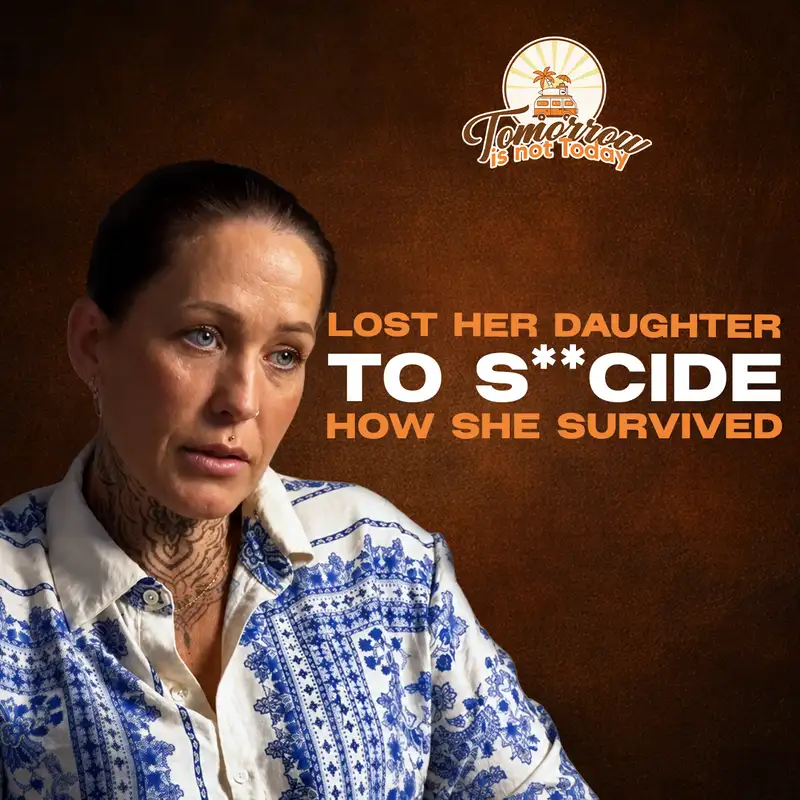
She lost her daugher to s**cide. Here's how she survived
Download MP3[00:00:00] I lost my teenage daughter, Riley. She jumped off my balcony 33 stories in the air with her sisters and I home, and I had to go down and find her. And when I did, I was a very angry person inside. It's taken me 44 years to come home to myself and realize there is a incredible strength in our capacity to be vulnerable.
Even for ages afterwards, I would be driving in the car and I would just wide knuckle the steering wheel and just, just scream. When, when you first become a parent or before you become a parent, you think, "This is such a massive responsibility. I've got to try and mold this kid and train them and teach them and I've got to be the, the guru of all parenting."
It's the things that we often shy away from that facilitate the opportunity for so much healing. Your self-awareness is just over the top. Like not a lot of people have a [00:01:00] big self-awareness like you do. It's really important to acknowledge your emotions, allow them to be, sit with them, validate them if they're valid.
How did you do that? I had a choice in the way that I viewed it. Question. Mm-hmm. How can you create the life you want and leave a legacy a proud of? I think that ... Well, welcome to the Tomorrows Not Today podcast. I have in the studio, um, Islana Lower. Yep. Um, we were talking- Yeah. ... before we started. You hadn't even got far and I'm wrecked already.
It's just nuts. I, I will say here, um, that, um, I'm hopeless when it comes to this stuff. I cry at not much at all. Um, my eldest brother, he's far worse than me, which is fantastic. I'm glad about that. But I'm bad enough. So I wanna tell you, get the tissues out, you're gonna need them. This is full on. But at the same [00:02:00] time, as Lana, we've only chatted once before.
Yeah. I think you have one of the best attitudes I've ever seen anybody. Thank you. Ever. So tell us a little bit about who you are now and what you're doing to help people, and then we'll dive into your story. To start with, I don't think emotions are a bad thing, and I feel- Yeah. ... like if I defined myself, I would say that my soul and my heart and all of my emotions are this big and they're crammed into this body.
So sometimes they come out through my tear ducts. So I'm never afraid of my tears or expressing my emotions because I think there is a incredible strength in our capacity to be vulnerable. Um, well, I think sometimes we think it, or see it as weakness and really it's strength. So I appreciate your honesty and your awareness-
And your tears even before they come. I don't, I never shy away from anything in life. Like you said, are you ready? I'm like, "Yeah, I'm always ready." Yeah. Yeah. Um, because vulnerability is my strength and I appreciate that about myself. But yes, uh, about me, I don't even know where to start. I was born and bred on the [00:03:00] Gold Coast.
I am a nurse and a midwife and a mother of four. And I also have a business doing aesthetics and cosmetic tattoo and stuff like that. So I wear many hats. Mm. And I love it. It's, uh, many tabs open in my brain at all times. Yes. I'm now an author as well, but I, um, where do I start? I lost my teenage daughter, Riley, to
So I had a boy and then three girls. Um, and Riley was the eldest of my daughters. My son was from a previous relationship, and then I was convinced when I was younger, I wanted six kids and I wanted them all to have penises. I did not want any girls because my childhood was filled with abuse, neglect, and just absolute trauma that made me so scared and feel ill-prepared to parent and protect daughters.
If my own mother couldn't do it and life had been so unkind to me, I didn't want that responsibility. And anger is easier than [00:04:00] sadness. So I was a very angry person inside because of the injustices of my life, and I just felt too rough around the edges for girls. And so that I was supposed to, if there was a God who was supposed to give me all boys, and then when we had the ultrasound for Riley and there was no penis on the ultrasound, I cried for like a month.
And then as- Really? ... you know, I was always born to be a midwife. So then I'm crying because I feel bad that I'm not welcoming this baby, but I'd say to my husband at the time, "What am I gonna do with a girl? Like I can't do this. " And it's funny because then I had three and if we got everything we thought we wanted in life, we would miss out on so much because everyone of them softened me more and more and showed me a love I never would've known if it wasn't for the opportunity to mother girls.
And ironically, it's the things that we often shy away from that facilitate the opportunity for so much healing because Riley was the most like me in features and appearance and her heart and her soul and being all this crammed into a little body and she was an emperth and she was [00:05:00] so much for this world in such a beautiful way.
But we had always said that she was just love, like she was our honeymoon love personified as Riley. And even as a little one, she was nicknamed Smiley Riley. She just had this beautiful positive impact on everyone that she touched. And, um, so obviously losing her at 15 to suicide very suddenly, um, without warning, we had no idea.
We knew she was struggling a little bit and I, I was going with a counselor to see her to try and get her to open up because on the back end of not wanting girls and then having them, I was like, "Okay, how am I gonna get through the teenage years?" My mom never had the difficult conversations. She shied right away from that.
If she had conversations, it was trauma dumping way too young about hitchhike, don't hitchhike when you're older because I got taken out to the bush by five men and r- and gang raped. But she'd tell me that story when I was like 10. So not appropriate preparation, made me scared and ill prepared and didn't talk to me about periods, drugs or [00:06:00] sex or boys.
And so all the things I, I should have been prepared for or, or had those conversations, I didn't. So I was like, "These conversations must be so hard to have. " And I was so scared of the teenage years. And she was a baby, like I was jumping way ahead. But I was like, "How am I gonna deal with periods? I didn't even want mine."
And so I realized very early on that ha- you don't accidentally get to the teenage years and have these well-adjusted girls that just talk to you. And that if I wanted honest, open communication with my teenagers, it started young with age appropriate honesty. And so I always offered that, them that, even if it meant poker facing the shit out of them, as if I'm fine with this conversation.
Um, but an example of that would be Riley had, we had had a vasectomy, but there was a condom in a packet in our room and Riley was eight. And she's like, "What is this? " And he's like going, just deer in headlights ran out of the room, like, "I can't handle this. She's so little." And I said, "Come here darling."
And my heart's in my throat, [00:07:00] but I just poke faced her. I said, "You know how I told you that sex makes babies?" And she goes, "Yeah." And I said, "Well, not everybody who has sex wants to have a baby." And I was so careful not to say some people have sex just because they love each other, because I also wanted to raise well-adjusted sexual beings who own their sexuality and understood that sex doesn't have to equal love.
So, and that it can just be about fun. And I said that. I said, "Some people have sex just to enjoy it and have fun." And so I ripped it open, I blew it up, I showed her how it goes over the man's penis and the stuff that would make a baby then get, goes in the bin essentially. And she was like, "Okay." And went on with her life.
And I was like, that was the first, that was the catalyst for understanding it really isn't that hard to have these difficult conversations. And the next day she goes to me and he was in the kitchen, "You know when I ask you questions, you give me a lot of information." And I was like, "Yeah, does that bother you, bother you?
And she goes, "No, not at all. It helps me my ... Instead of my brain thinking like this, " and she pointed straight ahead, "It thinks like this. " And she put her hands [00:08:00] out to the side and she, and I was just in tears. I was like, "I'm doing it. I'm, I'm doing this parenting thing." And she goes, "And it really helps me when I do things like Naplan to use my brain to think bigger."
And I, that was my first real memory of a absolute win of, I've, I've got this, I can do this. But as she grew, and particularly at a younger age, at the age that I had been sexually abused, it was so confronting to look at this beautiful, love filled, innocent child and even consider harming it or sexualizing it.
Mm-hmm. So it, it did. It brought a lot of anger that I had to greet and reintroduce it ourselves as, "I'm sadness, I'm not anger." And a lot of healing was kind of forced out of our relationship because she came here to be love and to teach me about love and how to love myself. And she gave me a lens to view myself differently because I found it so easy to love and adore her and to [00:09:00] realize it really isn't that hard to protect and love a child.
It's really interesting, isn't it? Because when, when you first become a parent or before you become a parent, you think this is such a massive responsibility. I've got to try and mold this kid and train them and teach them and I've got to be the, the guru of all parenting to be the best that there is.
But then as you go along- Yeah. ... you realize actually they teach you more, I think, than they teach them. Because if you realize, if you, if you don't let yourself put yourself or anyone else on a pedestal or be put on a pedestal, because if we put people on a pedestal in life, in order to do so, we have to put ourselves beneath them.
Mm-hmm. So I knew not to look at anybody else as if they were killing it, because even if they are, all they're doing is killing it for them right now, because in the next moment, things could change with kids and baby. 100%. 100%. And usually with social media, they're just taking the right angle of their life to make it look like they're killing it.
We're all in this shared experience of fumbling our way through life. Yep. And, and my [00:10:00] response to her was, "Darlan, I, I don't, I don't always know what I'm doing, but one thing I promise you is I will always do my best. I won't always get it right, but I will always tell you the truth." And I said, "Just because my body's bigger doesn't mean I know what I'm doing."
Mm-hmm. I didn't get the rule book. I don't know what I'm doing. And parenting a lot of the time feels like you're in a play, but you didn't get the lines and now you're being punished for getting the lines wrong, but the lines that I didn't get, like, what? And so it was so beautiful because even at age, she could reflect on that and have, and, and that's what I said.
And I said, "The, the thing is, while we're doing the best we can, and we'll help you navigate being eight, and then when you're 13, we will, and you're hitting these things for the first time, so are we as parents because you're our eldest." My son at that point was no longer in the same house. And I said, "So a lot of what we do with you, we're cutting our teeth on you.
We're, we're doing it for the first time. So we won't always get it right." I [00:11:00] said, "But at the same time, as I'm helping you be whatever age you are for the first time, I'm also doing my age for the first time, and I have never been 38 or whatever I was. " Um, and younger than that, I'm making myself older by whatever I was.
And I said, "But I also don't have parents in my life to help me navigate, and so I will make my own mistake. So I just need you to have some a- awareness and compassion." I worded it age appropriately for the fact that I'm doing my life for the first time too. And it was so beautiful sharing my life with her because she had that kind of awareness and empathy.
And she was the one I cut my teeth on in just poker facing conversations and it, because my whole goal was just get them to the difficult years without shame. And, uh, so much of my childhood and early adulthood and life has been overshadowed by shame or regret or guilt or remorse. And these are horrible emotions that lead to more often than not self-isolation, self-harm, and [00:12:00] then ending your life.
And so I had that awareness. And I was all about conscious parenting. Ironically, I ended up teaching workshops, which I have for years called Why Mindset Matters in Childbearing. And as a midwife, I helped people prepare for labor and birth in a way that saw them avoid unnecessary birth trauma. And absolutely you can.
You can have an incredible birth regardless of the environmental factors of how it plays out because through the workshop, what happened is it facilitated an awareness that by doing the things that I taught, not only did you greatly optimize the chances of birth going the way that you desired, and awareness that it's quite arrogant about our ego to think we can plan life and we think we can plan birth, but ultimately the same magic that creates life and the same body that is so magic in housing it isn't gonna drop the ball in labor and birth.
Sometimes our ego wants to force the way we think birth should look, and then the body will go, "Have you had enough? Are you ready to meet your baby in theater like you're supposed to? " And so I would help them prepare for all [00:13:00] possibilities so that even if they went into it going, "I want a water birth," they could navigate an emergency cesarean going, "We fucking did it.
We had our best birth." And so, like, the, and on paper, you could look at certain births and go, "That must have been traumatic." And they're like, "It was a completely fulfilling transition into parenthood." And that was my superpower. But when I had gone away to do the training for this, um, in, she was about eight, I have this beautiful photo of her on the bed just staring up at the, we were sitting in the dark, I was making slideshows.
I had told the girl, her, "I'm going away for a week to learn about how to help people not be scared to push a baby out of their vagina." She thought that was amazing. And, uh, she, I remember her knocking on the door and going, "What are you doing?" And I said, "I'm making the slideshows for my workshop." She said, "Can I come in?
And she's sitting there just, uh, asking questions about the slides and just in so much admiration for what I was about to do with my life. And even when we had a purpose built studio on our property, so when the couples would come and he would take them [00:14:00] out, because it was a two day, all day thing, um, each day he'd take them out, but she'd be like, "Please, can we just wait?
I just wanna see them. I just wanna see them in their bellies and the pregnant couples." And so then when I was done, she'd be glued to me wanting to hear about how it went and- Wow. ... the couples and which one was that? Or she'd ask, "Can I bring William out? " Because William is a reborn doll that's hand painted and looks like a real newborn.
So she would use it as an excuse to see them and meet them, and she just loved it. But she was about that age when we were somewhere and, uh, she was just looking at me as I walked in with her head tilted to, to the side and said to her dad, um, look at her, look at her. She's just so confident. She just walks in with her shoulders back and she just, she thought I was everything that I am.
And I finally, it's taken me 44 years to come home to myself and realize everything I am, but she saw it all those years ago. And Friday [00:15:00] is her 19th birthday. Um, and so that was a long time ago, but I, in a therapy session after she died, I was asked, "What do you think her purpose here was? " And I believe it was to be love and teach me about love on a level I never would have known if it wasn't for the opportunity to be her mom.
And it's our ego that wants to think if I knew she would still be here, that I could have done something or that her term here was meant to be longer, but what if it wasn't? What if I heard this beautiful thing that said, "Imagine if you are sitting in heaven or wherever our souls reside until in between coming to earth in the human form and God has this plan or the universe has this plan.
You get to go and have this lived experience and you have love and passion and adventure and all of it, but there will be hurt." And my soul went, "I'm not, I want, I'm not going without Riley." And it was like, well, [00:16:00] she can't go for the whole time. I know, but I don't want to go without her, but she's only gonna be there for 15 years and then you're gonna hurt.
And my, my soul was like, I'd rather hurt and have known her than go there without her. And then God, the universe says, "But when you get there, you're not gonna remember that we made this agreement." And so what if I could have kept her here? What if I could have known and what if her telling her peers that she was suicidal and wanted to take her life, that it's that ego that wants to think that we can white knuckle the fuck out of life and somehow control it or create certainty or even safety and in whatever context we think safety looks like and it's in letting go of the wheel and understanding that we can't plan life.
We can plan for it and we can be intentional in the way that we live, but life has its own plan for us. And even if I could have made her stay in this life, what if this was the beginning of [00:17:00] mental health issues that meant that she battled with addiction her whole life had children and then took her life anyway.
Maybe her term here was always 15 years. And if it was, she did exactly what she came to do. And so in, Riley took her life on November the 17th, 2022, she jumped off my balcony 33 stories in the air with her sisters and I home who were 11 and 13 at the time and I had to go down and find her and when I did, I was screaming so loud that the girls heard me from 33 stories up and they came down and they saw her body.
Um, it's a sound that I'm all too familiar with from my days in emergency and it's the same sound every parent makes when they find out their child is gone. Um, hmm, even for ages afterwards, I would be driving in the car and I would just wide knuckle the steering wheel and just, just scream, [00:18:00] just scream.
Um, she hid the turning circle, the s- the glass panel of the turning circle, which broke her fall and so she wasn't, she wasn't splattered everywhere. She looked like she was laying peacefully face down with her hands up around her head and I'm so grateful for that because that's what the girls saw. I'm so grateful that that's what I saw because had she been splattered everywhere I would have ro- looked for the next truck and run in front of it.
Oh, there's no way I could have survived that. Um, I'll never forget the feeling as I went down in the lift and it was like a physical feeling of my brain wrapping itself in cottonwool and just going brace yourself because what you're about to experience would kill you. And there is so much beauty and wisdom to our soul and our brain and the parts of us we will never understand that has the ability to protect us from unimaginable trauma because there's no way I could have had the gravity of that.
And, uh, [00:19:00] but as time went by, that same wisdom decided for me that you know what, you can have this. And it was right around the one year anniversary and I was like, "I don't consent. I don't think you're right. I don't, I want the cushioning back." And I felt like I was experiencing the full gravity of it. I wasn't.
As it turns out, I had 10%. So again, a lot of beauty and strength in the parts of us we can't see. But I, um, I made a very conscious ... I wasn't necessarily conscious in the beginning and I did a podcast episode. So I ended up doing a podcast last year, starting a podcast, and I called it Why Mindset Matters.
Mm-hmm. Um, and the first episode is called I Said Yes to Grief. And in the beginning, I didn't know that's what I was doing, but it ... I, I just gotta say how we often view things as if it's just one layer. Yeah. And that's it. And that's how it is. We've got grief or we've got happy- Yeah. ... or we're sad and [00:20:00] something happens and it's like, okay, well, you go into this bracket here.
Yes. But I love how you've described it as there's so many different- Yeah. ... layers to our life, to our emotions, to our thoughts- Mm. ... to who we are as people, as individuals, that Riley was sent here- Mm. ... for a purpose. Yeah, 100%. We all are. E- exactly. Yeah. Exactly. And it wasn't ... None of us know what it is. No. None of us knows what's happening tomorrow.
I actually think the, the life goal is to come home to ourselves. Yeah. To, to, that's what I feel like I'm doing. That's what I feel like, like that story of, like, we forget when we get here as babies. Your self-awareness is just over the top. Like, not a lot of people have a big self-awareness like you do.
Yeah. You've probably noticed that. But it sounds like ... And I have to say this, but it sounds like some of that has come from a very ugly past. Yeah. Do you know what's funny- Which is helpful. ... [00:21:00] I have been very conscious of not being a victim. Yeah. I tell my girls their whole childhood, it's really important to acknowledge your emotions, allow them to be, sit with them, validate them if they're valid, but then it becomes a choice whether or not you stay in that place, and that's the difference between being a victim or not.
So I prided myself on not being a victim of my circumstances, not being a sum, the s- I'm not gonna be the sum of my origins. I'm not gonna let it define me. And- How did, how did you do that? Because you're, you're not a, you're not a, uh, an adult with all of this wisdom- Yeah. ... when you decided to do that. No.
What, what happened? How did you decide to do that? 'Cause there's so many people live there. Yeah. I think- How did you decide not to? I think quite young, realizing living in housing commission, abuse, a lot of religious, religion was used as oppression, as a form of control, and all of this negativity, I always kind of felt like there was more to life.
There was more to me. I've always felt like this, crammed into this- Yeah. ... and too. And I [00:22:00] spent my whole life feeling like I'm too much or not enough or ironically both at the same time. Mm. And that's what I mean of coming home to myself, is sitting in the awareness that I'm neither of those things. And when I say no, I decided pretty early on I wasn't gonna be the sum of my origins.
And I was probably the first one in my family. I haven't really given it much thought to go to uni. I, I left home at 15, um, and had been, had been on my own since. I had quit after year 10, so I thought, even though I really wanted to be a nurse and a midwife, I can't do that because I didn't finish school.
And then when I had my son, I, I looked into, there has to be a way. There has to ... I, I came from housos. I didn't know that you could go to uni. Like, I didn't know- Yeah. ... that I was considered a mature age student at 20 years old with a baby because I'd been five years out of home and had all this lived experience.
So it turns out that I could sit a, a test and get a ranking and I did so well at school. So I nailed it and got in the top 15% of people that sat the test that year and then they had me write a letter writing a letter to sell [00:23:00] myself to the uni on why they should invest in me by allowing me to come-
Was the hardest thing I ha- had ever done in my life because I had to sell me and I didn't believe in me. And I found that letter not long ago and sat there just sobbing because it really w- was like it should've just been easy. It should've been a, an easy sell that- Why should it have been an easy sell?
Because of who I am, because of who I was even then, and how I show up in life. So there was b- I, I'm trying to get a difference here between who you were- Yeah. ... versus who you saw yourself as. So now I realize the power and how I show up, the emotional intelligence and the, uh, ability and awareness to invest in myself, because that's the greatest investment I'll ever make.
And that I've s- I had, I have spent my life going, I, okay, I feel like I'm too much or not enough, but I also, there's this part of me [00:24:00] that is like, but what if I'm just right? What if I'm everything that I'm supposed to be? And what if I'm not too loud and I'm not too many opinions and I'm not too strong-willed and s- s- what if my stubbornness is actually the thing that got me through my life and helped me find my voice?
And what if my ability to articulate everything is a superpower that helps people feel seen and capable because when I, when people would hear me talk about Riley's death, and the reason I mention it is to give weight to what I'm about to say, is that when people would hear me talk about the environmental factors of her death and what had happened for a good year on repeat, men or women would, same things would, same words, they would say, "How the fuck are you still standing?"
I couldn't, I wouldn't. And if you hear enough people say the same words, you start to think, "What am I doing that has you think I'm special because I'm not? " And has you convinced that you couldn't because you [00:25:00] can? And I think that I prided myself on not being a victim, but there was a point in the aftermath of losing Riley where, because I was in surface because I was getting a divorce and I was so heartbroken over that.
I wanted to be enough for one man and live this happy life and just have him be the king of the castle and to be finding myself in this divorce and just feeling completely lost in life and completely broken by it, I, um, I remember in the aftermath of losing her, the, having a moment of poor me, why me?
And I'd prided myself on never going to that place in life. But I sat with the, "Why the fuck did all that bad shit have to happen to me? When am I gonna catch a break?" Like so much more bad stuff than I do we have time to talk about. I have been stalked and drugged and raped and all of these things, domestic violence relationship as my first, like just all of the things.
I ticked all of the boxes of trauma. I made some kind of messed up soul contract that I was gonna, that is very me, I'm all or [00:26:00] nothing. I'm like, "You know what? Give it all to me. Come on, let's just see how far we can take it. " Bring it on. I sat in the, "What the fuck has just happened? Why? Why did, when am I gonna catch a break?"
And I sat there and realized that when I was younger and we had no food or whatever it was, if you were just kind to me, I saw kindness as an act of unconditional love. I was so grateful. If you fed me, my God was I grateful. Like just simple acts of kindness, and this is powerful message in itself, you never know how far that will go in someone's life, particularly a child.
And I've never met a child that doesn't love me because I greet them all with love, um, no matter how difficult the world s- thinks that they are. So I realized that I actually had the, the trauma and stuff that I had experienced had born a g- a gratitude, I had the resilience born of gratitude. And even after she died, when I caught up with a friend, it was two weeks after she took me to soak bathhouse and- [00:27:00] So, sorry.
Yeah. Can we go back there for a sec? Yeah. What you just said, I want you to unpack a little bit. Yes. Resilience- Born of gratitude. ... born of gratitude. Explain that. So when I was seeing this friend, um, telling her about how Riley had died, I said to her, "I'm so grateful that she looked peaceful laying there."
And it was less than two weeks after she died. And my friend is just tear stay in cheeks going, "As if you're talking about the things you're grateful for, I think you're gonna be all right." And she couldn't have been more right because I have a very difficult time having any conversation where I don't hear myself say, "I'm so grateful."
And what I, when I heard enough people say the same things, I started to reflect on, "What is it that I'm doing? What am I doing that has you think that I'm special?" And all the things that I had taught in my Why Mindset Matters workshop, ironically, for pregnancy were life skills, that if you hone them in like [00:28:00] a torch to light the path for child- childbearing, they're extremely beneficial.
And that's why the men loved it. They thought they were coming to a midwife to talk about vaginas and babies, and they met me. Bit of a pirate who's gonna talk about it all without a filter and no prethinking. And so they'd leave and the women would call me back going, "You've given me a better husband. I thought I was coming for an antenatal workshop," because I didn't give the men anything they didn't already have.
I just turned the light on so they could see they already had it within them, everything they needed. Wow. And the, the thing is we do, and I would say that gratitude, the daily practice of gratitude, even if you're unfamiliar, starting small, the fact that we're here, look where we live, the fact that I woke up, like, there's so many things.
If you pull the string of gratitude, I would challenge you. You will never find the end. There's never a point that you get to where you're like, "I'm done, bitch, there's nothing left to be grateful for. " Uh, game on, let's go. Uh, which is actually quite rewarding because if you're in a shitty mood or a shitty state of being, the way [00:29:00] you flip heads to tails is start thinking of things you're grateful for.
You cannot be grateful and shitty at the same time. Mm. Another thing I would challenge you to try because- I've tried. ... when, when we flip into gratitude, uh, it changes the way our brain, it changes the lens, like our, on a camera through which we see it. And anybody who's mucked around with cameras and lenses know that you can change the lens and have a completely different view of the same picture.
Yeah. And that's what gratitude does. And I started to realize that we had it so ingrained in our life that if the girls went to school or a sleepover or were separated from us for any reason, I would instinctively in the car when they were back go, um, "What was the best part of your day?" And they would sometimes be straight to it.
There was a top of the pile, like a winner. Other times they'd be like, "Um," which suggests that there's so many things that were great, I have to pick a winner. But what happens is your brain goes on a fact-finding mission to find things that you're grateful for. So they'll tell you the best thing and then you celebrate that.
And then I'd say, "What was the worst part of your day?" And sometimes again, it It [00:30:00] was quick and easy. Um, other times they'd be like, "Nothing." Like there was no bad part. Oh. So then I'd be like, "Well, that's a pretty good life, isn't it? " When there's no shitty part of your day. And so they'd be like, "Oh yeah, they'd feel even better about their day."
But if they did have something, let's say it was such and such was unkind, it would allow me the opportunity to unpack the behaviors, see, did you contribute to that or do you think you may have contributed to that in any way you didn't realize? And if not, help them understand that other people's behavior is really about you.
And so you'd see their shoulders lighten and the load was off. How old were they when you were doing this with them? Little. Just little. Because- How did you know to actually ask those questions, to actually go to those places with them, given your background, how did you know that? I think that I had realized pretty early on because of life being unkind, that I had a choice in the way that I viewed it.
I could feel sorry [00:31:00] for myself. I could easily have chosen drugs or alcohol or addiction. I had every justifiable reason. And I don't judge anyone that does. Sitting in the darkness of the grief and trauma that I did, I understand h- why people do. Mm. Because after what I went through, the, the, the way I see it is you are faced with three choices.
Drag yourself through the flames of grief and horrific trauma back through hell every f- every single day. And it is, it is a lot. Um, not knowing if it's gonna be worth it. And if you're gonna ever make it to the end of the flames, choose drugs or alcohol to numb it. So you either face the pain, you numb it, and those who can't do either take their life.
And I'm not saying they should, I'm saying that this is, I've been in, I've been in those situations. I've been very aware I cannot drink. I'm, I don't have any feel good hormones in my body to deplete. I can't do that. I'm already in ... And the times where I might have, I celebrated my book. I wrote a book. I went out drinking.
I had five drinks, but I mixed. They ran [00:32:00] out of the spiced vodka, so I was like, "Yeah." Uh, sorry, the caramel bo- vodka that I didn't know existed. They're like, "Spice rum is the same. So I drank rum. Whose idea was that? " I tell you what, I went home, that was one of the first times I was without my daughters.
This is September last year, so three years into it. And I sat on the end of the bed in the absolute darkness with my hand on the doorknob of life, so capable of exiting this life, so scared because I felt such a numbness. Before that, I thought, oh, people do it because they want their pain to end. I understand that Riley, because of what she was going through and her young, naive brain, and her inability to find her words in time, and it got to the point where it felt like
I honestly think because she hadn't opened up, it would have felt like she was juggling Bessa bricks while someone pelted oranges at her face. Mm. It all felt too much and she didn't know where to start. And her young, underdeveloped brain meant that [00:33:00] in a way that I would have felt, found it easy to unpack it and help her see this, these people's behaviors aren't about you, Darlan.
This isn't, this is more about them than it is about you. And I didn't get that opportunity. So I, I, I rationalized the awareness after losing her that I don't think she did this to hurt anyone. I think she wanted her pain to end and it's the only way she sought out. And I think that what happens is when we're in pain, we self-isolate as an instinct because we don't want our pain to negatively affect others or we think they won't understand it.
And then in that self-isolate-isolation, we just, uh, it's our undoing. Mm-hmm. We convince ourselves we're alone in our suffering and no one would understand it. We've got a hand on the doorknob of life, but we're in a darkness that if we just had the courage to yell out, "If anyone else is here, can you just turn the light on?
Suddenly the light would come on and you see this room you were convinced you were alone and it is filled with people having a shared experience of the same suffering, but all convincing themselves that they're alone. Mm-hmm. What? And so I, that was the perception I [00:34:00] had of suicide at that point. But that night, I sat in the awareness that sometimes it's a numbness.
Sometimes even your children aren't a protective mechanism. Sometimes you are so numb that you could perform a behavior or, or an act that in the cold light of day, not drug induced or alcohol, and I hadn't done drugs, I just drank. And alcohol is a drug whether we like it or not, I wouldn't have done. And so it's, it's about the inability to see that there's gonna be light.
And so you just go through the doorway. And so from a young age, I had an awareness that I was always very invested in my own development in trying to work out how to be a better version of myself. I own so many books. I, and I love that I own paper books because the world is changing one day. There'll be like stamps and, I don't know, old coins worth of ortho and you're welcome girls.
Um, but I [00:35:00] had always been on a journey of working out how I can show up better and be better and be kinder to myself, to others, to everyone, and just be the best version of myself. And I don't mean in a kind of, is altruistic the right word? I don't know, in a, in a, uh, ego type of way. Just I was so, so damaged, so broken.
And that version of me that cried over writing a one page letter about myself and why they should let me into uni. I'm the best nurse you ever be. I am the person that you want looking after you or your loved ones. I am all heart, plus skill, knowledge, you know, resilience, and I care so much. And so now, like I got to the point where when I apply for jobs, I'm like, "Do I want this job?"
Because I know I've got it in the back. I've got the clinical instinct behind me with 20 years, but I, I know what I bring to the table. Can I just interrupt for a sec? Mm-hmm. Because we went to some pretty heavy places there. Yeah. And I want people to [00:36:00] know that whatever's happening, there is a choice.
Yeah, 100%. Um- I, I think sometimes we, we think there isn't, but we don't realize that we need to take accountability for the choices we are making. Yes. Mm-hmm. I, I had a whole new shift a few years back on this whole scenario here, where I, I, years and years ago, I used to think it was selfish, but now I've got- Of suicide?
Yeah. Yeah. Yeah. But now I've come to realize it's the exact opposite. Yeah. Mm. Because you, you're usually doing it for other people- Yeah. ... because you think there is no- Yeah, you've got your option.self to a place where you're convinced that you're either a burden or that somehow, like, yeah, I don't know.
It just- Yeah, that the world's better off without you. Not that you're, it's not about you. No, it's not about- And I, I, didn't realize that till just a few years back. Yeah. And that totally changed any, everything. Can you speak to people who may be in a similar place to that because I can't really speak to it.
Mm-hmm. Um, because I've never been to that. I've been down, but not quite to that [00:37:00] level. Mm-hmm. You have. Yeah. Other people have. Can you speak to these people and let them know solution? I think the, I mean, I don't, I don't wanna act like I've got the answers because some people would say in the early days because I was articulate, "Oh, you should talk in schools about bullying."
I'd be like, "She just died." Yeah, yeah. And I don't want to. Yeah. And I don't wanna, oh, I don't wanna act like I've got the solution. I don't think we're ever gonna end that, you know? But I don't wanna ever presume to have the answers for suicidal ideation because the context of somebody's life can feel so great, significant, and different to them that it can feel patronizing for someone else to say, "If you just did this, but I think there is a weight to understanding the analogy of being in the darkness and just calling out because we don't, we think
And I started saying yes to life and it was a game changer because I would say that everything that you desire in your life that's not currently [00:38:00] in it is on the other side of a doorway we're yet to walk through. And how often do we say we want this, this, and this? It could be feeling better and not being suicidal.
And then the universe, God, whatever, starts opening doors and we're like, "No, thank you. " And we pre-judge it. We think we know what's on the other side. So I started saying yes. I started saying yes to things I didn't really know what I was going to, because the beauty is I'm an adult. If I find myself in a room that doesn't serve, honor, or respect me, I can leave.
If I'm not having a good time, I can leave. Mm. But by saying yes, I found myself in environments and rooms that facilitated connection with humans I would've missed out on. I have such a beautiful support network of people who hold my head above water when I'm convinced that I'm gonna drown. Or maybe it's just grab my shoulders and stand me up straight, remind me to just straighten my crown because I've got this.
Mm. And sometimes that's all we need. But if you're in the depths of it, then what I would say is it resists the urge to self-isolate, call out for help, whatever that looks like because there were times- How hard is that though when you're in that place? The hardest thing to do because that night I sat in that darkness and the [00:39:00] very next morning I reached out to a friend and I was sobbing.
She's never, we've known each other since kids. She's never heard me cry like that. And I said, "I, I don't wanna be here. I don't think I can do this. " And she was like, "Where are you? Let's go to the beach, no phones, bring the kids, like, let's go. " And we just connected. Mm. Our basic human need is for connection.
And when we lean into the instinct to self-isolate, it is the beginning of our undoing because we need connection like we need air and- Yep. ... it is. It's the, it's the nudge above the surface when you're convinced that you're gonna drown. And, and when I heard a thing that when dolphins birth in the wild, the other females will circle her, the birthing mother to protect her from a threat and the baby so she can focus on the birth.
But then to be there for her because when she's exhausted and overwhelmed by birth, they'll nudge the baby to the surface for its first breath. And we [00:40:00] are just another form of animals. We need support. We need a circle around us. Having the right people around our lives, especially at the right time- mm-hmm.
or at the wrong time. Yeah. At the right time. Yeah. And I think what a lot of people get to a point where you do, you do get to a point where it's like, nobody will want to be with me right now. Yeah. But the reality is- Well, I don't want my pain to negatively affect them. So in my grief- Yeah. ... in my heart and like I go to trivia on a Tuesday night and there were times where I was so sad and grief is a bitch.
You, the better I feel like I'm doing in life, the harder it knocks me on my ass and goes, "Hey, bitch, I'm still here. I'm not leaving you. " Yeah. I'm like, "I was doing so good." But I've learned to kind of just im- lean into the waves and know that it's, you know, not, this too shall pass and to reach out.
Sometimes self-isolation is self-care. Sometimes I'm at a point where I have access to enough help and resources to [00:41:00] know, well, is this an external thing I need support from a resistor? I'm just gonna take it easy. I'm gonna listen to my body. I'm not gonna go to the gym. I'm gonna have a early night or whatever it is.
Mm. But I don't stay in that place where it becomes self-isolation. Self-care and self-isolation are different. Very different. Don't get it twisted, but there were nights where I'd go, "I'm not going. " And if I said, "I don't have the social battery," people would be like, "Totally understand, you lost a child."
Like there's narrative I could've adopted that would've made it complete, you know, I'm just too sad. I didn't want my sadness to negatively affect them, but that, I recognized the ways that I subtly would self-isolate, and I thought, "This isn't gonna lead me to feeling better." So I would go and I, my face would hurt from smiling, I would leave feeling just completely kind of recharged.
And I'm not saying go to trivia if you don't, I get, if you're in the depths of hell, you're like, "Bitch, I'm not going to trivia. I'm not going to go have a party when I don't even feel like getting dressed." Yeah. I get it. Because sometimes it is, [00:42:00] but you know what? Even if you're somebody who's sitting here going, you, that's easy for you to say.
It sounds like you live in a nice place and you have access to people and you don't understand, I don't have anyone. The beauty of it being 2026, and one thing COVID was good for is that connection can be facilitated by technology in ways that we didn't have before. And what I mean by that is there are resources and counseling and therapists and, uh, help that you can get access to regardless of where you are.
And maybe that's the first step is if you really are in the depths, is accessing help, but the right kind of help because, uh, after Riley died, I saw therapists that specialized in grief associated with suicide because it's a different, it's a, it was sudden, no warning, there will never be answers to some of the questions.
And my girls have to live with that. So not only am I navigating this horrific unexpected grief loss and trauma, I'm trying to parent them in a way ... And you said like before, we think parenting is, I've [00:43:00] got to n- nail this and be their guru. Something that I realized early on is, that's not my job. My job is to have a healthy selfishness that realizes this is my life and I get to live it and I'm not gonna exist in martyrdom to their existence.
And my job is not to, um, control or dictate them because each one of them, nature versus nurture, look at your children. They're so different and they're living in the same loving discipline environment. And so it was hectic because I realized that my rah approach that had, and my frown that's back because my Botox was worn off.
When they were little, this was useful. There was a look that said, "You don't wanna mess with me. " And it kinda worked. And then my youngest came along and she was like, "I don't care." She would just be, I, I, I was like, "What is going on? The others didn't mess with me, but I had to alter, if she perceived me to be even be disappointed, if I raised my voice, then it, like, you didn't have to smack her when she was little and that was whether 2026 parents [00:44:00] agree with it or not something we did back then."
And, uh, you just couldn't because she would see even disappointment or the perception of disappointment as if everything is fucked, you don't love me, and she would just go into, like, self-implode mode and throw tantrums and kick doors and be so off the charts. And I'd have to go into her because I had this awareness of her soul and go, "Do you, are you done?"
And because I'd look at her and go, "You're not gonna win. Like, I am an Aries." So many years of being stubborn experience on you, just quit now. But when she'd kind of deescalate a little bit, I'd be like, "Are you done?" And she'd be like, "Y- yes." And I'd say, "Do you have something to say to mummy?" And she'd be like, "Ha, ha, I'm sop, Rick muck me.
But she'd just need a hug. She would just need a hug, not a smack. And so- Yeah, she knew. ... when I realized that each one of them was different and my job wasn't to control or dictate their life, their behaviors, their personality, it was to provide a safe enough buffer that they could negotiate their experience in the world in a way that [00:45:00] protected them from harm, too much harm.
And the real harm. Like, you can pull over and scrape your knees, split your eyebrow open, that's all fine, but let's stay away from predators. That was my job. But when you come from so much abuse, it can almost condition you to be like, "Oh, I've got to keep you close to me- Yeah. ... because everything..." And then I was an emergency nurse, so it was like-
We're not having skateboards, motorbikes, all of it, you could just die because I saw the worst of everything. So it did make me scared of a lot of things. Um, but I did everything I could to keep them safe and buffer them, and then I lost her anyway. Mm. And so the, I guess the conscious parenting part, that rocked me, because I taught about conscious parenting.
I was so invested in having honest, open, my one rule was just, just tell us the truth, whatever it is, we can face it together. And people said to me after she died, "Ez, she, she could've told you that she killed someone and you would've been like, all right, we're dealing with this. " And my thing was, there will always be consequences to whatever choices we make, but we can face it [00:46:00] together.
Yeah. Yeah. And that's what broke my heart is that she did ... But again, part of the conscious parenting is come, bringing the conscious awareness that it's not my place to think I can dictate someone's term here. I used to be so scared of losing someone. I used to sit behind ... I, and ironically, I've always had an sense of impending doom.
Since a child, I thought I was gonna lose someone. And I would sit behind my door sobbing at the thought of losing my mom because she was the lesser of the evils, and that would mean I was left with my dad, and just so scared, so petrified, so convinced that something bad was gonna happen to her and I was gonna be alone in this life.
And then I got away from that house, and when I met my husband, we were very young, codependent, enmeshed, and the kind to go, "I love you so much if you died, I would die." Very rare me and Juliet. Turns out I'm fine. Uh, not just fine and took a lot of work to get here, but I'm fine. And, uh, I had this impending doom of he's gonna die.
He's gonna leave me [00:47:00] in this life with these kids and he, and I would almost envision, have these visions of being an emergency, being told that I'd lost him. And I was so scared. I lived most of my life in fear or fight or flight. And like you said, people think that, uh, it's fight or flight or totally relaxed.
It's a spectrum. And I teach this in my workshops. We're not usually either totally zen and chill or in absolute fight or flight about to shit ourselves or, or pounding out of our chest. Usually we're somewhere on the spectrum and it's bringing an awareness to where am I and what can I do to edge myself down the end that serves growth and repair.
Mm-hmm. But sometimes things happen like her death that will flick you straight down there. And, uh, I had li- spent my whole life in fight or flight. I had lived bracing for impact because I was just waiting, ready for war, waiting for the next assault, insult or injury, because that's how my life had been.
And so somehow in amongst that, and yes, I am starting to have an appreciation and admiration for who I've [00:48:00] come through the flames like Kalisi Mother of Dragons, like it didn't destroy me. I am, I'm proud of myself, but- Good. ... I, um, it, it's, uh, there's a lot of the questions that you asked that I'm not really sure.
I think that when I look back, I've tried to ... I don't know at what point I realized that I wasn't gonna be the sum of my origins. I know in early adulthood when I realized that if I worked hard and I did, I could have anything I wanted. Mm-hmm. And that, that was a big ... When I became a parent and started to go
'Cause I had adopted the narrative, "Oh, I never own a house." Like then you have to fix stuff yourself, like if you ran ... And so we just adopted the narrative that served the fact that we really though we couldn't afford it. As soon as they increased the first home buyers and we're like, "What? We could afford it.
We wanted it. " We just said the things that aligned with what we believed about ourselves. Yeah, so true. It happens so many times. Can I take you to a place- mm-hmm. ... and I think this is really relevant and it's, I think it's a bigger, bigger and bigger issue. Um, what forced Riley [00:49:00] into that position? 'Cause I know you touched on it- mm-hmm.
but there's a lot more to it. Yeah. So, uh, what was going on behind the scenes? Before we go there, I want, I want people to understand what, what happens with who we are as people, what we say, all of that sort of thing- And the impact. And to look at ourselves and what do we say? How do we treat people? What are we doing?
Yeah. So Riley was not allowed Snapchat. I don't, to this day, believe that there should be any need for disappearing photos. I think if you live with integrity, then you should be able to send whatever you send- ... And let it be out there. Um, that's just me. And so obviously for teenagers, I was like, "No, you're not having Snapchat."
This was way before they came to their senses and realized children under 16 shouldn't be on all of these apps and stuff, including Instagram. But, um, I didn't mind Instagram. I just, and TikTok was okay at that point, but I just said, "I just don't believe that there should be any opportunity for someone to send [00:50:00] something that needs to disappear, Darlene."
And now they've brought it in on Instagram as well, but ... And I realized, because I pulled down and I didn't realize on my messages, if you pull down, it goes disappearing messages, so it looks like I said I'm like, "It's fine." You can screenshot everything. Um, I own everything in life and nothing can be used against me, but I, uh, that was my outlook and my stance on Snapchat.
So she wasn't allowed it. But when we moved to surface, the girls were getting the tram and then the bus to school. So I think what was happening was she was downloading it on the way to school and deleting it on the way home and that was what was being used to bully her is Snapchat so that things could disappear.
And, but she had started a job and was working with a adult lesbian supervisor who was grooming her. And Riley had lied to us and said this girl was 18, she was 21, Rileigh was 15. Riley had only just got her period and it was really messing with her hormonally, but they were seeing each other outside of work and she was [00:51:00] selling it to her dad.
Um, so her dad and I were living across the road from each other and she was selling it to him as if it was 18-year-old friend from work and they were hanging out. And she was convinced that she was bi. And I say it like that because since they were little I have been love is love and had really invested in having conversations way before the world caught up to whatever this is, um, of just normalizing that love is love.
And Riley was very passionate about having those conversations in case the girls wavered in their sexuality and were something other than straight. And when I would ask in the car, um, oh, so when they were little, this all came about because I was playing Eminem in the kitchen like a true 80s parent and he goes, "L- l- lesbian in the song."
And I stopped the song and I said, "Do you guys know what a lesbian is? " And they're like, "No." And I explained, and then Mia, the middle one goes, "Huh, thought it was an animal," and just [00:52:00] goes about her life and then Riley's there like, "Yeah, okay." And just go about their life. So then we had conversations about, and sometimes just in the car, "Do you think when you're older, you'll have a girlfriend or a boyfriend?"
And Mia would be like, "Just a boyfriend." And then Riley would just smile at me and go, "Just a boyfriend, mom." And she never wavered. And then there was a little bit where one of them would go, "Oh, maybe a girlfriend. No, I want babies." And then you'd, it'd open up a conversation, "You just need a doctor, darling."
And so we, that's why Riley was so passionate as well. She'd smile at me and like, "Yep, we're having this conversation." If she waved at all, she would've mentioned it. And that's why I don't believe she was necessarily bi. I believe it was she never had shown any interest before that and because of the grooming behaviors, not because I have any problem with it.
Maybe she was. Maybe this was just what opened the door for it, but she came out to her friend group apparently, this is all stuff I found out afterwards, as bi, and thought she was in love with this person who was really playing with her. And when Riley was seeking validation of what was going on, was toying with her.
When you [00:53:00] read the messages, Rileigh was more mature. And, uh, I believe it's because they were an adult and she was a child. And if this was a 21-year-old man, anybody would see this as wrong, anybody would want blood for what I read and what I saw and what was happening and the position of power and authority that was being abused and the degree of effort that was being put into grooming her.
And so she came out to her friend group as bi, and somebody close, previously close to her was using Snapchat to bully her and say things like, "No wonder you wanna kill yourself, you should just fucking do it. There's no place in the world for people like you because she said she liked girls and boys."
And I know because of how much Riley cared for this child and believed that they were gonna be cr- close across the lifespan, um, it would have broken her to think, how if I just pulled back the last little corner or curtain to the last little corner of my soul, did you change your whole stance on [00:54:00] how you view me as a person and the validity of my life?
Mm. And it's not even about you. And it just, I know she was an empath. She felt everything way too much. And it, when you're young and, and you have that superpower and you don't know it's a superpower, so you don't know how to harness it, it feels like a fire that burns you from the inside because you don't consent and you don't know how to protect yourself from, or even be aware that I actually can choose, I can choose how much of this empathy I take on.
And I didn't understand that. So my life has been a fire burning me from the inside because I felt everybody else's pain, uh, whether they wanted me to or not. And so I fully understand the place of pain that she would've got to, but it was relentless. It didn't stop and it included a voice message, a, a voice recording just absolutely annihilating her as a person.
And this was on the back of her making people aware that she was suicidal, that she had suicidal [00:55:00] thoughts or ideation. And she had said to somebody else, apparently, if I wanted to take my life, it would be easy. And I'm so grateful she didn't do it at her dad's place because he wouldn't have survived. So I
What was your question? Yeah, no, that's, that's it. Just I, I wanted people to understand, like, what we say individually. Yeah. So I think- Our thoughts, our actions, how they impact people. I think it's easy when you look at that to see how damaging that can be, but I think the thing for people to realize is that you don't know what somebody's dealing with.
Exactly. You don't know what will be the straw that breaks the camel's back. You don't know if that person ... And because of technology, it's relentless. She didn't get a break when she was in bed. She didn't get a break when she was on the tram to school and, and it's, it's like when we were younger, you had to pick up the phone if you wanted to bitch.
Yeah. You have to see me in person or write a letter. Like, it wasn't ... And even then it'd be filtered by your parents and you could decide if you wanted to hear the voice. It wasn't- Yeah. ... you know, this i- i- invasive opportunity for [00:56:00] people to good, bad, or ugly be a part of your psyche and impact you the way that they can.
And so I think too, even after she died, I was so grateful that it was Christmastime, not long after, because believe it or not, people are actually kinder. There's, they float through the Christmas period, and when you just feel like ... I felt like the world has never spun so fast around me and mine came to a crashing halt, so I was just a zombie that I'm sure looked like a 80-year-old homeless man as I've floated through life or just felt stuck in the moment, but at least people were a little bit more joyful in that period because it would've felt even more uncomfortable, the bumps of life and people's insensitivities because it is.
It's the, people say it all the time. It's the person who cut you off in traffic. It's the person who was rude. I was rude to people. In the early days of my grief, I know I was rude. I was so rude to somebody in a shop where I was, he just kept moving and he was just in the way every time. And I was like, I said something that I would never say.
Um, and I had a beekind shirt on and [00:57:00] and, and I heard myself and my girls, um, were like, oh, and I sat on Burley Hill and I just cried and I talked to them and I said, "I'm so sorry, girls. Like, I feel like I need to go to that man because they thought he heard me and it still gets me and apologize because that's not who I am."
And I said, "I know that the way that I carry myself, sometimes it's easy for you to just think I'm okay." And I know because a lot of my tears you don't see, I've never hid my emotions from them. I think it is something that has facilitated them being okay and lean into the awareness that emotions aren't bad, but sometimes in the early period there, I'd just be in bed and I'd just start howling.
I just start crying so much. And the girls, I remember them saying the next morning, "Were you crying last night, mom?" And I just think about them sitting in their beds just so sad that my heart was hurting, but I got so good at being strong in my life that I sat on that heel because [00:58:00] I had, I'd been strong for a long time and I said, "I know that it's easy for you to see me as an adult who's back at work and doing all these things, but I lost child girls and my heart is gonna hurt forever and sometimes it's easier to be angry than it is sad and I shouldn't have been rude to that man and I shouldn't wear a beak on shirt if I'm not feeling it because you know what?
You have to be aware of your resting bitch face if you are wearing a sh- ooh, a shirt that says be kind, because you, you really, it makes you smile more and make eye contact with people. But you can't walk around being a C word, that's for sure. I think, I think, um, sometimes we feel like if we don't have it all together- Mm.
there's something wrong with us. And [00:59:00] that's one of the things I think we've gotta realize that we don't always have it together. Yeah. We don't always have to be happy and joyful and, and just be this with it strong person that we all collapse- Yeah. ... sometimes. We all crumble. We all go through things and that's okay.
Yeah, 100%. Don't criticize yourself. Yeah. Don't judge yourself. Yeah. Understand that it's something you've gone through. Obviously you can't live there- Yeah. ... but be proud of yourself for keeping going afterwards. And whatever it takes, keep going. Mm. And that's the thing. Mm. And I love how you were so honest with, with your other girls- Yeah.
about who you were- Yeah. ... what you're feeling, what's going on, and you explain to them- Yeah. ... so they can understand a little bit. Yeah. And the other day you were telling me about, like, and I just [01:00:00] It boggles my mind where your girls are- Yeah. ... right now. Yeah. Can you, can you talk a little bit about how, just how well they're doing?
It's funny because I think that if we can't imagine enduring a traumatic event or loss, like what I have explained, um, then we definitely cannot imagine or fathom surviving it, let alone thriving. And so when people would, that's part of the compassion I had for people going, "Oh, I could and I wouldn't."
I'm like, "You could." We all have the capacity for an untapped and uncapped resilience. And unfortunately, we only get often introduced to on the other side of enough grief loss or trauma, but it's there. And I guess that is my superpower, is I did it in birth and, and I could admire the super, uh, that's how I describe it.
This is my superpower. You can birth without trauma. Um, but it is, is to be able to introduce people to that capacity because [01:01:00] I believe that our culture and society, not maliciously in its intent, but because we have trouble fathoming it, then we kind of, when we can't imagine surviving, let alone thriving, it, we, we, we, we have this undertone of if something that horrific happens, you must be destroyed by it because I can't comprehend anything other than that.
And so nobody would expect me to say I define, I describe myself as the happiest I've ever been because on paper that doesn't make sense to a lot of people. But like we said before, it's not one or the other. The capacity we have to learn how to live and grieve simultaneously is there for us. And the presence, uh, or validity of one, happiness, peace, contentment, or grief and loss and sadness, uh, does not, the presence of one doesn't invalidate or negate the capacity or opportunity for the other.
Actually, they can take up space and residence in the same part of my heart and soul as do, happiness can, as does sadness [01:02:00] and that they actually exist paradoxically because of each other. Mm-hmm. I am only as sad as I am and affected because of the happiness and love I got to experience. But I believe that our contractual agreement that our soul makes with this life is that I get to be here and have a love and passionate adventure, but I really experience sadness and grief at the absence of the people, um, or pets or whatever it is that I held nearest and dearest.
So none of us are getting out of life's got free. Mm. Well, even if you find me somebody who says that they've had a, amazing life, no trauma, amazing parents don't know where they live. Um, these unicorns, but whatever, they're out there apparently, and then they're not gonna get out of it because when they lose their parents, they li- y- y- there is grief and loss associated.
So it's a part of our lived experience. And instead of thinking I'm the one that's gonna ... And I did. I thought by staying on the safe side as a care- of the caring profession and being the carer and the helper, I was gonna be immune to the kinds of things that I saw every single day. Mm. And so helping my girls [01:03:00] understand this by living it, embodying the kind of resilience, being open and vulnerable and owning my shit.
Like I said to you, there's nothing anybody can use against me because you say I did something, I'll say it louder on camera. Like, yeah, I did. And I've taught the girls that to, as you grow, if you can, because I don't want shame. Shame has no place in our life. It doesn't mean that I am completely immune and stuff, um, but I think that we should live without regret because I think if we make amends where we need to and then live consciously with intention, then we can really own this journey and make the most out of it.
And if, uh, as I said to them, if you, you own your actions, no one can use them against you. Someone tries to bully you and says, "Oh my God, she did this, " or him, she did him. You can be like, "Yeah, dude, it was great." Or, "Yeah, it wouldn't do that again." But the f- the heat from the flames they're trying to throw is now dissipated because you're owning the very thing that they were trying to use against you.
And so by being this version of myself, which I actually don't know how to be any other it has [01:04:00] helped the girls really own their journey and when people would ask me, "How are the girls doing?" It's almost like they expect or it would be more palatable and not malicious in its intent for me to go, "They're fucked."
They'll never be all right. Their mental health is destroyed, they don't function or go to school or whatever it is. They do not expect me to say they are absolutely thriving. Those girls are my confidence and the stuff that I've talked about mirrored back to me minus the childhood rubbish. And I would say minus the childhood trauma, and I'm sure there's people that are like, "You just said they saw her body."
I'm like, "Yeah, but we don't, we're like around the one year anniversary, I sat them down and I said, I want the next year to be ... " We, we were stepping away from their little business that they had done and they had, uh, the kindness crew and spreading a message of kindness that it's a choice, not always an easy one.
And it had been such a powerful, beautiful, powerful way to process those early days, but you could see it was taking a toll. And I [01:05:00] said, but they didn't want to say that they wanted to step away from something that was essentially so beautiful because then there was guilt associated with that. And so I said, "You know what, girls?
We're just gonna take a break from it. You can see the little shoulders like light and like, yeah, I'm a bit, my soul's a bit tired." Spread this message and kind, we'll always choose kindness, but it's okay to choose kindness towards yourself and have that healthy, selfishness. Yeah. Yeah. And so I said, "We're gonna take a step back and I want the next year to be the year of who is Mia, who is Ali."
And they're like, "What do you mean?" And I said, "Well, what do you like? What do you not like? What do you wanna do with your life?" Because when I grew up, we had a disabled sibling and everything became about, "Can we go there? Can Katrina go there? If we get there, we'll be when Katrina's ready." And even some people at church reached out to my parents, remember we were in houses, so we were never gonna see the insider dream old and said, "Here's a family pass, take those other children to a theme park, get her cared for and take them and do something with your children because even they noticed that we were just background noise."
And because [01:06:00] I grew up never being asked, "What do you like? What do you not like? Do you know how hard it is? " Somebody asked me last night, "Do you like to watch crime shows?" And I was like, "Ugh." I, I still have tribal answering questions about what I like. And I, it led me to be a bit of a people pleaser. What do you want to eat?
Whatever you want. Like it, I, I didn't know how to answer questions about who I was. It should have been fundamental to my development. And so I was very conscious that I didn't want them to struggle with their identity or be defined by their grief. And I said that, when they asked, "What do you mean?" I said, "Riley will always be a massive part of our story and her death will be an exclamation mark in our story, but it's not gonna define it.
I will, I do not want the death of your sister to define your childhood. I don't want you to become the lower girls," that's our last name. And they, they were, they were the lower girls at school and the school had banded around them and supported them in a beautiful way, but I didn't want them to be the lower girls.
Mm. And I didn't want them to be the girls whose sister killed herself or the girls who sister took her life or however. And [01:07:00] there's so many but hurt politically correct things out there at the moment that I'm not supposed to say that. You're supposed to ... I don't even know what the up-to-date thing is.
You're supposed to say died by Sue. I don't even know. But the reality is when I came in contact with that and somebody had said, "You're not supposed to say trigger warning anymore. You're supposed to say content warning." I was like, "If I have to like think about the way that I speak and try and script it, the whole power is lost because the power is my passion and the inability to probably filter it too much because I, I truly believe and I guarantee that somebody is listening to this that needs me to show up the way I do.
I'm not too much. I'm not enough. I am exactly right. Exactly. I'm a bit of a pirate. It doesn't mind swearing. I don't think before I speak. But again, I've all, that's what's been the thing of you're too much. My tattoos were visible before everyone had visible tattoos. The difference was everyone has them.
You can see mine, but everyone prejudged me years ago, because I'm getting on now, [01:08:00] as a, or you have visible tattoos, you must do drugs and beat your children. I'm like, I'm like the parent you want in your life. So I have copped it for ... So I'm so stoked that the world has caught up, you know? Yeah. If we're out here changing our gender and being furries, then I should be okay with my necktatter and my swearing, right?
Like, you're welcome coming at you in full force. But I think my authenticity is my superpower and I believe that instead of trying to be everyone's cup of tea, I'd rather be the right person's shot of to kill her because that's what saves lives. Yeah. That's what gets through to the person who at the beginning of this podcast was like, mm, fuck you and fuck her and you don't know what I've been through and yeah, reach out and get support, whatever.
The reality is there are so many people that want to band around you. They want to be in your circle, in your life, support you. And some of them don't even know it yet. I've seen people posting in, uh, Facebook, uh, group pages lately going, "I've just moved to the area. I don't know how to make friends." I'm like, "This is amazing."
Because I was only just having a conversation with a friend recently where I was like, "Oh, it's a scam." [01:09:00] And he goes, I was all in my emotions and he goes, "What do you mean?" I was like, "Well, you know, when you're five and you just go, do you want to be my friend?" And they're like, "Yeah. And then you've got a new friend."
I was like, "Whose idea was it to pay bills and have to stress over everything? Do you know how hard it is to make friends?" And then I, I was in Tasmania and I had met, um, uh, one of the guys of a couple and his partner wasn't home. He was working and I didn't want him to miss out on connection and I want to go back there.
So I wanted the opportunity to meet him. Um, so I just went, "Can I just have his number? I'm just going to meet him and see, like, message and see if he wants to go for a walk tomorrow." So some random chick from the Gold Coast just randomly messages. He was so great. And I, and I, when I got there, um, neither of us knew what we were walking into.
I was like, I just didn't, I was the one who did night shifts and missed out on the social life. I didn't want to be down here and not meet you. And I thought, I said to him later, had it been awkward and it wouldn't have been me, but had you felt a bit awkward having me in your home, I would have read the room, I would have [01:10:00] wrapped it up pretty quick, thank you for the connection and at least kind of had a rapport for next time I was down here.
But he's just turned into somebody that when, when we left, when I left, he was like, "I'm so glad that I have you in my life." It was a beautiful connection. And so I'm the five-year-old. I have, my inner child is five. That is very cool. I'm like, "Let's make friends." And so I don't even know how we went down that rabbit hole.
So yeah, that was, that was quite a rabbit hole. Yeah. That was quite a rabbit hole. It was just, um, talking about your daughters- Yes. ... how well they're doing now. And so, so where are they now with everything? So they actually, um, because of an event we went to that was hosted by Glo Church on the Gold Coast that opened us up to understanding that was actually a church there in Rabina.
And so they were curious about, it's a really great function place, um, but they were like, "This is amazing. We didn't know church could be like this. " And that opened the curiosity to going to youth and they went to youth and then now they have found Jesus and they have, go to youth every Friday, [01:11:00] they go to Sunday, a church on Sunday and they use their money from working to buy their own Bibles.
They'll meet with their friends and do Bible studies. They have this sense of community around them and these beautiful friends. And it is one of the first things that I've felt genuine pride for myself as a parent was recently because Mia got asked if she would speak in front of the whole youth and she got up and spoke and said, Zali's a bit more, Shai's not the word, but a little bit more reserved and she's good once you know her, but Mia started her speech by going, "Sorry for calling you out, Zali, but she's my little sister.
Some of you don't know we had a big sister." And so she did this beautiful speech about how in the darkest times of their life they found hope and this scripture that says, "God meets you in your darkest hour." And she said, "I want you to notice that she's 16. It doesn't say God meets you when you're strong."
And she talked about [01:12:00] how even before they found religion or Jesus, she can reflect and look back at the times where she feels that God met her in her darkest hour and she did this beautiful speech and one of the youth pastors said, "I'm gonna start speaking in schools and would you like to be a part of it?
And so all of these beautiful connections and stuff are opening up. But if you remember at the beginning, I said to you that I was raised in religious oppression, I had harm come to me at the hands of people that shouldn't and, uh, was not left with a very good taste in my mouth as far as religion. I would consider myself to be spiritual.
I know that there has to be more to this life because I can't be all of this and then cease to be because my body taps out. So I've always felt like there's more. My ego doesn't think that I know the answer of that, but when they were younger, I made sure that when the school would send [01:13:00] the form home to pick a religion, I would put no religion.
And I said, "It is their choice individually. And this is what I meant about not controlling or dictating." It would have been very easy and I've seen people do it to let my trauma dump on them and go, "Religion is fucked. People are rah rah rah churches and I've seen it. " And parents have restricted or, um, controlled their children's choices when they've wanted to go to youth or wanted to check it out.
And that's an easy default as humans because we are just humans, us as adults and fumbling our way through this lived experience with a slightly bigger body, but I, uh, I made the conscious, uh, effort to not control that part. And the girls would resent it when they were little because there was a bit of manipulation.
The religious classes got lollies and they got- ... To color in and do fun stuff and they were like, "I wanna do ... " And they'd name a religion because they were get- they felt short changed and FOMO. And I was like, "Nah." And then I [01:14:00] remember Riley hearing her out on the swing set and she w- again, about eight, she was swinging the girls on the swings and she goes, "I just don't believe that there is a God."
And I was like, "Whoa, what's going on? " And so I'm eavesdropping and she goes, "I just don't understand." They'd learn about the, um, stolen generation and the Aboriginals. And she goes, "I just don't understand how can there be a God and he let that stuff happen to the Aboriginals." She was so much heart, right?
Mm. And so, uh, by not controlling and dictating their choices, it left them open to be able to find their own way to, and their own choices. And now it is the enrichment of their life. And at 15 and nearly 17, you can imagine what they could be doing with their life and they are having Bible studies, it's great.
And going to church on Sunday, but it's more than that. It's more than avoiding negative choices. It's the, they actually chose wealth. They've got the most beautiful kids and teenagers and youth pastors and adults in their life. And I did, I went with them to check out church [01:15:00] because I realized that in a room that full of people, statistically there could be some not so
And if my lamb to the slaughter children are always without an adult, it's the, it's the trauma in me. But I, I, um, I realized listening back to her speech how powerful an impact it was in not trying to control or dictate. And I sat them down and I said, "I'm so proud of myself as a parent girls because what enriches your life and brings so much joy and so much capacity for resilience in you to be able to show up as the people you choose to be.
'Cause I wasn't pushing Mia into ... I, I thought she might end up on a path speaking in schools, but that's not my thing to even mention because if she does, that's her journey. Yeah. Yep. But I said to them, "You know, it wouldn't matter if one of you was praying to Allah on a mat as the sunset and the right angle, I don't know, I don't know.
And I was an atheist and you found Jesus." It doesn't matter because as long as you're a good human and you don't let your religious beliefs negative, negatively affect another [01:16:00] person or have them feel less then, then it really doesn't matter what our belief systems are because we're all entitled to have whatever adds to our life, but as long as what underpins it is be a good human and choose kindness.
It is where, where they are is just incredible. Um, and, and really, and I'm glad you acknowledge this that as a parent, you've done a phenomenal job and with everything they've gone through the whole lot is just unbelievable. Obviously they're in a great place now with phenomenal people around them that are looking after them, but they found their own way at the same time.
Yeah. Yeah. And I think that is so, so cool. Um, we've gone over what we normally do, but I honestly could just keep going and going and going. Um, I'm just enthralled listening- you go before. Can I interrupt? That's what you have to do as I start talking. I feel bad. But then at the same time, I'm like, I have a big heart, no malicious intent and a powerful message.
100%. And [01:17:00] that's why you're here. I'm sure he'll stop me if like. That's why you are here. And I, I want to, um, and you gave me this before, which I'm really grateful for, um, resilience after great loss. If there's anybody can write a book like this, it's probably you. Um, so, and I want to encourage anybody, if you, any of the thoughts, anything you've been through this life, have a look, check this book out, go and buy it.
So- Can you download it as well? Uh, you can. Yeah. So it's available globally on Amazon. If anyone is on the Gold Coast or actually wants to sign copy me to write in something to you, then I've got copies on the Gold Coast or that I can post to you. Perfect. Um, but it is resilience after great loss, learning to live and grieve simultaneously.
And there's nobody that wouldn't benefit from it because even if life- Yeah. ... hasn't kind of come for you or brought you to your knees, in one way or another, it's going to, and that's not me being a pessimist. It's me being a real estate. That's, that's right. Thankfully, it is not a light read, but it is a valuable one.
But also, if, if it's not you personally, I'll guarantee you know somebody [01:18:00] that's close to you- 100%. ... been there or is there right now as well. So definitely encourage us. Just before we finish, I always ask que- question. Mm-hmm. How can you create the life you want and leave a legacy you're proud of? I think that I've always said I believe that everything in life is a lesson or a gift, sometimes both.
When you view it like that, it helps you constantly learn and evolve. And I think that two things that I've really become my life mottoes in my grief is I say yes to life, um, because like I said, everything that you desire that's not currently in your life is on the other side of a doorway you're yet to walk through.
So walk through the door because you can leave if it's not for you. Uh, but we miss out on so much. And then the second thing is that even when things aren't working out, they're always working out. That softens the blows of life. And what I mean by that is sometimes I've had things that, you know, are supposed to be happening and I showed up for a therapy appointment and she's like, [01:19:00] uh, she's left for the day.
She doesn't have it. And I was like, "What?" And then I went, "You know what? It's a good day to have a good day." Even when things aren't working out, they're working out. And she's like, "Oh my God, I love that. " I said, "What am I gonna do? Punish you for something that's not in your control? Like I can still have a great day."
And she was available the following day. So I wasn't missing out. I found myself ... I said, "I'm gonna go for a walk-in barely." On that walk, I made two connections that I would've missed out on had I not been in that place at that time and so many things like that happen. When something now doesn't work out, because I'm dating the universe, it's not on a budget, it spoils me.
I'm a powerful manifesto. So when something doesn't work out, I'm like, I don't know what the universe is doing or conspiring for, but I'm, I'm all about it because my life is so amazing when I have those outlooks. Yeah. And that we get to choose the lens through which we view our life. That's, that right there is so, so critically important.
And it's very easy to use the wrong lens sometimes. But I think it's worth making the point that some people would be, think that it's impossible to change the way [01:20:00] that I view things. It can feel impossible because a lot of the perceptions and lenses that we use to view our life are subconscious. Yeah.
And our subconscious is a storehouse of everything that's ever made an impression on you. If you look at my life, that's a lot of shit that doesn't serve me. And if I'm on autopilot through the way I view my life, which I'm realizing in day-to-day interactions, because life is a constant journey of self-development, that there are some outdated ways of viewing things that don't serve me facilitating the life that I want, but it's accessing the support, the resources, like we said before, the therapy, the
And, and to touch back on that, it is accessing support and well trained in the area that you need it, but also, you know, having a good GP, complimentary therapies. There's, there's so many things, and I've mentioned it all in my book. Um, the book covers everything that it took for me to embody this resilience.
Yeah. Um, and so it is a brilliant read, and the font is big for those who might be feeling their age and their [01:21:00] eyeballs, but it means that it's not a long read because you get through it faster too. So it is really valuable because I also unpack and acknowledge that I didn't do this or get here on my own.
There are so many parts that made up the support network that lifted my head above what if they say it takes a village to raise a child, it definitely takes a village to survive the loss of one. So you just need your village, find your village. And, and I think it's important as well, like the old saying, life doesn't happen to you, it happens for you.
Yep. And it's making that conscious decision to view things the right way. And sometimes it's really, really hard- mm-hmm. ... especially if it feels like the whole world, no matter what's going on, everything is conspired against you. Mm-hmm. And sometimes it feels like that. Sometimes that narrative feels to people who are in the darkness as if it's like
And I used to say it before Riley died, I'd be like, everything happens for a reason. You hear that after you witness your child's death, you wanna stab the person in the eye and you feel bad. You catch yourself when you go, "I believe everything is a lesson or a gift, sometimes [01:22:00] both. I believe she was both, and I believe she came to be all of that.
So that's a much nicer way to live my life and ha- lens. Then everything happens for a reason because when we go, and even if you're in the darkness now and you hear us say, "Life isn't happening to you, it's happening for you, " you'd be like, "That sounds like toxic positivity. That sounds like you've rolled a turning glitter and calling it a diamond over here."
I can. And again, I think that it's, the lesson for me has been being careful with my words in that I don't tell myself or anyone else that, you know, everything happens for a reason. I'm like, "Well, there's a lesson or a gift in everything that happens." That's right. Rather than- And you've managed to turn that.
Mm. So what's happened to me is like, no, no, no. I'm turning this around and finding the good in that. Yes. Yeah. There is good something and it's actually having a positive benefit on you- Yeah, hundred perfect. ... and then onto your kids and who knows how many other people that that's happening to. Yeah, [01:23:00] 100%.
Aslana, thank you so much for today. Like, it was, it was, it was a podcast. Yeah, it was. We should've said at the beginning, strap in. I real- I l- your whole attitude towards life and to everything is just unbelievable. I absolutely love it and appreciate who you are as a person- Thank you. ... and what you're giving out.
And thank you so much for coming on the podcast. I do wanna thank you though, because this often happens in the aftermath when I get to listen back to this. This is the fourth podcast that I've done now. And when I actually ... I just do it. I just talk and then I walk out and I get on with my life and I think, "Oh, I wonder what we talked about.
Like, and then it comes out and I sit usually crying, listening to myself. Sometimes when, much like Tasmania facilitated, we step outside of our life and can look from the outside in. It facilitates a view and a lens through which we don't often get to view ourselves. Mm. And doing things like this facilitates more strengths and admiration for myself than I previously had [01:24:00] because I get to look from the outside in.
And I know when I listen back to this, I will have even more ability to love myself because you had me on here, so thank you. Absolutely. Absolutely. If you are dealing with stuff in life at the moment, find your people, find somebody, just don't do it alone, find somebody, um, get help if you need to. Um, thank you so much.
Everyone is created for a reason and for a purpose. Every one of us is here for a reason. Uh, the only other thing I wanted to say is I would never want money to be the reason somebody doesn't access support. So if you really, really cannot afford the book, please touch base with me. You can find me on Instagram, I'll send you a copy wherever you are in the world.
Wow, that is insane. Thank you so much.
Creators and Guests