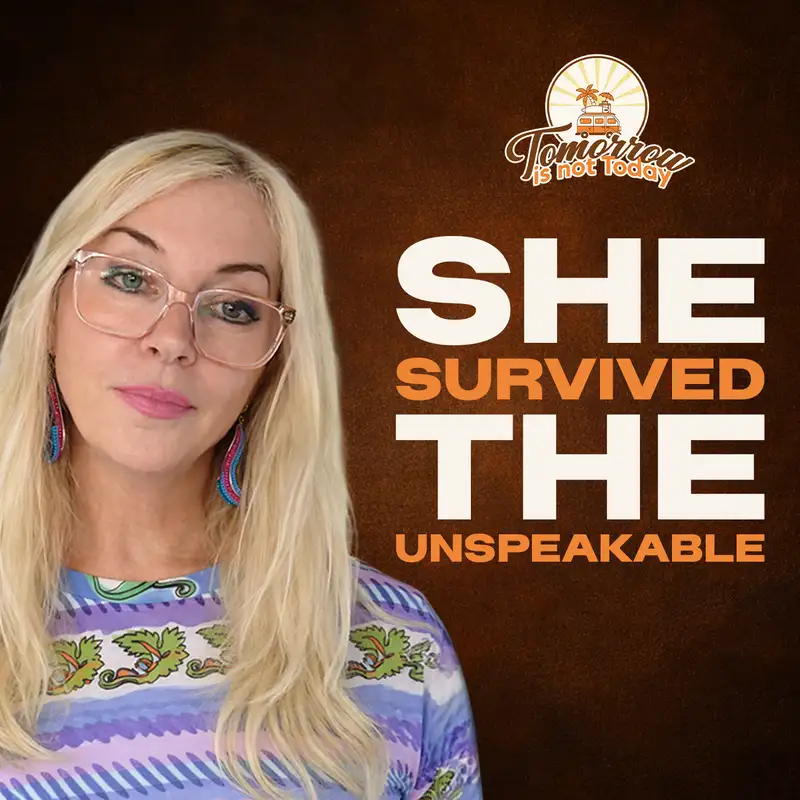
She Survived the Unspeakable
Download MP3TINT_Kerrie 2
===
[00:00:00] I was set upon by a pedophile, and the police just said, look, there's nothing we can do. It just cemented the fact of my belief that I was just a worthless piece of crap and because of the fear of public humiliation.
Despite my parents' struggle with alcohol and me knowing the damage that it could do, I actually found a cask of wine under a caravan, and I drank almost the whole cask. For the first time in my life, I felt normal. What do you mean by normal? I felt I always dreamed of being a famous jazz musician or an actress, uh, but life had other planned ooh, and the pain in my life that's led me to my greatest purpose ever.
I help people that are struggling in life find hope. Pain is the greatest motivator of change. Until we can accept something and take [00:01:00] responsibility, we can't actually get well and we can't move forward. But unfortunately,
Kerry Atherton, welcome to the Tomorrow's Not Today podcast. Thank you, Kingsley. Great to be chatting with you today. I love how this podcast has actually come about. Uh, we met at the end of last year, I think it was at, uh, an event on the sunny coast or for the uninitiated, the Sunshine Coast, uh, just north of Brisbane.
And, um, hadn't really communicated since then. And then I'm going around and I'm looking, you know what? I need to find some more, uh, podcast guests. And, and then I remembered, uh, about meeting you up there and, uh, did a little bit of research. This was great. We made connection and like, yeah, let's, let's go, uh, on the podcast.
And I was talking to a friend of mine on the Sunshine Coast [00:02:00] that night, and we are just, I don't, not sure what we were talking about, but she goes, do you know Kerry Atherton? And I'm like. Yeah, why? And she started telling me all about you and the amazing work you were doing and how impressed she was and how she was supporting your work early on, uh, when you're first getting this happening and just raved over you.
And I'm like, that guarantees that she has to be on the podcast. So, so I love how things work like that. Yeah, that's great, isn't it? So tell us a little bit about who you are, what you're doing now, and all that sort of thing, and then we are gonna deep dive into all the juicy bits. Well, who I am, uh, I am a, firstly a wife, mother, grandmother.
Uh, I'm a creative, I'm a jazz piano player and I sing, and what I do is I help people that are struggling in life find hope. Ooh, [00:03:00] and gotta wear a few different hats. So I've, for the past 20 years, I've been, um, a leader in the community, a mental health advocate and coach. Uh, I've been a addictions counselor.
Uh, I've been, um, walking the re in the road of recovery myself from addictions now for a very long time. And I have a real, uh, passion for people that have really broken down in life and feel like they're all alone and that they have no one that they can reach out to. 'cause I've been at that point myself.
Uh, I'm a podcaster, an author. I am on the board of Directors for Mentoring Men Australia. I volunteer my time there supporting men's mental health, and I'm also an ambassador for a wonderful PTSD organization called Fearless. And I also host my own Stories of Hope events. In Queensland and have [00:04:00] also done them around Australia.
You've just given us so much to go into right there. Like you can definitely tell where your passions lie and how you help people, uh, in a, yeah, in a really significant way. So if you're going to be obviously that passionate and you are dedicated your life to helping people that way, which is what The Tomorrow Is Not Today podcast is all about.
I'm gonna get you to take us back a little bit now because you don't do that sort of work. Just go while you're at school and go, oh, I'm gonna study this and help people this way. Anybody who's so passionate and so dedicated to this has a reason. So take us back and tell us some of your story about, take us back as early as you can about how you got to this point.
What's interesting before I start is that you said nobody kind of wakes up and thinks, oh, I'm gonna do this kind of work, or as a child. Dreams of that. And the opening [00:05:00] sentences in the chapter about my life in, in my Stories of Hope Books is that I always dreamed of being a famous jazz musician or an actress.
Uh, but life had other plans. I never, ever set out to be a counselor and somebody that sits in the trenches with people. But addiction and trauma really stole my dreams and going right back to it. Uh, alcoholism was right through my family and I was actually looking at photos yesterday and. I came across some death certificates and family tree information about my family.
And I never got to meet my grandparents because they died from, uh, addictions. And my dad's auntie and mum both, uh, died of suicide. Um, his auntie when she was 44 and mother when she [00:06:00] was 50, and my grandfather died at 56 of alcoholism and alcohol related, um, diseases. And so my dad was 30 when I came along.
I was a bit of a surprise. Um, my mom was only 20 or actually 19, and they were both alcoholics. My dad was a recovering alcoholic and my mom was an active alcoholic. And I was born into this, um, family with two broken people. Obviously that loved me enough to go through with the pregnancy and keep, me and my mom and dad hadn't been, um, together for a very long time, and they got married, had me, and within 14 months had my brother and then another little boy, my younger brother, uh, three months, three years later.
And life [00:07:00] was, there's many great times, but when I think back there, often overshadowed by the times of trauma that I experienced. And those traumatic times started really early on. I can't remember a lot about my mum's drinking, but what I do remember is the uncertainty of her behavior. And she actually lived with bipolar, which we, uh, back then it was called manic depression, man, manic depression.
Uh, and. You know, you just couldn't predict what was gonna happen from one minute to the next. And they did their best. They didn't have, my dad had no parents for support. He had no brothers and sisters, uh, no aunties and uncles. So there was just our little family and my mom had very little support from her mom and her stepfather.
So they really battled through as best as they could to raise us in the middle of the [00:08:00] dysfunction that they were living in. But I think my earliest memory of things starting to really unravel and deep fear starting to into my life was the day when I was seven and I was walking towards the laundry.
Just like any other afternoon, asking my mum for my favorite purple dress. And I heard her screaming and I just saw her shaking violently and she was attached to the washing machine and she was being electrocuted. And it was just one of the most terrifying things ever. I just remember running from the laundry and grabbing my little brothers and we just huddled together and we were jumping up and down in terror on the lounge and my dad must have been home and took us to the neighbors and I didn't think I was ever gonna see my mom again.
And he took her to hospital. She actually told me later on that she believed [00:09:00] that she died at that moment because her whole life flashed before her eyes. And she said that she was being walked through the most beautiful park that she'd ever seen and. A man had her by the hand and said, will you come with me?
And she said, no, I have to go back. I've got three small children. And so that day of fear entered my life of losing people close to me. She came back the next day and she had two scars on either side of her wrists about that long where the circuit had gone through her entire body. And then a short period of time after that, there was another traumatic event where my little brother's, 4-year-old best friend was killed on our main road.
He was run over by a semi trailer. And mum and dad took us to that funeral. And that just exasperated the terrifying fear that somebody I close to me could die. And just a terrible fear of death really set in. [00:10:00] And not long after that, that little boy's dad also passed away. And at the time I was also being bullied at school and a couple of years later I was on holidays with my family, what was meant to be a time of probably reprieve and a happy time after going through a traumatic period of a couple of years and I was set upon by a pedophile in the carport of, uh, where our cabin was.
And it ended up being the adult son of the owner of those holiday cabins. And back in the day, you didn't give your credit card details, you gave your address and phone number. And my mom and dad took me to the police and the police just said, look, there's nothing we can do. It's your daughter's word against his, just take her home back to Sydney.
Uh, we don't recommend that you. Press [00:11:00] charges because then she's going to have to go through the trauma of reliving things all over again. Just pretend it didn't happen. And my parents said back then that they got the sense that, that the police knew that this had happened a lot. They knew who it was straight away and going home with me that day was this absolute terror that I would never be safe in my home again because this person had our address and they knew we'd been to the police even though I was in another state in my 9-year-old mind.
I just could not escape the entrapment of fear. And my bedroom, which was on a four lane highway, became a den of terror. And I say this in a lot of interviews that I do, but most people have a haven either at school or at home. And I didn't have one anywhere because I was also being bullied by a teacher at school who'd had a nervous breakdown.
And for six months, she publicly humiliated me in front of all of my class, uh, made me [00:12:00] stand with my back to the class, with my hands on my head. Most of the lessons. She would cane me in front of everyone, she'd call me names. And not long after that, um, I'd started to become overweight because I started eating my feelings.
Uh, and that just really added to the humiliation. At 10, it just became too much and I had a full on breakdown and I was put under the care of the family psychiatrist and prescribed medication for anxiety and depression, and I became addicted to those pills because I needed something to numb the pain.
I also. Felt like I just needed to escape from myself. I never felt like I fitted into this world. And that's something that we often hear in the 12 step rooms of aa. And fast forward to 15, when I picked up my first drink of alcohol, my mum had since got sober, uh, when I was 12. [00:13:00] And the pills really weren't doing it for me.
And I picked up alcohol for the first time. And despite my parents' struggle with alcohol and me knowing the damage that it could do, the curiosity just really got the better of me. And a and alone. One day in a deep depression, I actually found a cask of wine under a caravan that my brothers had hidden across the road.
And it was boiling hot wine, and I drank almost the whole cask and I was violently ill. But the effect. Something that I've never forgotten, because for the first time in my life I felt normal. So yeah. Just in that, tell me when you said for the first time in your life you felt normal, what do you mean by normal?
I felt all of a sudden, like the rest of the world or my perception of everyone else that I knew. Uh, [00:14:00] as I said, I, I just desperately wanted to escape from myself from as far back as I can remember. Um, really when I say that too, I think there's a sense of deep shame that I carried. Uh, and you hear this from children of alcoholics, they carry like a veil of shame 'cause they're covering secrets.
I was covering the secret of me being sexually assaulted by the pedophile and I just hated myself. I think the reinforcement of the treatment of, um, the students towards me by being bullied and the bullying that I was receiving from the teacher at home as well was just cemented the fact of my belief that I was just a worthless piece of crap.
And that was truly what I believed about myself. And because of that and because of the fear of public humiliation, I couldn't even hold a conversation with anyone and, and look someone in [00:15:00] the eyes, you know, I had my head down all the time, but when I drank alcohol, I felt like I could face people and I could actually talk to people and relate to people in a way that I had never been able to do before.
So the alcohol gave you everything you needed to be able to face the world? Pretty much a hundred percent. And it was the great escape. Because even though the taste was disgusting, the effect was just so magical. And I had this belief really, I was very lonely as well. Mm. Uh, I was looking for some, it, it's pretty sad really.
But I was, I was looking for some photos, um, you know, to, to share for you, because you asked for photos about my childhood and I really only have a photo with one friend, and she was kind of my, my only friend. But because. There was just something different about [00:16:00] me. Uh, her parents didn't want her to spend time with me either, and this seemed to be a common theme, so I just felt like I was rejected from every angle and I was never good enough.
Uh, my parents were very loving and me and my two brothers felt very loved by my parents. And I think we, we were all codependent, but outside the family, it was a dangerous place. And it was a place where if I was to go there, I needed something in my system to be able to alleviate the fear of stepping out of the comfort zone.
So, at home, obviously excluding, you know, the fact of what happened to you, um, it was, it was sort of safe within your family, but I guess at night and different times like that, or if there was no one around. It was a scary place, but, and then ev when you stepped outside your front door, the whole [00:17:00] world was a very scary place.
Yeah. So you live with this and so the only way really to get through at this stage is a bit of alcohol to get you through there. Yeah. And not just the bit of alcohol. Kingsley a lot of alcohol and, and, and pills. I was still taking pills, so I was mixing them both. Wow. I was ODing on Panadol and Coke. You know, it's Coca-Cola back then.
That was the combination that could, you know, get you out of it. Um, and. Whatever I could, I, I didn't touch hard drugs 'cause my dad had really drummed into me the danger of heroin and the drugs that were around back then. And I knew that that could spell instant death. And I, even though I was suicidal when I say that, uh, what I mean is I can remember from the age of 10 right through to 18, many, many nights I'd go to sleep and [00:18:00] I would hope that I didn't wake up in the morning.
And then when I would wake up in the morning, I would not know how I was going to face another day. And I lived with this black cloud hanging over my head constantly. So we had some great times as a family and my mum and dad provided a wonderful life and went on great holidays and, but everything was marred by this black cloud.
And we talk about the black dog. As a term for depression, but it was this black cloud hanging over my head constantly. That never went away. The only way that it did go away was when I would drink alcohol and it would be a temporary thing, because when I came to and was trying to dry up and get sober the next day, if I had to go to work or something like that, the depression was tenfold, and so [00:19:00] alcohol just took away.
I drank my feelings and ingested my feelings with food pills, boyfriends. I changed jobs about 14 times between the age of about 15 and 23. Uh, I had about 15 different boyfriends and I kept thinking that the problem was exterior to me. So if I could change things around me, then maybe things will get better, but it always just kept coming back to the problem is with me.
And I didn't realize that until I hit rock bottom when I was 18. One of the things that is really strikes me is as a parent, when you've got kids, you are wanting to make sure your kids have good friends. The values, the morals, the not drinking, the, all of this sort of stuff. That's what [00:20:00] you, you, what you aim for with your kids to put them in the right place because those kids are bad and they're a bad influence and they do the wrong things.
And I, and, and it's true. But then you've just put a whole new spin on that altogether as far as why is it like that? And as a parent of the, of your own kids, is it like, is there a way maybe we can influence that other person or that other kid that's the bad kid in some way to help them Because it, for you to go through that, there's a reason for it.
And for any kid that's playing up, doing whatever it is, there is a reason for it. And I think as parents sometimes we don't think about that. We just think about our own kids. Uh, which, which we need to, I'm not taking that away at all. I was like that with my kids. I always made sure they had good friends, uh, around them, that they [00:21:00] were their main friends.
But at the same time, sometimes I would have ones that weren't necessarily that good and I would always go, okay, why? What's wrong with them? Uh, not what's wrong with them, but why do they act up? Why do, do they do that sort of thing. And I, I think to, to, to be able to try and have a different view on things and different view on people and try to understand more, um, is a really important thing to do.
And the other thing I want to, I'll say with this as well, is the fact that a lot of people. They've been in your place or a lot now, even business people, successful people are dealing with what you dealt with as a pre-teen and as a teen. And they don't think there's any hope for them. They don't think there's any way out for them.
Everything looks fantastic and looks great on the outside, but the loneliness and the hurt and the pain and the alcoholism and the drugs that's silent, supposedly [00:22:00] is affecting them massively. And I, I, I love what you are doing now is you've got through that and you are now helping people like this in a big, big way.
And I think that's so, so important to be able to do that. Tell us a little bit about the what, when the change happened for you. When the change happened, a couple, I spiraled very quickly from 15 to 18 and I was drinking daily. Uh, I, I became very, uh, sick, you know, physically, emotionally, mentally. When I was 17, I was raped one night when I was drunk and that had a very profound effect on my life.
I didn't actually deal with that till I was in my fifties. And I'd also been in a very abusive relationship. And I was on holidays in the December, uh, and actually it was, it was January [00:23:00] and this guy had punched me in front of families at the caravan park waiting room. And I came back from that holiday and I was just devoid of all hope and I just didn't know how I could live anymore.
And I woke up this particular morning after we got back from that holiday and I planned to end my life. I thought, this is the day that I'm going to actually take action because I can't live like this anymore. And I heard a loud voice, so don't do it. If you hang on a bit longer, you'll find happiness one day.
And I'd been brought up with the faith and I really believe that that was the voice of God that day interjecting and giving me a second chance. And my dad had taken me to Alcoholics Anonymous when I was 16, because even that early on in my drinking, my parents and all their friends said, you, you, you're an alcoholic.
You've [00:24:00] got a problem. And I was like, just don't be ridiculous. I'm 16, you know, I can't possibly be an alcoholic. And I kept drinking. But because I'd been in the rooms of AA and I'd heard all the older sober members get up there. And when I was there, they pointed at me and they said, I wish I'd found this when I was your age, because if I did, I wouldn't have lost my job.
I wouldn't have lost my family. I wouldn't have ended up in a mental institution. I wouldn't have lost all my finances. I wouldn't have killed that person. I wouldn't have ended up in jail. And I knew that if, if I was to continue drinking, uh, that, that that's what waited for me. Those were the yets. And so I went to Alcoholics Anonymous that night, and I haven't had a drink since that day.
And that's been 44 years now, but coming so close to death. And I had also had a near death experience when I had an accidental overdose, probably six months [00:25:00] prior to that. I found a. I didn't wake up, but all I, all I can remember about that was watching my lifeless body on the floor of a nightclub. And I was begging God to let me live.
And I can't remember anything else. I can't remember anything after that. There's just so many pieces of this puzzle that I can never put back together again. And I've since come to this conclusion about three years ago, that life for an addict or alcoholic, and I'll go as far to say, somebody who's experienced a lot of childhood trauma as well, remains like an unsolved jigsaw puzzle.
And one where the pieces can never be put back together again. But a beautiful new jigsaw puzzle can be made. And so that's what I've done with my life. I had a real desire after 18 for suicide prevention and to spread my message to as many young people as [00:26:00] possible. Uh. So they didn't end up where I ended up.
And so I've become a real interventionist and really worked in the field of prevention by sharing my stories, by, um, mentoring people. I went on to become a counselor because everybody would come to me with their problems and say, I've never told another soul this Kerry. But I feel like I can tell you, and I can't tell you how many hundreds of people's, thousands of people's secrets I'm keeping.
Uh, but I thought, wow, I, I might as well, you know, do this for a job because it's real burden carrying people's secrets. Uh, it's a great, it is. It can be a burden and, but, but it's also, yeah, it's, it's, it's a privilege, isn't it? To think that somebody would entrust you with their deeper secrets that they can't tell anybody.
And it's something that's can be very shaming and embarrassing really. [00:27:00] Um, for them to, to trust you with that is huge. Absolutely huge. Take, take me back a little bit because what I'm hearing is bravery. Like for somebody to come where you were, to go to AA and make that decision to be on, on a nightclub floor and you're not sure where you are, what's going on to beg to be alive, that sounds to me like a lot of bravery.
What, how, at that time, what was happening with you in your mind, in your emotions? What was going on to, to give you that strength? It was a deep desire, uh, to look, I was so close to my parents and my dad had grown up in the midst of severe violence at home with his mother. He suffered from. The worst trauma, post traumatic stress, you know, of anybody that I've really ever, I mean, there's a lot of people [00:28:00] that go through post traumatic stress, but I didn't know a lot of people back then.
But knowing what my dad went through, um, I, I, you know, I've rarely seen, met somebody that suffered like he did, and I was just so close to my parents that I thought I, I really, I wanted to get well for myself, but I just, I didn't want them to lose me. You know? I knew that they, they couldn't lose anyone else, and we were all, like I said, we were all just so codependent.
But my, my dad and my mum really, through all the adversity and, uh, trauma that they'd been through, they really modeled bravery to me. And so. I knew that AA worked because I'd seen it with both my parents. I'd seen them both get well and I'd seen a lot of people in their life get well from the 12 steps.
And just being in those rooms and connecting with [00:29:00] other like-minded people who are on the same journey and seeing their bravery modeled to me as well, there's just no doubt in my mind that I could do it as well. It sounds like there's two things going on. Number one, you, you had it modeled for you, so you looked around and saw are your parents and then other people as well.
And number two, you weren't, you weren't just thinking about you, you were thinking about other people and the effect on other people that w that it would have, uh, if you were to take your life or if you were to do anything else like that, you were thinking about other people. Is that the two things really that, you know, I was, you know, mindful of the fact that I'm the older sister of two brothers and.
Without sharing their stories. You know, they, they had their own struggles and I felt responsible to, you know, to be a role model and to be able to do that. But the thing that was incredibly hard about being in AA at [00:30:00] 18 was that other than two other girls, I was actually the youngest person then in the rooms.
And those two girls were sisters. One of them is still sober today. Um, she's probably one, one year more sober than me. And her sister unfortunately got sober for a long time and then went out and drank again, and she ended up ending her life. So back then at 18 when everyone else is partying and having a great time.
I had to come to the acceptance that if I was to live to see my 21st birthday, that this was what life was gonna be like. And there's a prayer in the AA rooms. God grant me the serenity to accept the things I cannot change, and courage to change the things I can. And, and the first step in AA is all about acceptance.
Until we can accept something and take [00:31:00] responsibility, we can't actually get well and we can't move forward. And I had to come to that point at 18 that this is gonna be my life If I wanna live. I just cannot drink like other people. And I'm going to be attending AA meetings when everyone else is out partying.
And, and, and that's, and that's just it. And I just adopted a, a mindset of acceptance back then. Okay. Let's get really, really practical here. Um. We have a lot of business people listen to this podcast, a lot of people doing a lot of things. Like I said before, a lot of people are very successful on the outside, uh, but not necessarily.
And I'm sure with the work you've done, you've seen plenty of this go on as well. Someone's dealing with this themselves. They know they're listening right now, or they're watching right now, and they're, they're going, I wish I could, but I can't. I just can't stop myself. I just can't help it. What is it gonna take for people to [00:32:00] make a choice like you and so many others have done?
If I'm practical it, I would say it just takes one step. But the reality is, and I say this to all my counseling and coaching clients, pain is the greatest motivator of change. Now, working as a preventionist in an early intervention, there's, there's so many people that, that I just wanna grab them and go, you don't have to hit rock bottom before you change.
But unfortunately human nature is that until the pain becomes so great, I won't make that change. And that's why I share my story in the hope that, and that's why I wrote my last book, light Bulb Moments Through the Eyes of Men in the hope that people will pick that book up or listen to my story. And so I don't, I don't have to walk to the end of the road Un until I make that [00:33:00] change.
I don't have to lose everything. I don't have to take that risk. I, I can make a change today, but they've gotta, they've gotta wanna do it for themselves. What does it take really, because obviously you can get right down to rock bottom, and like you said, you don't have to do that. What, what does it take in somebody's mind, in their psyche to be able to go.
I can make this change. 'cause obviously if, if it's an addiction and addiction is something that's an addiction because you can't do anything about it to a degree, but at the same time you can. But it's, it's really, really hard to get past that. And I'm sure we all either know somebody or have dealt with that personally, um, who has been there or lives with that.
What, what does it take, how individually for somebody to get to that point, and obviously everybody's different as well as to what level that is. And I say that all the time. Every rock [00:34:00] bottom is different. I sit in the 12 step rooms with people who have lost absolutely everything before they stopped everything.
People that have come out of jail because they've committed crimes. And, and then only then did they think, wow, you know, I, it's actually is the alcohol or it is the drugs or whatever. But the thing is. There's a number that a leading, uh, USA psychiatrist psychologist who worked with all the stars, ran a massive rehab rehab over in America and he wrote a book about hope, hope for the addicted.
And he came up with this number that of negative consequences that he felt seemed to be about a roundabout number that people come to that have addictions before they're lulled out of the delusion that sets in. And this is the thing, so many people, and [00:35:00] it's the a frustration for me working in the addiction space too, because so many people that are battling with addictions are in denial.
And that's because delusion has set in and delusion itself is actually an illness. And until they are rocked out of that delusion. They actually can't realize that, that the problem lies within them. And as I said before, I changed jobs, I changed my hair, I changed boyfriends, I changed my location, I changed everything I could to try and make things right.
But everywhere I went, I took me with me. And when we talk about that number 54, for some people that brings a relief. And for others they're like 54. Wow. How much longer, you know, would it take to hit rock bottom? And my rock bottom was an emotional one because emotionally I couldn't hold on any longer.
And I plan to end my life for other people that [00:36:00] have a different. I dunno. Different makeup, different background. Their rock bottom looks totally different. And like I said, it looks like losing everything. But there's four Ls that we talk about to come to this number of 54, and they are, is your love life being affected?
So are the relationships in your life being affected by your consumption of alcohol or drugs or gambling? Let's say the main addictions, uh, people that love you saying stop or your behavior's changing when you partake of or over overdo that. The next one is livelihood, is work being affected? Days off work, waking up with hangovers.
Blowing off and blowing up at people at work because you're just on the edge all the time, falling asleep at work. You know, I used to sleep actually at [00:37:00] lunchtime in the boardroom because I had a hangover productivity. The next one is liver. Is your health being affected? You're taking, like I said, gonna the doctor more often.
Is your liver affected? Headaches, physical symptoms, there's gut problems. There's so many things associated with that. And the big one is that usually really comes at the end is the law. Has your alcohol consumption or drug taking or gambling caused you to be charged by the police? Have you been affected by the law?
And so when you add all those things together, uh, it's not usually until around that number 54 that somebody finally. Feels the effect of the consequences of their alcohol and drug abuse, and comes to realize that my life is out of control. When I pick up a [00:38:00] drink. I can't guarantee my behavior or what's gonna happen, or when I pick up that drug or when I hit that poker machine and my life is out of control.
And it's only when you get to that point, which I hit that point of acceptance, that then that you can actually start to take steps to get well, there'd be people listening right now that going, yep. Yep. Yep. Hopefully it's freaking people out. It's scaring them. That's what I want to happen be, but I want them to realize as well, I don't care where you are, I don't care what you're doing or anything that's happening.
There is hope for you. You can turn this around and you can be like you are doing, have a very positive influence on those around you and who knows what other way, because the, the word you used before, um, is probably not something that's typically associated, uh, with this delusional, like delusional is like an extreme type of a word in my mind.[00:39:00]
Uh, and I know this is all extreme, but explain a little bit to me more about the whole delusional aspect that you're talking about. Delusion is when you are not living in reality. I mean, nobody likes to be called delusional, but the fact just is for somebody that is really bogged down by addictions, they, they actually lose the ability to perceive reality as it really is.
So their per perceptions are very skewed and very out of whack. So hence the denial aspect. That's right. And they can't see what everybody else around them is seeing. You know, I have clients that, uh, in all, all kinds of fields, you know, like, um, she, nurses, doctors, um, in, in aa, back when I got, when I got sober, we had a [00:40:00] politician, a scientist, a brain surgeon.
All these people, you know, seriously, like, you would never think a pilot, an international pilot. You would never think that. Those people would be alcoholics, but there's alcoholism and addiction is no discriminator of of people. And I think the biggest struggle is for the person that is high functioning and that is that business person is that leader in community or leader in their business or the CEO or right up the top of their game in the professional world.
And that deep sense of fear of what would happen if anyone really knew the truth. And they are the loneliest people because who can they turn to? And I think that's what's [00:41:00] so great about finding somebody to talk to who's actually walked that same road, because all of a sudden when clients come and talk to me about their addictions, that I'm upfront straight up, you know, I'm like, I've walked this path.
And it's like something, it's like the weight of the world comes off them because they think, well, I don't have to feel ashamed in front of Kerry. She's, she's been there. She, she understands what the life of a, the secret life of an addict or alcoholic is. But that in some of my stories of hope events, which we haven't even really gotten to yet, but I'd have, you know, CEOs sitting up the back and, uh, I remember one night when one ca lady came up to me in tears and she said, I'm a CEO of a large organization and my daughter is an ice.
And she's like, nobody, there's nobody I could ever tell [00:42:00] about that. She said The shame and fear associated with that. And I hear this kind of story a lot. And so in AA and in the 12 step rooms, you've got a whole lot of people that are sitting there in a confidential environment and everybody's got the same to lose by speaking out and sharing their story because nobody wants that out there.
So you've got that code of silence and that code of confidentiality in within that room. And I think that's why the 12 step rooms work so well because you are connected with other people who have also walked in there with shame. And when you share with somebody that's walked that journey, the shame is shedded somebody who's got.
A close person to them, spouse, kids, parents, close [00:43:00] friend, and they know what's happening. But obviously is the whole thing of denial. No, I'm, I'm fine. It's not that bad. You're exaggerating All of that sort of thing going on. What's the best way to actually try and positively influence them to change or get help or something like that?
I have a lot of parents come to me, um, and their biggest question is, uh, my, my child or my loved one. I have wives coming, my, my husbands or husbands coming. My wives asra, you know, they're, they've got an addiction, and the first question I ask them is, do they want help? And, and they often say, oh no, I, I've been trying to get them to get help.
But they, they don't, they don't want help and it's because they don't see that they need help. But I actually say, [00:44:00] well, have you got help yourself? Because I think that the greatest thing that somebody who's got somebody in their world struggling with that is that, is that they go and seek help themselves because they will need to learn how to detach while caring for their loved one with an addiction until the time that that number 54 hits and their loved one wants to get help.
What do you mean by detach? Emotionally? Detach? Because what happens is that when they, there, there's a saying that the family is as well as the suffering addict or alcoholic. And I've just seen it so often that when there is an addict in the family, the whole family is affected. It's a family disease.
Everyone's treading on eggshells. Everybody's trying to make sure that they don't upset the addict or the alcoholic. Everyone's [00:45:00] trying to make sure that they keep them alive, that they keep the peace, because it's like this, that you are watching your loved one up on a tight rope, and they're balancing, and the loved ones on the ground do everything they can, even what they don't agree with on the inside to keep them from falling, but eventually, in order for that loved one to get help and start to recover, they have to fall.
And so it's detaching, it's taking the enabling behavior away, taking the props away, still loving from a distance. But not enabling that behavior to continue. I mean, I had, I've had parents say, look, I don't give my kids money. You know, they're drug addicts, but I pay for their electricity and I, you know, I pay for their phones and they, when they've got no food, I send them money for food.[00:46:00]
And as hard as it sounds, I said, if you are paying for their electricity and you are paying for their food, you are paying for their drugs. That would be a very hard one for a parent to swallow. I know, I know. And it's, it's, it's really for a family, parent, or loved one of an, I I've, I've lived in it myself with a family of, of, you know, alcoholics.
And it's, it's a re it's very, very soul destroying, standing by watching, uh, and waiting. But I think the most important thing to do though, is to keep the door open with love. And I'm really big on the five love languages and they are words of affirmation, quality, time, acts of service, presence and gifts.
And if you can keep the doors and the channels of love open while the person that you love is [00:47:00] going through the addiction without enabling their behavior, they will always come to you when they need help. I'm gonna hit you on this one. I'm gonna hit you on this one. 'cause I know a lot of people, it's, it's really interesting where you're walking that fine line where you've got to, you love them like.
Emotionally, physically with what you do and how you do things. But at the same time, you've gotta stop paying the electricity, you've gotta stop paying for the phones, you've gotta do all this sort of thing. You may even have to kick them out of your house. You may have to take some drastic measures and things like that.
Um, and you know, you, you ask, will you go and buy me some beer or some wine or some, whatever it is? How do you walk that line of loving, but not compromising your values, but also, uh, enabling them? [00:48:00] How do you walk that line that it's, that's a hard question, Kingsley. That's why you are here. I know, I know.
I've heard it said so many times, you know what to do, but every, every situation's so different. And at the end, at the end of the day. The heartache for a parent is, what if I don't do those things? Let's get right to the bottom here. The heartache is, what if I don't do those things and I lose my child?
That's the biggest fear, and every parent has to make that decision themselves because it's a terror that a lot of them live with. Especially young, you know, when they've got alcoholism is a shocking disease, but when you've got a kid that's on ice or or heroin or meth, like they deteriorate a lot quicker [00:49:00] and they go missing for days and.
I've heard, you know, I've had so many parents that have not been able to have their kids like that in their house anymore because they've developed drug induced psychosis, which is something that never gets talked about, but it's a danger to the whole family. If there's an addict in the family with drug induced psychosis and they're inside the house, they become violent and aggressive.
And I've, at times, you know, I've said, said to parents when they've been attacked, have you rang the police? And they're like, oh, no, no, no, I can't do that. I can't do that. But nothing's gonna change it, it that's just gonna escalate and continue and get worse and worse. And it really comes back to what they say on a plane.
If you, if you need oxygen, put the O Oxygen mask on yourself first and then [00:50:00] assist those people around you. So would you say. A way of putting that crudely would be tough love. Definitely soft love just doesn't work with an addict and they become ruthless. They, they turn, they, they turn into the drugs, turn them into, and alcohol into somebody who is a totally different person.
And it's not that the person that they love is still not there, but it's buried underneath the behaviors of the addiction. I think it's a really crucial and key thing to, when there's a period of time where, uh, the loved one is not under the influence, that's a, that's a crucial time to really talk, try and talk about the effect of the behavior that it's having on the family.
I actually [00:51:00] encourage people to maybe tape or film. The behavior when somebody's drunk or when they're in the middle of a psychotic episode, so that, that, that can play that back to them when they're sober. And often that is a big wake up call for them because they don't see themself when they're drunk and on drugs and they have no idea.
I, I mean, I used to black out and I'd end up paralytic and people would tell me about my behavior and I wouldn't believe it because I hadn't seen it. Interesting. Um, this podcast has definitely gone way more in depth in that way than what I was anticipating, but I really appreciate you being open and sharing this because I know there's a lot of people that deal with this that they won't admit it or they know it's there, but they pretend it's not happening.
Uh, and I know there's a delusional side, and then I know there's the de denial side of like, I think some people know. I know it's there, but I'm gonna pretend it's not. Um, so that you'll leave me [00:52:00] alone and I can just live my life and I don't have to face what I know I've gotta face, but it's just too hard.
It's just too painful to try and face it. And there's a lot of that as well. Um, so I really appreciate you going in and doing this and, and I know this is gonna make a, a big difference with people. And I wanna go into a little bit about what you are doing now, how you are working with people, um, like your stories of hope and that sort of thing, which is just phenomenal, um, on their, tell us a little bit about both the events and all the podcasts, things you're running.
You do as well. Thank you, Kingsley. Well, I'll make this this short 'cause I know we've gone on into a lot of other stuff. I just quickly wanna add, uh. In, in there before I tell about stories of hope for, for anyone that might be struggling with, uh, addictions and they don't want to say, I'm struggling with addictions.
Alright, [00:53:00] seek a therapist or seek help and say that you're going through stress. A lot of people will feel more, especially business people, feel comfort, more comfortable to either may maybe have coaching for stress and anxiety and they don't have to divulge, oh, I'm, I want coaching or counseling because I think I've got addictions.
So I just wanted to put that out there. Um, as a way of seeking help. If you're feeling like you can't actually. Put the word addiction to what you're going through. That's great. That's so good. Um, and yeah, so about eight years ago while I was, you know, still in the middle of all my work as a, as a counselor and community leader, and I struggled with my own really terrible, probably the worst rock bottom that I've had after losing both my parents and going through a myriad of traumatic events over [00:54:00] quite a short period of time, and I now have.
Come to believe and na I, I name that as like a trauma trigger tsunami. And I developed post-traumatic stress. And in the middle of that time, when I was the person that everybody went to for help, I found myself drowning. And I desperately sought somebody who had been through the level of, of vicarious trauma that I'd been through who could tell me that I was gonna be okay.
And I knew people that had lost one parent or that had been an acar accident or had their dog put down or had a sick partner. But I didn't know anybody that had, you know, put everything together that I went through. And I just couldn't find that person. And so there was one day when I was sitting in a women's conference after I'd locked myself away for six weeks and I had a light bulb moment that if I couldn't, I.
Find that [00:55:00] person that I would become that person for others. And two weeks later, I started Stories of Hope because I didn't want anybody to have to experience the, um, the desperate loneliness that I was going through. And it became really evident to me in that time that we can never look at somebody from the outside appearance and presume that they've got it all together or that they're okay.
Very often it can be the people, the leaders that we expect the least, that can be struggling the most. And so I put on a free community event every month for five years. I want to first say one thing, the amount of courage for someone to look for that and not find it and go, you know what? I'm gonna do it.
I'm gonna make the difference. [00:56:00] That to me is huge. Absolutely huge. And anybody, wherever they are, um, get some help, get through stuff, but realize that you can make a difference in, I, I think one of the big things as well as helping somebody else in the midst of your pain and agony, if you can do the most minute thing for anybody in any way, it makes a massive difference to you.
And also you were mentioning before, let's give a really current, relevant example that we were talking about before we actually, uh, pressed record of what you were talking about just then. Yeah. I just, I, I found out, um, last night that. My doctor who, uh, had really walked through that whole journey with me and that I, I suffered a lot physically after all that trauma, and I was living with a lot of fear and everything, and the post-traumatic [00:57:00] stress.
And I went to, I started going to her around that time and I found out last night that she passed away yesterday. And I, I haven't, um, spoken to anybody directly, but from all the posts, it was, it appears that it was in relation to a struggle with her own mental health. And yeah, it just, that's really an example of, of what I've, what I'm talking about and the, the coaching package that I've really just put together as well, because I know that there's so many lonely leaders out there.
That goes back to what I was saying before, people that feel like the pressure's so great, but they're at the top of the ladder in everyone else's eyes. And I don't mean the top of the ladder as in, you know, financially or success or anything, but, but they're the go-to for so many other people because it seems like, what I [00:58:00] noticed about this doctor as well is that it seems like she's helped so many people in so many ways, was just so giving and caring and almost couldn't do enough for other people.
And like I said, everybody went to her and she just cared so much for other people. So you would think she had it. All together and happening. 'cause just a, a beautiful person. Oh, absolutely. Absolutely. I've never ever known a doctor like her. And when you would sit with her, she would just look at you in the eyes and she'd just hold space for you.
And I can remember just sitting in her office like crying a few times. But the thing is that I, I actually saw the overwhelm in her eyes when she was looking at me. I could sense the pressure that was on top of her, uh, to be able to [00:59:00] keep up that level of care for her clients and the time to get into her became increasingly longer and longer.
And so much so was the demand for her time and the amount of time that she would spend with each client. She wouldn't just give them the five or 10 minutes and you are out. She would sit there until she felt like you'd been heard. And sometimes I was in there for 20, 25 minutes. So in the end, you had to wait for an hour and a half, sometimes in the waiting room because she was running so far behind.
And that was kind of the last time that I saw her. I thought, oh. Obviously the demand for her time's so great now, and I, I don't wanna drive all this way and wait for an hour and a half anymore. So I, about two or three years ago, started seeing a different doctor, but I have family that she had been looking after for quite a period of time as well.
And just to think that [01:00:00] she was so overwhelmed with whatever it was, whether it was pressure, people's problems, um, feeling like she couldn't carry the burden anymore and to feel that she was that overwhelmed that her mental health ended her life, uh, was, is just so devastating. And I. Hope, you know what, uh, people, we don't, people don't have to get that go down that low.
People don't have to get that far. And I think boundaries is the cornerstone of emotional, physical, and mental health. And if the right boundaries can be put in place early on in the peace and the right support, this can prevent so many people from spiraling into a place of mental devastation. The, this you just opening up a [01:01:00] whole new area.
I would love to keep going here. Um, we are gonna have to pull it back though. I'm sorry. I'm gonna ask you on the spot. Would you come back and do some more on where you are heading right now? I sure will. That would be absolutely gold because what we, just example, that example you just gave is a perfect, yet ridiculously sad example for that.
I want people to realize, don't look at what people look like on the outside, especially if they are a leader, especially if they are helping a lot of other people in so many different ways. You have no idea. Um, and, and we just need to, uh, who's that? Robin Williams, to me, one of the greatest comedians ever.
Um. You know what I mean? People look to them and, and look at them and there's so many people that are helpful and kind, but why are they so helpful and kind What's happening sometimes, uh, is a big question. Um, but yeah, I I'm, [01:02:00] I I really want to get you back and go, go talking about what you were talking about then.
But I really want to just before we close, if we can, um, tell us a little bit more about, uh, the stories of hope and what you're doing there and how you're helping people. 'cause it's absolutely phenomenal. It's desperately needed. Well, look, we've grown from nine years ago when I started. Uh, I've released three books now.
Which have the story of almost 50 people that have spoken at on our stages. Uh, now I'm running the events, um, every two or three months. And so by checking out my stories of her Facebook page, you can keep up to date what's going on there. I've got a former undercover detective who was in the crimes, um, and drug squads after his, uh, partner suicided speaking, um, in April.
And I've also, um, got a podcast out now, which is something that I started in COVID, interviewing resilient people from around the world that [01:03:00] could bring hope to everybody who didn't even think they'd get through COVID. And I thought if these people could get through what they have in their life. You are all gonna get through COVID.
So that's turned into a podcast now, which I released last year, um, called Inspirational Humans with Kerry Atherton. And um, yeah, I've just recently launched my coaching package, which is really for leaders that are burned out and broken down and really wanna reconnect with what really matters in their life.
And therefore, anyone struggling with addictions as well, who needs a confidential ear, that's fantastic. And I really hope people and encourage people to get in touch with you and, and do things with it for themselves, for other people or whatever it is. Uh, I love the fact that. You've had quite a journey in life that most of us, none of us would ever want to go through.
But you've done that, you've turned it around, which again, this is what the [01:04:00] podcast is all about. You've turned it around. Now you spend your life helping people through these things, making a difference. Literally saving who knows how many lives, uh, and families and everything else along those lines, which is just fantastic.
Um, I always ask a question at the end of the podcast, how do you create the life that you want? Wow, that's a big one. Um, look, I'll end this with, I have a really strong faith, and I'll go back to the 12 steps. It's all about surrendering to a higher power and to create the life that I really want, uh, is to get out of the driver's seat and let my higher power lead me and guide me and be okay with that.
For me, really, the, the joy of my life now is, is helping people. And [01:05:00] if I can help just one person, I don't know what world changer that person's gonna go on to be. And I really, you know, the greatest, that's the greatest joy for me these days is, is the people that I can help and the lives that I can change.
And I didn't get to be a professional jazz piano player or an actress, but I, I help people for a living and that's the life that I want. You know what, you know, what you redefined what success is for you. And I always ask people, what is success for you? Not society, not what people say it should be, but what is success for you?
And I believe you just there redefined what success is for you compared to what it was when you were younger. And I love that. How fulfilling is that? Oh so fulfilling. And it's the pain in my life that's led me to my greatest purpose ever. And I think when we find our greatest [01:06:00] purpose, then we've really found how to truly live.
I can't wait to get you back on, 'cause there's so many things I want to go into with all of that. Kerry, thank you so much for being on the Tomorrows Not Today podcast. Um, I know that is gonna be very impacting for so many people, uh, who are dealing with personally or friends or whatever. Uh, like I said, it went way more into that whole aspect of addiction and alcoholism than what I, what I was anticipating.
But hey, obviously people need to hear it. Thank you so much Kingsley, for the opportunity to share with you and your audience. Thanks Kerry. Have a fantastic day. You too. Thank you.
Creators and Guests